Military Factory
Military Pay Chart
Global Firepower
Military Industrial Complex
Second World War
Home
Military Pay Scale
Military Ranks
Small Arms
Aircraft
Land Systems
Navy
Education
Military Factory Facebook Logo
flag of United States

Colt Walker Revolver (1847)

Authored By Staff Writer | Last Updated: 11/21/2011

The massive and powerful Colt Walker was originally designated a pistol by the US Army Ordnance Department for its personnel had never come across a revolver before then.

Find a School Near You
Follow Military Factory on Facebook:
Trending on Military Factory:
Recent Articles:
Captain Samuel Hamilton Walker (1817-1847) served as a Texas Ranger and within the US military through the violent wars in the American West against native Indians and he would later go on to serve in the Mexican-American War until his death in battle. Walker visited fabled gunsmith Samuel Colt in New York, bringing with him plans for a new revolver based on the Colt Paterson - to which he had familiarity with and a hand in its original design through a partnership with Colt. The Colt Paterson was in circulation since 1836, becoming the first commercially-available repeating revolver that showcased a multi-shot cylinder and it proved a general success mainly in Western affairs. Colt patented this design in February of 1836 and the namesake for the revolver was taken from its place of production - Paterson, New Jersey. One of the unique design elements of the Paterson was its folding trigger unit which sprung out after actuation of the hammer. Mr. Walker served the Colt concern well and proved instrumental in securing US government contracts at a time when Colt was facing bankruptcy. Samuel Colt honored Walker's request for a more powerful repeating revolver and began work on what would become the mythical "Colt Walker". All told, the Walker was to be the most powerful revolver of its time with manstopping qualities akin to that of an infantry rifle. With a more powerful gun, mounted personnel could now counter both enemy personnel and their mounts alike, firing a large bullet in a form that was more compact than a rifle.

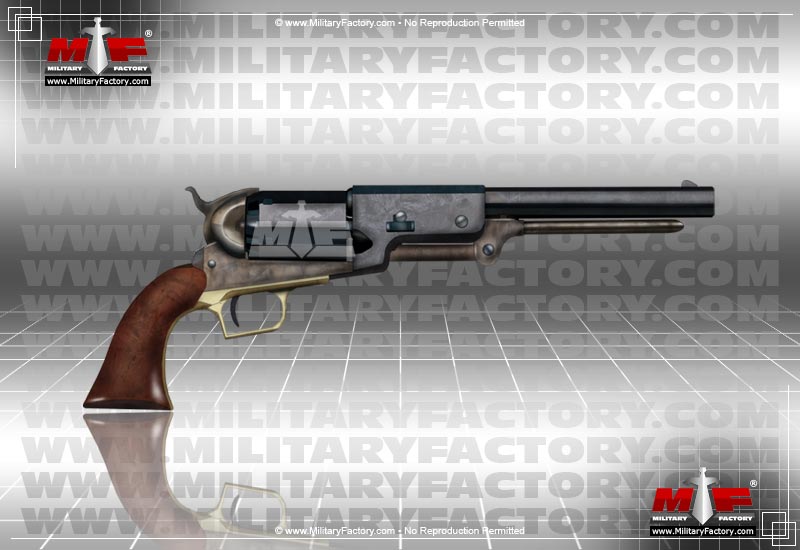
Outwardly, the Colt Walker was a beautifully crafted revolver. Conventional in its design and layout, the Walker showcased the smooth and clean lines of the Paterson before it and was consistent with other Colt revolvers up to this point. Key exceptions with the Walker were its 6-shot cylinder (as opposed to the well-established five-round series) and static trigger system. The Walker was a massive firearm, measuring over 15.5 inches in length with a 9-inch barrel, the revolver collectively weighing in at 4.5lbs. The weapon was chambered for six large .44 ball bullets (.45 was also supported) and the firing operation was of single-action, requiring manual cocking of the hammer for each shot. The cylinder rotated with each hammer action allowing for repeating fire until all chambers had been cleared. The ball ammunition was loaded with black powder and ignited by percussion caps manually placed on each chamber rear along the cylinder. The powder charge (60 grains) was fed into each chamber (from the front) from a tear-drop style flask carried by the operator. Each chamber then was fed a ball with the cylinder being manually rotated by the user. There was a loading lever set under the barrel and hinged to fold downwards. The folding action create a "ramrod" style effect in which an attached arm pushed the chamber contents to the extreme rear near the percussion cap. The receiver of the gun had an open frame meaning there was no support across the top of the cylinder - this seen in later upcoming revolver types, Remingtons being quite famous for the design element. The hammer spur was clearly visible at the rear and the wooden-covered pistol grip was ergonomically finished for a firm hand hold. The thin trigger assembly was held within a wire-type trigger ring. Despite its size, the Walker was designed for use from a holster.

The Colt Walker was introduced in 1847. Unfortunately for Captain Walker, he suffered a fatal wound in battle that same year but was the recipient of two of these sidearms prior to his death. Colt netted a government contract and enlisted the help of Eli Whitney, Jr and his Whitneyville, Connecticut facility for the assignment. In all, some 1,100 Colt Walkers were produced with 100 or so of these being specialized forms for the civilian market. Production lasted only through 1847 however.

In practice, the Colt Walker did not disappoint on the whole. She was a handful of power with stopping qualities out to 100 yards - comparable to that of then-modern rifles. The ball ammunition could cause maximum damage at range but was truly ruthless in close-in fighting. A cavalryman could open fire with his Walker at distance and, once out of ammunition, could close in with his sabre for the final death blow - hopefully against retreating forces. The firing action was, as expected, rather violent in nature and with a heavy recoil. The recoil proved violent enough in some actions that the loading lever was lowered unexpectedly, such was its force. This led to many in-the-field remedies to rectify the issue. Compared to other sidearms of the day, the Colt Walker was a very heavy handgun and its large dimensions made for some issues when quick handling from a holster was in order, particularly when on horseback - the user needed to clear over 15 inches of gun from his holster before aiming and firing. Additionally, early construction was such that the cylinder held a nasty habit of rupturing when deposits of gunpowder unknowingly remained near the firing chamber openings along the front of the cylinder. To counter this issue, Colt suggested a 50 grain load instead of the listed 60 and repaired any damaged Walker units - about 30% were returned with this damage.

The Colt Walker led a legendary existence despite the rather modest production numbers. Few firearms matched the stopping capabilities of the gun at the time and it was not until the arrival of the famed .357 Magnum in America that the Colt Walker was "truly" unseated from its throne. Due to its uniqueness in the field of firearms and its scarcity in original availability, the Colt Walker is a favorite among collectors today. Its popularity is such that modern firearms manufacturers have taken to production of replicas for the civilian market.

The limitations of the Colt Walker led to the development of the Colt Dragoon model of 1848. It featured smaller dimensions, a revised loading lever and different metal construction. The US government alone would go on to order 8,000 of this very popular Colt product. The Dragoon was also featured in the Mexican War.
Text ©2003-2013 www.MilitaryFactory.com • All Rights Reserved • No Reproduction Permitted
MilitaryFactory.com does NOT sell equipment/weaponry. Material presented throughout this website is for historical and entertainment value and should not to be construed as usable for hardware restoration, maintenance or general operation. Please consult manufacturers for such information. Our disclaimer. Email corrections / Comments to MilitaryFactory at Gmail dot com.
Picture of Colt Walker
View All Images (1)

Specifications for the
Colt Walker
Revolver


Country of Origin: United States
Manufacturer: Eli Whitney, Jr Whitneyville / Colt Firearms - USA
Initial Year of Service: 1847


Overall Length: 400mm (15.75in)
Barrel Length: 229.00mm (9.02in)
Weight (Empty): 4.54lbs (2.06kg)


Cartridge: .44 Ball; .45 Ball
Action: Single-Action; Rotating Cylinder
Feed: 6-round rotating cylinder
Muzzle Velocity: 1,100ft/sec (335m/sec)
Rate-of-Fire: 6 rounds per minute
Range: 300ft (91m; 100yds)
Sights: Front Iron


Variants:
Colt Walker - Base Series Designation


Operators: United States

ALL SMALL ARMS CATEGORIES

BY YEAR:


1700 to 1799
1800 to 1899
1900 to 1909
1910 to 1919
1920 to 1929
1930 to 1939
1940 to 1949
1950 to 1959
1960 to 1969
1970 to 1979
1980 to 1989
1990 to 1999
2000 to 2009
2010 to 2019
VIEW ALL
Compare Guns


BY TYPE:


Anti-Aircraft Weapons
Anti-Material Rifles
Anti-Tank Weapons
Automatic Rifles
Bolt-Action Rifles
Carbine Guns
Flamethrowers
Flintlock Guns
Grenade Launchers
Hand Grenades
Lever-Action Rifles
Machine Guns
Mortars
Musket Guns
Pistols / Handguns
Recoilless Rifles
Revolvers
Rocket Launchers
Shotguns
Silenced Guns
Sniper Rifles
Special Weapon Systems
Submachine Guns
VIEW ALL


SPECIAL:


18th Century Warfare
3 Soldiers Statue
Battle of Mogadishu
Chainmail Armor
Firearm Types Defined
French Military Victories
Medieval Crossbow
Medieval Longbow
Vietnam War Casualties
Vietnam War Memorial

WORLD WAR 2:


British Guns
French Guns
German Guns (ALL)
German Rifles
Italian Guns
Japanese Guns
Soviet Guns
US Guns
US Infantry Regiment-Level Guns
Machine Guns
Pistols
Rifles
Submachine Guns
Sniper Rifles
VIEW ALL


WORLD WAR 1:

Pistols
Rifles
Machine Guns
Mortars
US Guns
VIEW ALL


KOREAN WAR:

Machine Guns
VIEW ALL


VIETNAM WAR:

Mortars
VIEW ALL


COLLECTIONS:


Ancient Weapons
British SAS Weapons
Civil War Guns
Colt Guns
Glock Guns
GROM Polish Special Forces
Guns of Libya
Guns of North Korea
Guns of Syria
Guns of WW1 & WW2
Heckler & Koch Guns
Kalashnikov Guns
Modern Russian Guns
Navy SEAL Weapons
Spetsnaz Weapons
Weapons of Desert Storm
Wild West Guns
Winchester Guns


HOLLYWOOD/GAMES:


Guns of the Walking Dead

Site Disclaimer | Privacy Policy | Site Map | MF Origins


©2013 www.MilitaryFactory.com • Content ©2003-2013 MilitaryFactory.com • All Rights Reserved • Site Contact Email: militaryfactory at gmail dot com. The "Military Factory" name and MilitaryFactory.com logo are registered ® trademarks and protected by all applicable domestic and international intellectual property laws.


Top MF Stuff: 2013 Military Pay Scale | Military Ranks | WW2 Weapons | Sniper Rifles | Kts to Mph | WW1 Aircraft | Automatic Rifles | Aircraft Cockpits | Vietnam War Weapons | Main Battle Tanks | Submachine Guns | Shotguns | French Military Victories


Most photographic images appearing on this site are courtesy of the United States Department of Defense and are approved for public use. Other images acquired through the public domain. Digital art work courtesy of Dan Alex. Business Consulting by Kyle Williams. Material presented throughout this website is for historical and entertainment value and should not to be construed as usable for hardware restoration, maintenance or general operation. Please consult manufacturers for such information.


eXTReMe Tracker