Military Factory
Military Pay Chart
Global Firepower
Military Industrial Complex
Second World War
Home
Military Pay Scale
Military Ranks
Small Arms
Aircraft
Land Systems
Navy
Education
Military Factory Facebook Logo
flag of Finland

Suomi KP/-31 (Konepistooli m/31) Submachine Gun (1931)

Authored By Staff Writer | Last Updated: 11/1/2012

The excellent Finnish Suomi KP/-31 submachine gun served throughout the Winter War against the Soviets and forged an existence into the late 1990s.

Find a School Near You
Follow Military Factory on Facebook:
Trending on Military Factory:
Recent Articles:
When World War 2 began in September of 1939, Poland was split into two halves by the victors - the Nazi Germans took the West while the allied communist Soviets settled the East. Not more than two months after that offensive, the Soviet Union looked to overrun neighboring Finland, believing it could take the country through sheer numbers and brute force - in true Russian fashion. The Red Army held the quantitative advantage in aircraft, tanks and men and launched their formal offensive into Finnish territory on November 30th, 1939. While on paper, this may have appeared to be a sure victory, the resilience and tactical know-how of Finnish fighters turned the "Winter War" into a bloody campaign for the Soviet Union - one that would end with an "interim peace" in March of 1940 before starting back up again in the following - and aptly-named - "Continuation War" of June 1941.

The submachine gun was a battlefield component that was still evolving by the time of World War 2. To the West, there arose such names as the American M1 Thompson, the British Sten Gun and the German MP43 series and each proved, in their own way, the value of such compact firearms capable of dealing "machine gun-type" shock unto the enemy. Perhaps one of the lesser-known contributions to the SMG field for most readers became the excellent Suomi Konepistooli KP/-31 (also known as the "Suomi m/31" or "Kpist m/37") series of Finnish design - its origins dating as far back as 1922. The KP/-31 was developed from the preceding "KP/-26" which was introduced in 1926 and itself based on a prototype known simply as the "M-22". The KP/-26 was chambered for the 7.63mm Mauser cartridge and sported a noticeably curved magazine. However, the series only saw very limited production and the arrival of the KP/-31 sent the KP/-26 out to pasture.

The KP/-31 was introduced in 1931 and design of the weapon was attributed to Aimo Lahti and Lieutenant Y. Koskinen. Serial production was handled out of the state-owned Tikkakoski facility to which some 80,000 examples were ultimately delivered. The KP/-31 would go on to see extensive service throughout the Finnish actions against the Soviet Union and played well up to its inherently strong and robust design. Production would cease in 1953 but the KP/-31 itself would exist in frontline service into 1998 - a true testament to its excellent arrangement and construction.

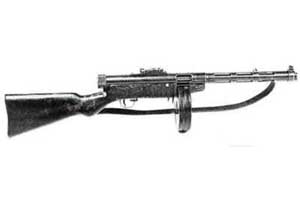
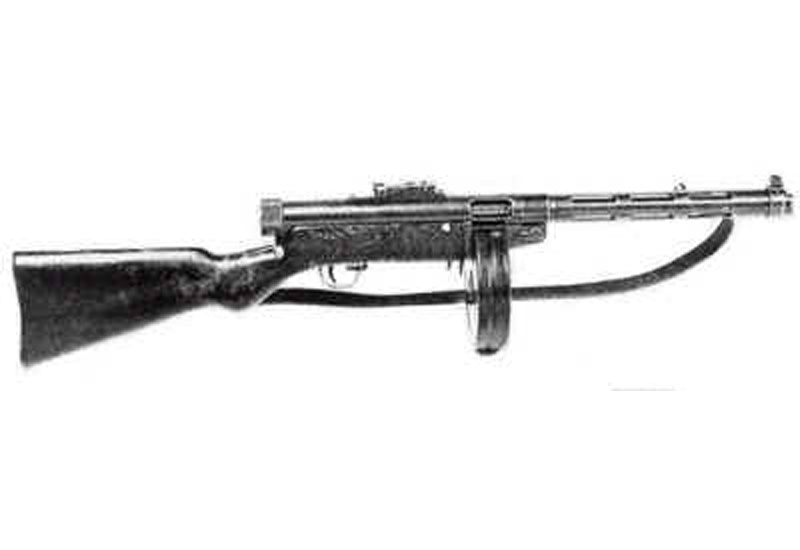
Externally, the KP/-31 appeared as any other conventional submachine gun system of the period. It sported a single-piece wooden body with an integrated ergonomic stock making up the rear hand grip. The metal portion of the receiver - containing the necessary internal working components - was dropped within the wooden body. The trigger unit was underslung from the wooden receiver near the hand grip and consisted of a curved trigger assembly and wire-thin trigger guard. Magazines (or in some cases "drums") were inserted into the feed mechanism along the bottom of the forend. The barrel protruded a distance away from the gun body and was shrouded in a slotted heat shield. Iron sights were provided in the form of a rear notch and a front post. The KP/-31 was chambered for the 9x19mm Parabellum cartridge and could fire from a 20-, 36-, 40- or 50-round detachable box magazine (or "casket" boxes) as well as an impressive 71-round "drum". The firing action was a conventional straight blowback system to which 750- to 900-rounds-per-minute could be loosed. Overall weight was just over 10lbs with a running length of 34 inches, the barrel measuring just 12 inches. Maximum range was out to 500 meters.

The KP/-31 was produced to a higher quality than most other weapons of World War 2 which, in the long run, proved one of the few limitations of the series - it was simply too expensive and time-consuming to produce in the large numbers required of war time. The design arrangement also made the Suomi KP/-31 rather heavy for a submachine gun but this in no way detracted from its battlefield usefulness for the weapon proved to be very accurate in the role - especially at close quarters. Construction included machining and forging of the vital metal parts and this made for a highly robust and reliable weapons while the rest of the form was completed in readily available wood. The firing mechanism included a spring which was fitted within the bolt and allowed the design to be shortened in length to a more compact form. The bolt handle (with a fixed firing pin) was set to the rear of the gun body and was essentially managed by the internal mechanics in much the same way that a manually-operated bolt-action would be. The action proved wholly sound in practice and added to the excellent qualities of the KP/-31.

Some 4,000 KP/-31 were in circulation by the time of the Soviet invasion of Finland. The offensive only prompted a stout resistance on the part of the Finns and the war machine ramped up to fulfill increased demands. The KP/-31 was issued to Finnish infantry squads in limited numbers, however, largely due to their lack of availability. Nevertheless, the m/31 soldiered on in good form and dealt the invading Red Army a nasty surprise. The Finns proved experts in their knowledge of the home country and utilized the environment to their advantage - in a few instances even laying waste to entire Soviet Army elements. Captured Soviet weapons were reused whenever possible and the Finns ultimately dealt blows to both Soviet invincibility and national pride, embarrassing the Red Army on the world stage. Despite their larger numbers, the Red Army was further handicapped by Stalin's "Great Purge" which removed many capable leaders from their posts prior to the invasion - effectively watering down his immense fighting force. The Finns did go on to lose territory in the war but did force an interim peace and maintained their sovereignty. The Soviets lost nearly 127,000 men (including 188,600 wounded), 5,500 tanks and over 400 aircraft in the foray while the Finnish dead numbered 26,000 soldiers. The war would pick up once again in the "Continuation War" which saw the Finns now aided by allied Nazi Germany - the Germans had finally turned their attention against the Soviet Union at this time. The result of this endeavor, however, was a Soviet victory forced on by a stand-still in the fighting. The Finns gained territory in the fighting but subsequently lost these back the Soviets. The Moscow Armistice ended fighting on September 19th, 1944 to which Germany collapsed in May of the following year. The war between the two nations formally ended in 1947 with the signing of the Paris Peace Treaty.

The KP/-31 was developed only into a few known official variants. "The KP/-31 SJR" featured a new muzzle brake which lengthened the overall design some. This variant actually went on to make up some 50% of all KP/-31 produced stocks for the Finns. Another variant was developed and intended for short-ranged, close-quarters use, being completed with a thinner barrel cover and lack of a stock. The stock was replaced by a true pistol grip and this helped to increase portability and compactness of the weapon. A similar vehicle version was also devised for tanker crews.

KP/-31s were also known to have taken part in the 1948 Arab-Israeli War fighting alongside Israeli units. Other global operators went on to include Bulgaria, Croatia, Estonia, Norway, Poland and Slovakia. The German Army of World War 2 ordered some 3,000 examples for their own inventories and these saw heavy use everywhere the Germans fought. Even the Soviet Army made use of captured specimens which clearly showed the type's impressive stature to the enemy. In fact, they went on to copy the KP/-31's 71-round drum magazine for their own wartime PPSh-41 Submachine Gun - the Soviet weapon showcasing an appearance not unlike the Finnish KP/-31. The PPSh-41 would not enter service until 1941.
Text ©2003-2013 www.MilitaryFactory.com • All Rights Reserved • No Reproduction Permitted
MilitaryFactory.com does NOT sell equipment/weaponry. Material presented throughout this website is for historical and entertainment value and should not to be construed as usable for hardware restoration, maintenance or general operation. Please consult manufacturers for such information. Our disclaimer. Email corrections / Comments to MilitaryFactory at Gmail dot com.
Picture of Suomi KP/-31 (Konepistooli m/31)
View All Images (1)

Specifications for the
Suomi KP/-31 (Konepistooli m/31)
Submachine Gun


Country of Origin: Finland
Manufacturer: Tikkakoski Plant - Finland
Initial Year of Service: 1931


Overall Length: 870mm (34.25in)
Barrel Length: 314.00mm (12.36in)
Weight (Empty): 10.14lbs (4.60kg)


Cartridge: 9x19mm Parabellum
Action: Straight Blowback
Feed: 20-, 36-, 40-, 50-round box; 71-round drum
Muzzle Velocity: 1,299ft/sec (396m/sec)
Rate-of-Fire: 825 rounds per minute
Range: 1,640ft (500m; 547yds)
Sights: Iron Front and Rear


Variants:
M-22 - Original Prototype of 1922


KP/-26 - Preceding Design; appearing in 1926.

KP/-31 - Base Series Designation; appearing in 1931.

KP/-31 SJR - Thinner barrel shroud; sans stock; pistol grip.

Konepistooli M/31 - Alternative Designation


Operators: Bulgaria; Croatia; Denmark; Estonia; Finland; Israel; Nazi Germany; Norway; Poland; Slovakia; Sweden; Switzerland; Soviet Union

ALL SMALL ARMS CATEGORIES

BY YEAR:


1700 to 1799
1800 to 1899
1900 to 1909
1910 to 1919
1920 to 1929
1930 to 1939
1940 to 1949
1950 to 1959
1960 to 1969
1970 to 1979
1980 to 1989
1990 to 1999
2000 to 2009
2010 to 2019
VIEW ALL
Compare Guns


BY TYPE:


Anti-Aircraft Weapons
Anti-Material Rifles
Anti-Tank Weapons
Automatic Rifles
Bolt-Action Rifles
Carbine Guns
Flamethrowers
Flintlock Guns
Grenade Launchers
Hand Grenades
Lever-Action Rifles
Machine Guns
Mortars
Musket Guns
Pistols / Handguns
Recoilless Rifles
Revolvers
Rocket Launchers
Shotguns
Silenced Guns
Sniper Rifles
Special Weapon Systems
Submachine Guns
VIEW ALL


SPECIAL:


18th Century Warfare
3 Soldiers Statue
Battle of Mogadishu
Chainmail Armor
Firearm Types Defined
French Military Victories
Medieval Crossbow
Medieval Longbow
Vietnam War Casualties
Vietnam War Memorial

WORLD WAR 2:


British Guns
French Guns
German Guns (ALL)
German Rifles
Italian Guns
Japanese Guns
Soviet Guns
US Guns
US Infantry Regiment-Level Guns
Machine Guns
Pistols
Rifles
Submachine Guns
Sniper Rifles
VIEW ALL


WORLD WAR 1:

Pistols
Rifles
Machine Guns
Mortars
US Guns
VIEW ALL


KOREAN WAR:

Machine Guns
VIEW ALL


VIETNAM WAR:

Mortars
VIEW ALL


COLLECTIONS:


Ancient Weapons
British SAS Weapons
Civil War Guns
Colt Guns
Glock Guns
GROM Polish Special Forces
Guns of Libya
Guns of North Korea
Guns of Syria
Guns of WW1 & WW2
Heckler & Koch Guns
Kalashnikov Guns
Modern Russian Guns
Navy SEAL Weapons
Spetsnaz Weapons
Weapons of Desert Storm
Wild West Guns
Winchester Guns


HOLLYWOOD/GAMES:


Guns of the Walking Dead

Site Disclaimer | Privacy Policy | Site Map | MF Origins


©2013 www.MilitaryFactory.com • Content ©2003-2013 MilitaryFactory.com • All Rights Reserved • Site Contact Email: militaryfactory at gmail dot com. The "Military Factory" name and MilitaryFactory.com logo are registered ® trademarks and protected by all applicable domestic and international intellectual property laws.


Top MF Stuff: 2013 Military Pay Scale | Military Ranks | WW2 Weapons | Sniper Rifles | Kts to Mph | WW1 Aircraft | Automatic Rifles | Aircraft Cockpits | Vietnam War Weapons | Main Battle Tanks | Submachine Guns | Shotguns | French Military Victories


Most photographic images appearing on this site are courtesy of the United States Department of Defense and are approved for public use. Other images acquired through the public domain. Digital art work courtesy of Dan Alex. Business Consulting by Kyle Williams. Material presented throughout this website is for historical and entertainment value and should not to be construed as usable for hardware restoration, maintenance or general operation. Please consult manufacturers for such information.


eXTReMe Tracker