Military Factory
Military Pay Chart
Global Firepower
Military Industrial Complex
Second World War
Home
Military Pay Scale
Military Ranks
Small Arms
Aircraft
Land Systems
Navy
Education
Military Factory Facebook Logo
flag of United States

CheyTac Intervention Bolt-Action Sniper Rifle (2001)

Authored By Staff Writer | Last Updated: 8/18/2012

The CheyTac Intervention sniper rifle makes use of the specialized .408 CheyTac cartridge.

Find a School Near You
Follow Military Factory on Facebook:
Trending on Military Factory:
Recent Articles:
The CheyTac Intervention is a sniper weapons system developed by the American firm of CheyTac Associates based out of Arco, Idaho. The Intervention is classified as an "anti-material rifle" intended to counter light or "soft" armored threats and other targets of interest at extreme ranges utilizing a large-caliber cartridge developed by CheyTac itself. Anti-material rifles are used to a high degree by military forces the world over to give sharpshooters the ability to target and disable key components of enemy vehicles including vision ports, sensors, track linkages, engine blocks and the like. The Intervention is sold as a complete weapons package to include the rifle, case, optics, ammunition supply, replacement barrels and various accessories and is considered one of the most accurate long range shooting platforms anywhere in the world with effective ranges out to 2,000 meters. Under ideal testing conditions, the Intervention has shown its accuracy out to 2,200 meters including group shots (bullets repeatedly hitting the same spot on a target). The Intervention has gone on to set a world record for best grouping at distance (2,122 meters).

While many of today's anti-material rifles utilize the widely-accepted .50 BMG cartridge, CheyTac developed their .408 for use in their Intervention. Per CheyTac's own wording, the .408 is a bridge cartridge between the 338 Lapua and .50 BMG rounds currently in widespread use. The .408 cartridge was developed utilizing computer software and is produced by Lost River Ballistic Technologies. The round is said to compete favorably with the .50 BMG in the anti-material role and collectively weigh much less, allowing the operator to carry more ammunition. General comparisons between the .50 BMG versus the Intervention's .408 cartridge put the .50 BMG ahead in its initial muzzle velocity (11,200lbs versus 7,700lbs) though, as Cheytac explains, their .408 retains much more of its energy beyond the 700 yard mark which leads to its highly-touted long-range accuracy.

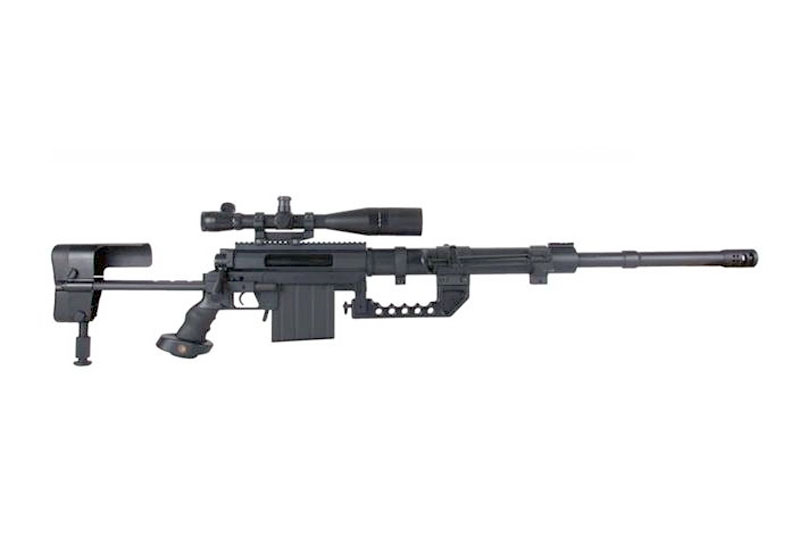
All told, the Intervention is a rather conventionally-designed sniper system. The major working internal components are held within the receiver which contains the firing action as well as the manually-actuated bolt-action lever (turn-bolt design). The lever hangs down to the right side of the gun body. There is a forend assembly over the barrel base and the barrel extends a distance out from the gun body proper. The barrel is further capped by an integrated muzzle brake and can accept a suppressor. Atop the receiver there is a Picatinny style rail system for the mounting of optics and accessories. An ergonomic carrying handle is attached under the forend ahead of the receiver. The .408 ammunition is fed via a spring-loaded, seven-shot, detachable box magazine ("repeater" production models only) inserted ahead of the pistol grip and trigger unit. The magazine itself is wide with vertical ribbing and inserts directly under the forward portion of the receiver. An ejection port is identified to the right side of the gun body, above the magazine feed. The pistol grip is of a rugged and stout design, ergonomically finished and conveniently angled rearwards with an enlarged base. The trigger is well-protected by a low-set guard as well as the pistol grip aft and the magazine feed ahead. The shoulder stock is another ergonomically refined element, hollow in its design and supported by two extension rods emanating from the receiver sides. This allows the operator to wholly adjust the extension of the shoulder support as needed. A collapsible bipod is adjustable and fitted to the forend assembly. An adjustable monopod is seen at the base of the shoulder stock. The Intervention weighs in at 31lbs without optics and sports a running length of 53 inches on full extension.

The Intervention benefits from the use of a highly efficient stainless steel muzzle brake - the McArthur PGRS-1 series - to help contend with the inherently violent recoil of such a weapon. An "efficient" muzzle brake allows repeated firing of the gun without exhausting the operator which, in other systems, generates fatigue and can lead to inaccurate results over the long run. The unique muzzle brake design, by gunsmith Bruce McArthur, forces the resulting gasses away from the eyes of the shooter prior to the bullet actually leaving the muzzle brake itself.

As a "take-down" rifle system, the Intervention can be broken down into smaller major components for storage during transport or during infiltration (via sea or air). CheyTac claims that their rifle system can maintain its "zero" tolerance meaning that, in the event of a complete system takedown, the rifle can be reassembled without loss to its inherent accuracy. Regardless of time of day or position from shooter to target, the Intervention has proven this feat in testing to consistently deliver rounds on target.

CheyTac markets their rifle with two distinct primary optical sighting systems. The standard scope model is the Nightforce NXS 5.5-22x variable telescopic sight. The night vision version is the SIM RAD. Customer-specific optics can also be used. The Intervention can mount other accessories beyond the traditional optics including a suppressor, an infrared (IR) laser illumination system, the KESTREL 4000/4500 data processing system (for accurate reading of wind, air temperature and pressures), the Leica Vector IV laser rangefinder and the SUUNTO X6 environmental computer won on the operator's wrist.

The Intervention has appeared in a handful of variants under differing model numbers per company nomenclature. The M-200 is a standard rifle design with a 29 inch barrel of which a shortened carbine form was also developed, since out of production now. The M-200 CIV is a known civilian market model. All M-200 series rifles operate from the detachable box magazine and feature the aforementioned adjustable wire telescoping shoulder stock. The M-310 series includes the M-310 SS and M-310 R to indicate respective "single-shot" and "repeater" firing actions. Both have a 29 inch barrel. The M-325 series includes the M-325 SS and M-325 R with the same respective firing actions as the M-310 series though these are finished with 28 inch barrels. The 300-series rifles are seen with McMillan fiberglass shoulder stocks.

McMillan fiberglass shoulder stock. The M-310 is further evolved into sub-variants to include the M-310 SS and the M-310 R, the major difference between the two designs being the former's "single-shot" action and the latter's "repeating" action - hence their associated letter designations.

Despite its American origins, the US military does not make use of the Intervention at this time - much to the disappointment of CheyTac. However, special forces of Poland and Turkey have found the system highly favorable for their operatives and actively use the weapon today. Production began in 2001 and is ongoing as of this writing.
Text ©2003-2013 www.MilitaryFactory.com • All Rights Reserved • No Reproduction Permitted
MilitaryFactory.com does NOT sell equipment/weaponry. Material presented throughout this website is for historical and entertainment value and should not to be construed as usable for hardware restoration, maintenance or general operation. Please consult manufacturers for such information. Our disclaimer. Email corrections / Comments to MilitaryFactory at Gmail dot com.
Picture of CheyTac Intervention
View All Images (1)

Specifications for the
CheyTac Intervention
Bolt-Action Sniper Rifle


Country of Origin: United States
Manufacturer: CheyTac LLC - USA
Initial Year of Service: 2001


Overall Length: 1346mm (52.99in)
Barrel Length: 736.00mm (28.98in)
Weight (Empty): 30.86lbs (14.00kg)


Cartridge: .408 CheyTac; .375 CheyTac
Action: Manually-Actuated Turn-Bolt-Action
Feed: 7-round detachable box magazine
Range: 6,560ft (1,999m; 2,187yds)
Sights: Optional Optics


Variants:
M-200 - Base Series Model; 29 inch barrel


M-200 Carbine - Shortend Variant

M-200 CIV - Civilian Variant

M-200 RK

M-310 SS - Single-Shot Variant; 29 inch barrel

M-310 R - Repeater Variant; 29 inch barrel

M-325 SS - Single-Shot Variant; 28 inch barrel

M-325 R - Repeater Variant; 28 inch barrel


Operators: Poland; Turkey

ALL SMALL ARMS CATEGORIES

BY YEAR:


1700 to 1799
1800 to 1899
1900 to 1909
1910 to 1919
1920 to 1929
1930 to 1939
1940 to 1949
1950 to 1959
1960 to 1969
1970 to 1979
1980 to 1989
1990 to 1999
2000 to 2009
2010 to 2019
VIEW ALL
Compare Guns


BY TYPE:


Anti-Aircraft Weapons
Anti-Material Rifles
Anti-Tank Weapons
Automatic Rifles
Bolt-Action Rifles
Carbine Guns
Flamethrowers
Flintlock Guns
Grenade Launchers
Hand Grenades
Lever-Action Rifles
Machine Guns
Mortars
Musket Guns
Pistols / Handguns
Recoilless Rifles
Revolvers
Rocket Launchers
Shotguns
Silenced Guns
Sniper Rifles
Special Weapon Systems
Submachine Guns
VIEW ALL


SPECIAL:


18th Century Warfare
3 Soldiers Statue
Battle of Mogadishu
Chainmail Armor
Firearm Types Defined
French Military Victories
Medieval Crossbow
Medieval Longbow
Vietnam War Casualties
Vietnam War Memorial

WORLD WAR 2:


British Guns
French Guns
German Guns (ALL)
German Rifles
Italian Guns
Japanese Guns
Soviet Guns
US Guns
US Infantry Regiment-Level Guns
Machine Guns
Pistols
Rifles
Submachine Guns
Sniper Rifles
VIEW ALL


WORLD WAR 1:

Pistols
Rifles
Machine Guns
Mortars
US Guns
VIEW ALL


KOREAN WAR:

Machine Guns
VIEW ALL


VIETNAM WAR:

Mortars
VIEW ALL


COLLECTIONS:


Ancient Weapons
British SAS Weapons
Civil War Guns
Colt Guns
Glock Guns
GROM Polish Special Forces
Guns of Libya
Guns of North Korea
Guns of Syria
Guns of WW1 & WW2
Heckler & Koch Guns
Kalashnikov Guns
Modern Russian Guns
Navy SEAL Weapons
Spetsnaz Weapons
Weapons of Desert Storm
Wild West Guns
Winchester Guns


HOLLYWOOD/GAMES:


Guns of the Walking Dead

Site Disclaimer | Privacy Policy | Site Map | MF Origins


©2013 www.MilitaryFactory.com • Content ©2003-2013 MilitaryFactory.com • All Rights Reserved • Site Contact Email: militaryfactory at gmail dot com. The "Military Factory" name and MilitaryFactory.com logo are registered ® trademarks and protected by all applicable domestic and international intellectual property laws.


Top MF Stuff: 2013 Military Pay Scale | Military Ranks | WW2 Weapons | Sniper Rifles | Kts to Mph | WW1 Aircraft | Automatic Rifles | Aircraft Cockpits | Vietnam War Weapons | Main Battle Tanks | Submachine Guns | Shotguns | French Military Victories


Most photographic images appearing on this site are courtesy of the United States Department of Defense and are approved for public use. Other images acquired through the public domain. Digital art work courtesy of Dan Alex. Business Consulting by Kyle Williams. Material presented throughout this website is for historical and entertainment value and should not to be construed as usable for hardware restoration, maintenance or general operation. Please consult manufacturers for such information.


eXTReMe Tracker