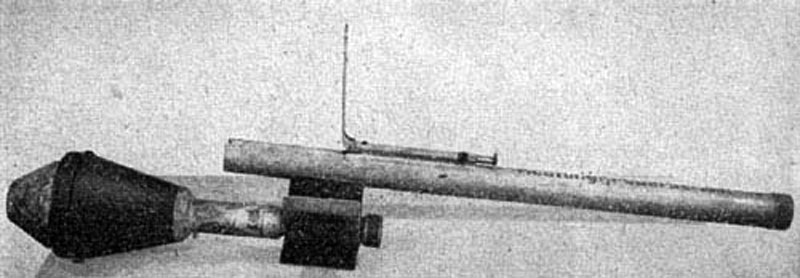
Panzerfaust 30
The Panzerfaust 30 was an ingenious disposable anti-tank launcher system.
By Staff Writer
The Panzerfaust series of hand-held disposable anti-tank rocket systems was a highly-feared adversary to American tank and vehicle crews. The large caliber projectile could defeat any level of armor available to Allied crews and the system as a whole could be quickly produced - appearing in large numbers from 1943 up through the last months of World War 2.
The Panzerfaust was an ingenious design, providing the firer little more than flip-up leaf sights and a firing-ready disposable tube. The operator need only to aim at the target with the launcher tucked under his arm (to protect from the projectiles exhaust) and fire the weapon. The destructive power of the projectile would usually render Allied armor ineffective or damaged for the remainder of the engagement. Such was the crippling power of the Panzerfaust that Allied tank and vehicle crews took steps to defeat the penetration power by applying makeshift armor protection. German infantry were almost exclusively fielded with the system, sometimes in lieu of a primary rifle, when defending territory.
If the Panzerfaust maintained any deficiencies they lay in the rather-infant stage of strategic thinking when fielding a weapon of this type. Range of early Panzerfaust systems was limited to about 30 meters with future systems becoming progressively more versatile. The effective range was indicated in the designation, hence the Panzerfaust 30, Panzerfaust 60 and the Panzerfaust 100. The initial Panzerfaust became the Panzerfaust 30 "klein", to which Klein indicated "small" as in the size of the projectile (these fielded with 100mm types). The second Panzerfaust 30 system utilized a 150mm projectile and appeared soon after the first. The consecutively larger Panzerfaust 60 and Panzerfaust 100 systems fielded the same 150mm projectile but had increased range.
Plans and testing were already underway for the Panzerfaust 150 and Panzerfaust 200 series systems which would have allowed for a reusable firing tube as opposed to the previous series’ disposable types. Additionally, range was to be increased thanks to added amounts of propellant for the rocket grenades. In the end, however, these two systems ran out of time with the fall of Germany in 1945.
An effective weapon, considering the ease of use, ease of production in great quantity and the lethality of the projectile, the Panzerfaust was the German infantryman weapon of choice when defending against Allied armor. The drawbacks of limited range was certainly a feature worth noting, as was the use of a disposable firing tube - an act that use up and permanently discarded some much needed German production resources that would never be recouped.
History text ©2003-2009 www.MilitaryFactory.com • All Rights Reserved •
No Reproduction Without Permission • Corrections / Comments to MilitaryFactory at Gmail dot com
Last Updated: 7/7/2009
|