Military Factory
Military Pay Chart
Global Firepower
Military Industrial Complex
Second World War
Home
Military Pay Scale
Military Ranks
Small Arms
Aircraft
Land Systems
Navy
Education
Military Factory Facebook Logo
flag of Soviet Union

Tokarev SVT-38 Self-Loading, Semi-Automatic Rifle (1938)

Authored By Staff Writer | Last Updated: 7/27/2012

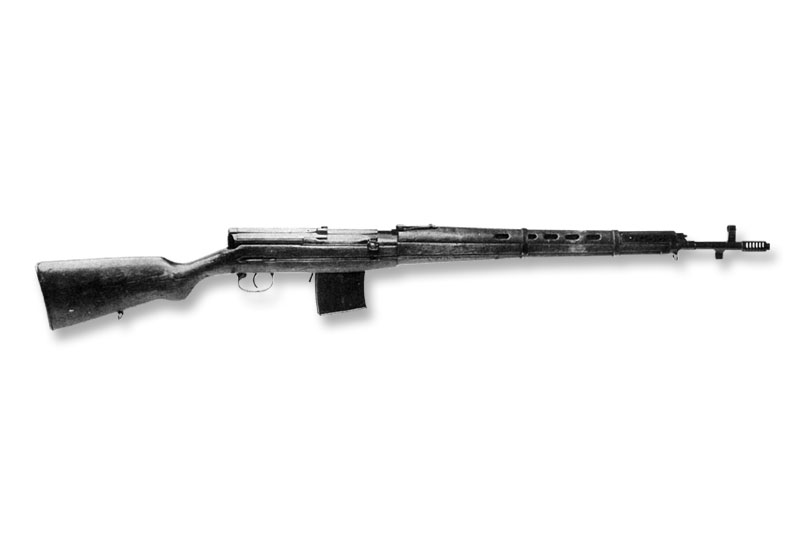
The Tokarev SVT-38 fired the powerful 7.62x54R Russian cartridge but proved too frail once in practice.

Find a School Near You
Follow Military Factory on Facebook:
Trending on Military Factory:
Recent Articles:
The Tokarev SVT-38 was the beginning of the Tokarev line of self-loading, automatic service rifles. The SVT-38 was developed in the mid-1930s and was soon pressed into service with Soviet forces upon the arrival of World War 2. Once in action, the SVT-38 proved powerful yet fragile. After a short time in the field, the limitations of the SVT-38 shown through and the type was replaced by the similar yet more robust SVT-40.

Soviet interest in self-loading rifles was piqued when leader Josef Stalin enacted a competition in 1935 to find the next standard-issue Soviet infantry rifle. By this time, engineer Fedor Tokarev had abandoned his attempts at creating a self-loading rifle based on recoil operation and instead geared his attention towards the creation of a similar rifle operating from a gas-minded principle. Competing firearms designer Sergei Simonov submitted his own design which proved to be what Stalin was looking for and Simonov won the contract. His self-loading rifle was designated as the AVS-36 and entered service in 1936, becoming the first automatic rifle to be accepted in quantity by the Red Army.

However, once in service, the AVS-36 was not all it seemed. Muzzle blast and recoil effects were two of its detrimental factors. In an attempt to rectify the design, Simonov fitted a two-baffle muzzle brake to help contend with the recoil and the receiver was hollowed to allow open movement of the cocking handle. The former change was welcomed but the latter unnecessarily exposed the internal working components of the AVS-36 to the grime and abuse of combat which did not lend itself well to a service rifle. As such, the AVS-36 was given a rather short service life in the inventory of the Red Army and a replacement was in the works soon after.

Fedor Tokarev submitted his simpler automatic rifle design back into the fray and it was formally accepted into Red Army service as the SVT-38 (also "Tokarev 1938"). The rifle was issued in 1938 and quickly moved to replace the Simonov AVS-36 series. What made the SVT-38 unique in Soviet firearms lore was its relatively complicated design. To this point, Soviet firearms were generally simple in design and easy to produce and could further be used by just about anyone with very little training involved.

The SVT-38 was designed with a two-piece wooden stock. Wood made up the stock, receiver and the forward hand guard. It was not until later that a steel-sheet hand guard replaced the forward wooden one. All major internal working components were set within the metal portion of the receiver. The oblong trigger ring hung under the receiver near the ergonomic hand grip with the curved trigger unit situated inside. The magazine feed was well-forward of the trigger unit and fed by a 10-round curved, detachable magazine. The feed was also accessible from the top of the receiver which allowed use of the 5-round stripper clips consistent with the Russian Mosin-Nagant rifle. A magazine release lever was fitted just aft of the magazine feed. The receiver sported a milled rail system to accept a telescopic sight as optional - a fairly forward-thinking addition to the SVT-38 design. A cocking handle was situated along the forward right side of the receiver near the cartridge ejection port. The forend was long and extended a ways from the body of the rifle, the wood double banded by steel bands before tapering off to expose the barrel proper. The forend showcased both a section with circular cooling holes and rectangular cooling slots over the aft portion of the barrel. The barrel featured a front post and was capped by a multi-baffled muzzle brake (originally 6-baffled) to help contend with recoil. A 2-baffled muzzle brake was fitted after 1940. Interestingly, the cleaning rod for the weapon was held externally against the right side of the stock against a carved out groove. Traditionally, such accessories were mounted under the barrel to keep the weapon clear of potential obstructions.

The SVT-38 was chambered - as was the AVS-36 - to fire the powerful 7.62x54R Russian cartridge. The firing action centered around a gas-operated, short-stroke piston with tilting bolt. The internal gas system was adjustable. Muzzle velocity was rated at 2,756 feet per second with and effective range out to 550 yards. The rifle weighed in at 3.95kg when unloaded and featured a length of 1,222mm with a barrel length of 610mm sporting 4-grooves with a right-hand twist.

The SVT-38 saw its first taste of combat in 1939 when it was issued to Soviet troops during the Winter War (1939-1940) against Finland. Initially, the weapon proved too heavy and rather long for the hold of Soviet soldiers and her complicated and sometimes fragile nature proved poor against the abuse inherent in modern combat. One detrimental effect was the magazine completely falling out of its feed from under the receiver during action, much to the shock of the operating Soviet soldier. The rather fragile construction and after-action reports of the rifle soon led to a cancellation of further production in April of 1940. By this time, some 150,000 examples were in circulation with some taking advantage of the telescopic sights fitting. Regardless, the SVT-38 proved both as something of a success and a failure. As a success, it pioneered solutions to some rather difficult problems involved in a self-loading rifle design, particularly when taken in the scope of Soviet arms design up to this point in history. As a failure, the Soviets were still without that standard-issue, war-winning automatic rifle that they had sought since the middle of the 1930s.

It was not long before an improved Tokarev self-loading rifle appeared to take the place of the failed SVT-38. The SVT-40 appeared in July of 1940 out of the Tula facility as a revised and lighter automatic rifle design. The cleaning rod was relocated to the underside of the barrel and the stock was of a single piece. The SVT-40 was purposely designed as a tougher and easier-to-produce alternative to the original SVT-38 and succeeded for the most part. Its success was showcased in the use of the weapon by German forces who managed to capture examples intact. Hundreds of thousands of SVT-40s were soon generated and at least 50,000 were specialized scoped sniper variants.

Soviet self-loading technology impressed the Germans enough for them to study and engineer their own self-loading types during the war. These became the Gew 41 of 1941 and its replacement, the Gew 43 of 1943.
Text ©2003-2013 www.MilitaryFactory.com • All Rights Reserved • No Reproduction Permitted
MilitaryFactory.com does NOT sell equipment/weaponry. Material presented throughout this website is for historical and entertainment value and should not to be construed as usable for hardware restoration, maintenance or general operation. Please consult manufacturers for such information. Our disclaimer. Email corrections / Comments to MilitaryFactory at Gmail dot com.
Picture of Tokarev SVT-38
View All Images (1)

Specifications for the
Tokarev SVT-38
Self-Loading, Semi-Automatic Rifle


Country of Origin: Soviet Union
Manufacturer: State Factories - Soviet Union
Initial Year of Service: 1938


Overall Length: 1222mm (48.11in)
Barrel Length: 610.00mm (24.02in)
Weight (Empty): 8.71lbs (3.95kg)


Cartridge: 7.62x54mmR Russian
Action: Self-Loading; Semi-Automatic
Feed: 10-round detachable box magazine
Muzzle Velocity: 2,756ft/sec (840m/sec)
Sights: Front Post; Flip-Up Rear


Variants:
SVT-38 - Base Series Designation


Operators: Nazi Germany; Soviet Union

ALL SMALL ARMS CATEGORIES

BY YEAR:


1700 to 1799
1800 to 1899
1900 to 1909
1910 to 1919
1920 to 1929
1930 to 1939
1940 to 1949
1950 to 1959
1960 to 1969
1970 to 1979
1980 to 1989
1990 to 1999
2000 to 2009
2010 to 2019
VIEW ALL
Compare Guns


BY TYPE:


Anti-Aircraft Weapons
Anti-Material Rifles
Anti-Tank Weapons
Automatic Rifles
Bolt-Action Rifles
Carbine Guns
Flamethrowers
Flintlock Guns
Grenade Launchers
Hand Grenades
Lever-Action Rifles
Machine Guns
Mortars
Musket Guns
Pistols / Handguns
Recoilless Rifles
Revolvers
Rocket Launchers
Shotguns
Silenced Guns
Sniper Rifles
Special Weapon Systems
Submachine Guns
VIEW ALL


SPECIAL:


18th Century Warfare
3 Soldiers Statue
Battle of Mogadishu
Chainmail Armor
Firearm Types Defined
French Military Victories
Medieval Crossbow
Medieval Longbow
Vietnam War Casualties
Vietnam War Memorial

WORLD WAR 2:


British Guns
French Guns
German Guns (ALL)
German Rifles
Italian Guns
Japanese Guns
Soviet Guns
US Guns
US Infantry Regiment-Level Guns
Machine Guns
Pistols
Rifles
Submachine Guns
Sniper Rifles
VIEW ALL


WORLD WAR 1:

Pistols
Rifles
Machine Guns
Mortars
US Guns
VIEW ALL


KOREAN WAR:

Machine Guns
VIEW ALL


VIETNAM WAR:

Mortars
VIEW ALL


COLLECTIONS:


Ancient Weapons
British SAS Weapons
Civil War Guns
Colt Guns
Glock Guns
GROM Polish Special Forces
Guns of Libya
Guns of North Korea
Guns of Syria
Guns of WW1 & WW2
Heckler & Koch Guns
Kalashnikov Guns
Modern Russian Guns
Navy SEAL Weapons
Spetsnaz Weapons
Weapons of Desert Storm
Wild West Guns
Winchester Guns


HOLLYWOOD/GAMES:


Guns of the Walking Dead

Site Disclaimer | Privacy Policy | Site Map | MF Origins


©2013 www.MilitaryFactory.com • Content ©2003-2013 MilitaryFactory.com • All Rights Reserved • Site Contact Email: militaryfactory at gmail dot com. The "Military Factory" name and MilitaryFactory.com logo are registered ® trademarks and protected by all applicable domestic and international intellectual property laws.


Top MF Stuff: 2013 Military Pay Scale | Military Ranks | WW2 Weapons | Sniper Rifles | Kts to Mph | WW1 Aircraft | Automatic Rifles | Aircraft Cockpits | Vietnam War Weapons | Main Battle Tanks | Submachine Guns | Shotguns | French Military Victories


Most photographic images appearing on this site are courtesy of the United States Department of Defense and are approved for public use. Other images acquired through the public domain. Digital art work courtesy of Dan Alex. Business Consulting by Kyle Williams. Material presented throughout this website is for historical and entertainment value and should not to be construed as usable for hardware restoration, maintenance or general operation. Please consult manufacturers for such information.


eXTReMe Tracker