Military Factory
Military Pay Chart
Global Firepower
Military Industrial Complex
Second World War
Home
Military Pay Scale
Military Ranks
Small Arms
Aircraft
Land Systems
Navy
Education
Military Factory Facebook Logo
flag of Soviet Union

M1943 (MT-13) 160mm Heavy Mortar (1943)

Authored By Staff Writer | Last Updated: 3/24/2011

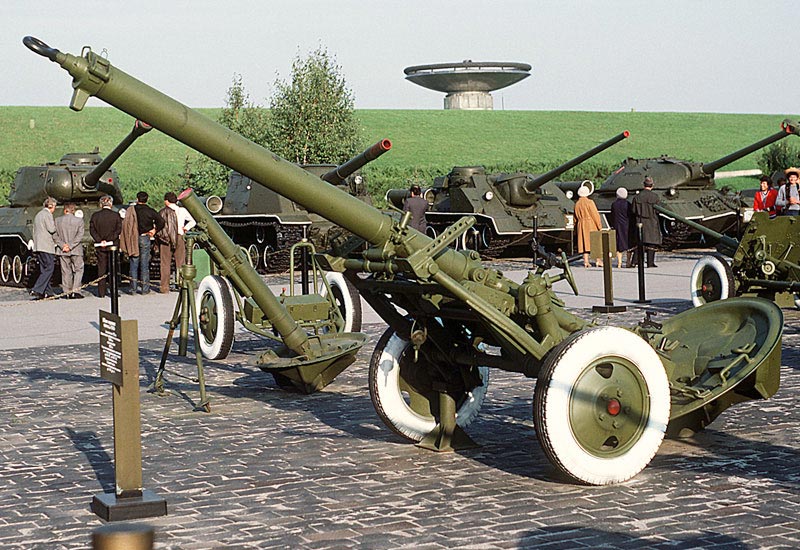
The M1943 heavy mortar fired a massive 160mm projectile.

Find a School Near You
Follow Military Factory on Facebook:
Trending on Military Factory:
Recent Articles:
The M1943 (also known as the "MT-13") was a heavy field mortar utilized by the Soviet Army through the latter half of World War 2. What made this particular mortar system unique was its large-caliber 160mm projectile which, in some ways, precluded its use as a "quick-set" weapon for infantry (as opposed to the smaller, portable 60mm and 81mm units available). With Germany having invaded the Soviet Union in June of 1941 through Operation Barbarossa, every weapon available to the Soviet Union was of great importance and the M1943, with its large caliber shell, proved a devastatingly lethal addition to the Red Army arsenal. The weapon was adopted for service sometime in 1943 and became the heaviest battlefield mortar to be utilized by the Soviets in the conflict - known to the Communists as the "Great Patriotic War".

The M1943 was brought about based on need from a resource-strapped military campaign. Already embroiled in full-scale war for years, the Soviet Army needed a cost-effective solution to help deliver quantitative amounts of high-explosive ordnance against a determined and prepared enemy. The Red Army would require a potent weapon that could combat enemy concentrations at range or tackle dug-in point targets with equal fervor across plains and mountain ranges.

The M1943 was based on the form and function of the earlier M1938 120mm mortar system, itself a direct copy of the excellent French-designed Brandt mortar system of 1935. However, the M1938 was a muzzle-loading weapon in much the same way that any conventional mortar system was. The difficulties faced by Soviet engineers was in how to load a 160mm projectile into a firing tube measuring nearly 10 feet in length, particularly when the tube would be elevated upwards off the ground in order to produce the correct firing arc needed. Engineers, therefore, developed a breech-loading mechanism for the new weapon and installed a formidable suppression system to help combat the effects of the inherently violent recoil experienced when launching a projectile of this magnitude. A circular convex baseplate was affixed to the rear of the firing tube to assist in retarding the recoil effects. The tube was further mounted onto a two-wheeled carriage system for ease of transport by mover vehicle or armored personnel carrier. The wheels could also serve the gunnery crew well when relocating over short distances or turning their weapon against a target area as needed.

As a breech-loaded weapon, the M1943 featured a hinged firing tube which opened forward at about its center point to allow complete access to the firing chamber. After the 160mm shell was loaded, the barrel was brought back to position which, in effect, closed the breech and the weapon was made ready to fire. The M1943 maintained an operational weight of 2,580lbs with the projectile itself weighing in at 90lbs, both of these qualities requiring multiple crew to manage. Elevation was limited to +45 to +80 degrees and traverse was 25 degrees. A trained gunnery crew could fire off 10 rounds per minute at a muzzle velocity of 804 feet per second with a range out to 5,600 yards. A truly effective battlefield weapon considering its hefty payload - and the German Army soldier would pay the ultimate price.

After World War 2, the M1943 continued to serve the Red Army and its interests across Bulgaria, Czechoslovakia, Poland, Romania and Syria. The M1943 was then replaced in Soviet service by the M-160, a 160mm caliber mortar system that retained the breech-loading philosophy of the proven M1943 but featured a longer barrel and, thusly, longer inherent range. While no highly regarded in today's technologically-minded world, the 160mm class of mortar can still be found in service in some far-off places around the world.
Text ©2003-2013 www.MilitaryFactory.com • All Rights Reserved • No Reproduction Permitted
MilitaryFactory.com does NOT sell equipment/weaponry. Material presented throughout this website is for historical and entertainment value and should not to be construed as usable for hardware restoration, maintenance or general operation. Please consult manufacturers for such information. Our disclaimer. Email corrections / Comments to MilitaryFactory at Gmail dot com.
Picture of M1943 (MT-13) 160mm
View All Images (1)

Specifications for the
M1943 (MT-13) 160mm
Heavy Mortar


Country of Origin: Soviet Union
Manufacturer: State Factories - Soviet Union
Initial Year of Service: 1943


Overall Length: 3075mm (121.06in)
Barrel Length: 3,030.00mm (119.29in)
Weight (Empty): 2,579.41lbs (1,170.00kg)


Cartridge: 160mm
Action: Breech Loading; Manually-Actuated
Feed: Single-Shot; Reusable Firing Tube
Muzzle Velocity: 804ft/sec (245m/sec)
Rate-of-Fire: 10 rounds per minute
Range: 16,892ft (5,149m; 5,631yds)
Sights: Adjustable


Variants:
MT-13 - Base Production Series Designation


M1943 - Alternative Designation


Operators: Bulgaria; Czechoslovakia; Poland; Romania; Soviet Union; Syria

ALL SMALL ARMS CATEGORIES

BY YEAR:


1700 to 1799
1800 to 1899
1900 to 1909
1910 to 1919
1920 to 1929
1930 to 1939
1940 to 1949
1950 to 1959
1960 to 1969
1970 to 1979
1980 to 1989
1990 to 1999
2000 to 2009
2010 to 2019
VIEW ALL
Compare Guns


BY TYPE:


Anti-Aircraft Weapons
Anti-Material Rifles
Anti-Tank Weapons
Automatic Rifles
Bolt-Action Rifles
Carbine Guns
Flamethrowers
Flintlock Guns
Grenade Launchers
Hand Grenades
Lever-Action Rifles
Machine Guns
Mortars
Musket Guns
Pistols / Handguns
Recoilless Rifles
Revolvers
Rocket Launchers
Shotguns
Silenced Guns
Sniper Rifles
Special Weapon Systems
Submachine Guns
VIEW ALL


SPECIAL:


18th Century Warfare
3 Soldiers Statue
Battle of Mogadishu
Chainmail Armor
Firearm Types Defined
French Military Victories
Medieval Crossbow
Medieval Longbow
Vietnam War Casualties
Vietnam War Memorial

WORLD WAR 2:


British Guns
French Guns
German Guns (ALL)
German Rifles
Italian Guns
Japanese Guns
Soviet Guns
US Guns
US Infantry Regiment-Level Guns
Machine Guns
Pistols
Rifles
Submachine Guns
Sniper Rifles
VIEW ALL


WORLD WAR 1:

Pistols
Rifles
Machine Guns
Mortars
US Guns
VIEW ALL


KOREAN WAR:

Machine Guns
VIEW ALL


VIETNAM WAR:

Mortars
VIEW ALL


COLLECTIONS:


Ancient Weapons
British SAS Weapons
Civil War Guns
Colt Guns
Glock Guns
GROM Polish Special Forces
Guns of Libya
Guns of North Korea
Guns of Syria
Guns of WW1 & WW2
Heckler & Koch Guns
Kalashnikov Guns
Modern Russian Guns
Navy SEAL Weapons
Spetsnaz Weapons
Weapons of Desert Storm
Wild West Guns
Winchester Guns


HOLLYWOOD/GAMES:


Guns of the Walking Dead

Site Disclaimer | Privacy Policy | Site Map | MF Origins


©2013 www.MilitaryFactory.com • Content ©2003-2013 MilitaryFactory.com • All Rights Reserved • Site Contact Email: militaryfactory at gmail dot com. The "Military Factory" name and MilitaryFactory.com logo are registered ® trademarks and protected by all applicable domestic and international intellectual property laws.


Top MF Stuff: 2013 Military Pay Scale | Military Ranks | WW2 Weapons | Sniper Rifles | Kts to Mph | WW1 Aircraft | Automatic Rifles | Aircraft Cockpits | Vietnam War Weapons | Main Battle Tanks | Submachine Guns | Shotguns | French Military Victories


Most photographic images appearing on this site are courtesy of the United States Department of Defense and are approved for public use. Other images acquired through the public domain. Digital art work courtesy of Dan Alex. Business Consulting by Kyle Williams. Material presented throughout this website is for historical and entertainment value and should not to be construed as usable for hardware restoration, maintenance or general operation. Please consult manufacturers for such information.


eXTReMe Tracker