Military Factory
Military Pay Chart
Global Firepower
Military Industrial Complex
Second World War
Home
Military Pay Scale
Military Ranks
Small Arms
Aircraft
Land Systems
Navy
Education
Military Factory Facebook Logo
flag of Switzerland

Waffenfabrik Bern (W+F) MG51 General Purpose Machine Gun (GPMG) (1951)

Authored By Staff Writer | Last Updated: 2/27/2013

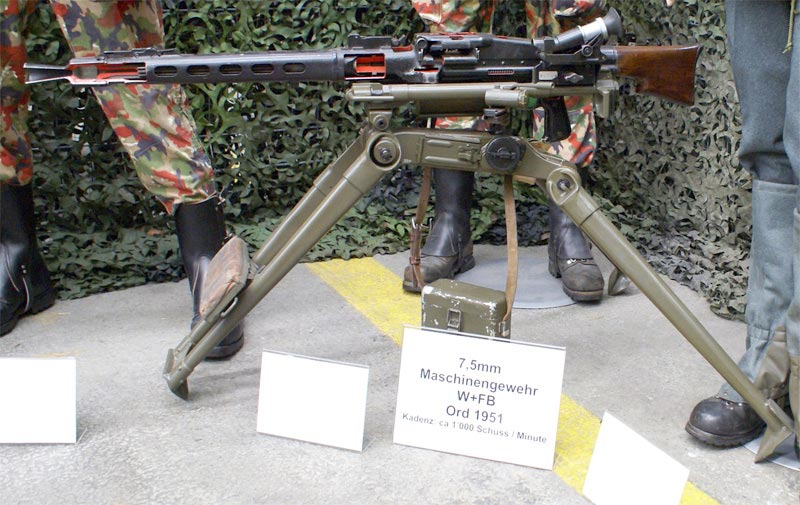
The Swiss Army MG51 General Purpose Machine Gun emerged during the post-war years as a simplified, heavier form of the wartime German MG42 series machine gun.

Find a School Near You
Follow Military Factory on Facebook:
Trending on Military Factory:
Recent Articles:
The Maschinengewehr 51 (MG51) General Purpose Machine Gun (GPMG) was developed in Switzerland in the years immediately following the end of World War 2 (1939-1945). The design was highly influenced by the excellent German Army MG42 appearing during the conflict and, therefore, exhibited the same general shape, operation and layout. The MG51 was officially adopted in 1951, hence its formal designation, with production handled by the state-owned Waffenfabrik Bern (usually abbreviated as "W+F"). Beyond its acceptance by Swiss Army forces, the MG 51 was also adopted by Denmark.

The MG51 was born from a World War 2 initiative intending to replace the aged Furrer LMG25 and Waffenfabrik Bern MG11 series of light and heavy machine guns, respectively. The LMG25 was adopted in 1925 and was a "rifle-like" automatic weapon fired from the shoulder while supported under the barrel by a bipod assembly. It was chambered for the 7.5x55mm GP11 cartridge operating under a recoil action and fed from a 30-round detachable box magazine. The MG11, an even older firearm adopted in 1911, was based on the successful water-cooled Maxim machine gun of 1889. This weapon was chambered for the same Swiss cartridge and operated from a short-recoil action while being fed through a canvas-and-metal belt arrangement. Both weapons had seen their best days by the time of World War 2 and an official change to a modernized type was in order.

Despite an open competition approach that included both the SIG and Hispano-Suiza concerns, the state-owned Waffenfabrik Bern's interpretation of the German wartime MG42 eventually won out. Working prototypes were unveiled in 1944 and subsequently set through the requisite evaluation and testing paces. With some modifications to suit the Swiss Army requirement, a finalized form of the weapon emerged in 1950 and formally adopted the following year.

Despite its MG42 origins, the MG51 deviated from its predecessor in that it was constructed of high-end milled steel rather than stamped sheets. Locking flaps were then assigned to the internal bolt assembly as opposed to the rollers as seen in the wartime German model. All of these changes made for a heavier end-product but one that proved just as reliable and robust as the original German offering. The weapon fired from the short recoil principle to a rate of 1,000 rounds per minute at a muzzle velocity of 2,500 feet per second. Ranging was accomplished through available, optional gun optics backed up by traditional iron sights. The MG51 was commonly issued with a heavy-duty tripod assembly that could collapse for ease-of-travel. The pad came complete with carrying straps for "over the back" placement as well as pads to sooth pressure against the carrier's shoulders. Early MG51 production forms were given wooden shoulder stocks and pistol grips though these, with the changing of the times, eventually gave way to plastic types.

The MG51 was initially chambered for the standard-issue 7.5x55mm Swiss (M1911) cartridge originating in 1889 and still undergoing quantitative production today (2013). Feeding of the weapon was through 50-round belts from an awaiting ammunition pack seated beside the weapon (the belt entering through the left side of the receiver). Expanded Swiss military commitments and NATO involvement eventually introduced the 7.62x51mm chambering into the mix. Those MG51 systems procured by Denmark were modified to fire the localized American 30-06 Springfield cartridge.

As the MG51 took the place of both a light and heavy weapon system, the new design was adopted as a fire support and sustained fire solution. For the former, a bipod assembly could be fitted and, in the latter, the aforementioned heavy tripod was utilized. The weapon was further evolved into a vehicle-mounted version under various "Pz Mg" marks to promote improved logistics within the Swiss Army inventory as well as manage a limited defense budget. The MG51 currently sees active service in the Swiss Amy ranks.
Text ©2003-2013 www.MilitaryFactory.com • All Rights Reserved • No Reproduction Permitted
MilitaryFactory.com does NOT sell equipment/weaponry. Material presented throughout this website is for historical and entertainment value and should not to be construed as usable for hardware restoration, maintenance or general operation. Please consult manufacturers for such information. Our disclaimer. Email corrections / Comments to MilitaryFactory at Gmail dot com.
Picture of Waffenfabrik Bern (W+F) MG51
View All Images (1)

Specifications for the
Waffenfabrik Bern (W+F) MG51
General Purpose Machine Gun (GPMG)


Country of Origin: Switzerland
Manufacturer: Eidgenossische Waffenfabrik Bern - Switzerland
Initial Year of Service: 1951


Overall Length: 1270mm (50.00in)
Barrel Length: 564.00mm (22.20in)
Weight (Empty): 35.27lbs (16.00kg)


Cartridge: 7.5x55mm Swiss; 7.62x51mm NATO
Action: Gas-Assisted; Short Recoil Operation; Automatic Fire Only
Feed: 50- or 250-round metal link belt
Muzzle Velocity: 2,460ft/sec (750m/sec)
Rate-of-Fire: 1,000 rounds per minute
Range: 4,921ft (1,500m; 1,640yds)
Sights: Iron; Optional 2.3x Optical Sight


Variants:
MG51 - Base Production Series Designation


MG51/71 - Vehicle-mounted version

PZ MG87 - Tank-mounted version (Swiss Army Leopard 2 MBT).


Operators: Denmark; Switzerland

ALL SMALL ARMS CATEGORIES

BY YEAR:


1700 to 1799
1800 to 1899
1900 to 1909
1910 to 1919
1920 to 1929
1930 to 1939
1940 to 1949
1950 to 1959
1960 to 1969
1970 to 1979
1980 to 1989
1990 to 1999
2000 to 2009
2010 to 2019
VIEW ALL
Compare Guns


BY TYPE:


Anti-Aircraft Weapons
Anti-Material Rifles
Anti-Tank Weapons
Automatic Rifles
Bolt-Action Rifles
Carbine Guns
Flamethrowers
Flintlock Guns
Grenade Launchers
Hand Grenades
Lever-Action Rifles
Machine Guns
Mortars
Musket Guns
Pistols / Handguns
Recoilless Rifles
Revolvers
Rocket Launchers
Shotguns
Silenced Guns
Sniper Rifles
Special Weapon Systems
Submachine Guns
VIEW ALL


SPECIAL:


18th Century Warfare
3 Soldiers Statue
Battle of Mogadishu
Chainmail Armor
Firearm Types Defined
French Military Victories
Medieval Crossbow
Medieval Longbow
Vietnam War Casualties
Vietnam War Memorial

WORLD WAR 2:


British Guns
French Guns
German Guns (ALL)
German Rifles
Italian Guns
Japanese Guns
Soviet Guns
US Guns
US Infantry Regiment-Level Guns
Machine Guns
Pistols
Rifles
Submachine Guns
Sniper Rifles
VIEW ALL


WORLD WAR 1:

Pistols
Rifles
Machine Guns
Mortars
US Guns
VIEW ALL


KOREAN WAR:

Machine Guns
VIEW ALL


VIETNAM WAR:

Mortars
VIEW ALL


COLLECTIONS:


Ancient Weapons
British SAS Weapons
Civil War Guns
Colt Guns
Glock Guns
GROM Polish Special Forces
Guns of Libya
Guns of North Korea
Guns of Syria
Guns of WW1 & WW2
Heckler & Koch Guns
Kalashnikov Guns
Modern Russian Guns
Navy SEAL Weapons
Spetsnaz Weapons
Weapons of Desert Storm
Wild West Guns
Winchester Guns


HOLLYWOOD/GAMES:


Guns of the Walking Dead

Site Disclaimer | Privacy Policy | Site Map | MF Origins


©2013 www.MilitaryFactory.com • Content ©2003-2013 MilitaryFactory.com • All Rights Reserved • Site Contact Email: militaryfactory at gmail dot com. The "Military Factory" name and MilitaryFactory.com logo are registered ® trademarks and protected by all applicable domestic and international intellectual property laws.


Top MF Stuff: 2013 Military Pay Scale | Military Ranks | WW2 Weapons | Sniper Rifles | Kts to Mph | WW1 Aircraft | Automatic Rifles | Aircraft Cockpits | Vietnam War Weapons | Main Battle Tanks | Submachine Guns | Shotguns | French Military Victories


Most photographic images appearing on this site are courtesy of the United States Department of Defense and are approved for public use. Other images acquired through the public domain. Digital art work courtesy of Dan Alex. Business Consulting by Kyle Williams. Material presented throughout this website is for historical and entertainment value and should not to be construed as usable for hardware restoration, maintenance or general operation. Please consult manufacturers for such information.


eXTReMe Tracker