Military Factory
Military Pay Chart
Global Firepower
Military Industrial Complex
Second World War
Home
Military Pay Scale
Military Ranks
Small Arms
Aircraft
Land Systems
Navy
Education
Military Factory Facebook Logo
flag of Switzerland

SIG-Sauer P220 (Pistole 75 / Model 75) Semi-Automatic Pistol (1975)

Authored By Staff Writer | Last Updated: 5/12/2011

The SIG-Sauer P220 opened up the successful family of semi-automatic pistols.

Find a School Near You
Follow Military Factory on Facebook:
Trending on Military Factory:
Recent Articles:
The SIG-Sauer P220 was a semi-automatic pistol series of Swiss origin with production also handled out of Germany. As the Swiss government maintained highly strict export laws concerning firearms, SIG (Schweizerische Industrie-Gesellschaft) teamed up with German-based J.P. Sauer to allow for production of the handgun on German soil and, thusly, bypassing the Swiss restrictions and opening the weapon up to a larger market. As such, production of the P220 fell under both the SIG of Neuhausen-am-Rheinfalls (Switzerland) and J.P. Sauer & Sohn or Eckernforde (Germany) banners creating the SIG-Sauer name. This melding of manufacturers produce a weapon system that was - while being mostly of SIG design in origin - fielded with some alterations based on Sauer involvement. The P220 series spawned a larger family of successful semi-automatic pistols ranging from the P225 to the P229. Operators grew to include Canada, Iran, Japan, Switzerland and the United States. West German police were former operators during the cold war.

At its core, the P220 was a revision of the original P210 system appearing in the late 1930s. The SIG concern purchased several French-based patents and began the design and development of their own automatic handgun with the resulting product becoming the P210. The P210 featured a locked-breech pattern not unlike the original Browning design and made for a solid and reliable weapon. The P210 had the ability to fire both the 7.65mm cartridge and the 9mm Parabellum, the latter with some required internal alterations of course. Five versions of the P210 ultimately appeared and the type was issued to the Swiss Army as the primary sidearm. Such was the quality of the handgun that the P210 stayed out of reach for many budget conscious militaries and police forces suggesting that the gun was too expensive to obtain in any number.

The P220 was therefore designed along the same lines as the P210 before it. However, the P220 was designed as a faster and cheaper version to produce for concerned shoppers. The slide-locking feature was simplified from the original P210 and the weapon's construction was assisted by computer-controlled machinery for precise measurements. The gun was delivered to market in 1975 and entered service with the Swiss Army as a primary sidearm that same year. In service, the Swiss designated the weapon as the "Pistole 75" or "Model 75" replacing their P210s in the process.

Internally, the P220 sported a locked-breech system and a short-recoil action, each with origins based in the hugely successful John Browning system. For safety, the P220 did not disappoint with the inclusion of a de-cocking level, an automatic firing-pin safety block (patented in design), a safety intercept notch and a trigger bar disconnect to ensure that the weapon did not fire by mistake. The trigger was double-action in nature but a single-action function could be attained if need be. There was no manually-operated safety catch thanks to this integral four-point safety system. The firing action saw the slide and barrel - as they were locked together - move rearwards along the frame. The barrel was then cammed down until the bullet left the barrel. The rearward motion of the slide ejected the spent shell casing and set a recoil spring into action. The recoil spring now brought the slide forwards and the resulting action stripped a fresh round into the firing chamber. The barrel was now cammed upwards and joined the slide in the forward-moving action, readying the gun to fire once more.

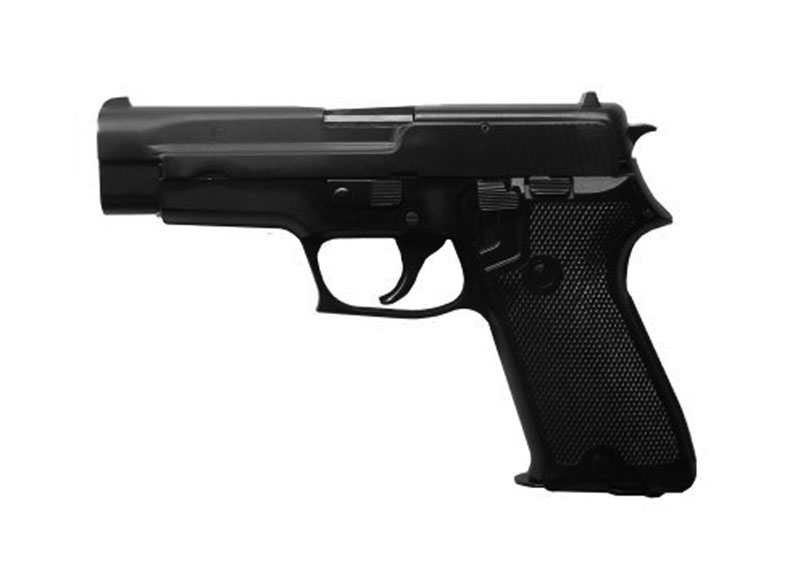
The P220 maintained an overly clean appearance consistent with the SIG-Sauer brand. The slide was rectangular with smooth slab sides. The pistol grip fit well in the average hand for a good solid hold and a prawl made sure the gun stayed in the hand of the user when fired. The hammer was visible as a protrusion at the rear of the frame. The barrel was seated within the slide and measured 4.40 inches in length with a 6-groove, right-hand twist rifling pattern. The entire weapon maintained a running length of 7.79 inches. The trigger was hinged along its top section and protected by an oblong trigger guard. The ejection port was located along the top middle of the weapon frame with a notch sight seated at the rear and a post sight at the front, just above the muzzle. Support for Picatinny rails was added later. In whole, the P220 proved a solidly constructed sidearm made specifically for the rigors and abuse of everyday handling in intense lines of work.

The primary cartridge for the P220 became the 9x19mm Parabellum, these fitted into a spring-loaded 9-round detachable box magazine (also available in 7- or 10-round counts and varying calibers) inserted into the patterned pistol grip. Muzzle velocity was rated at 1,132 feet per second. Empty weight of the entire weapon system was 1lb, 13oz. There magazine release was located to the rear of the magazine well but this was later relocated to the left-hand side of the pistol grip, just rear of the trigger.

The P220 has since proved popular to its users in the security, police, military and special forces departments. It is supplied in two major versions known as the P220R and the P220ST. R-models utilize an aluminum alloy frame with a stainless steel slide (or stamped steel if produced in Germany, otherwise made in the US) while the ST-models are made with a frame and slide of stainless steel. Variants within the P220 family became the P220 "Rail" sporting the Picatinny rail system on the dustcover to accept various sights, scopes and accessories, the P220 "Carry" with its shorter 3.9-inch barrel and accessory rail, the P220 "Compact" (four variants in itself), the two P220 "Combat" .45 ACP models for military use, the P220 "Classic 22" chambered for the .22 "Long Rifle" cartridge, the P225/P6 compact form, the P245 .45 ACP for the Swiss Army and West German police (P6) and the P245 for the American market chambered only in .45 ACP.

The P220 has since been succeeded along the SIG-Sauer production lines by the P226 model. When it was first imported to the US, the SIG-Sauer P220 was marketed under the name of Browning Double Action (BDA). These were offered in .38 Super, the original 9mm and .45 ACP calibers. Since then, the P220 was sold strictly a .45 ACP weapon.
Text ©2003-2013 www.MilitaryFactory.com • All Rights Reserved • No Reproduction Permitted
MilitaryFactory.com does NOT sell equipment/weaponry. Material presented throughout this website is for historical and entertainment value and should not to be construed as usable for hardware restoration, maintenance or general operation. Please consult manufacturers for such information. Our disclaimer. Email corrections / Comments to MilitaryFactory at Gmail dot com.
Picture of SIG-Sauer P220 (Pistole 75 / Model 75)
View All Images (1)

Specifications for the
SIG-Sauer P220 (Pistole 75 / Model 75)
Semi-Automatic Pistol


Country of Origin: Switzerland
Manufacturer: Schweizerische Industrie-Gesellschaft (SIG) - Switzerland / J.P. Sauer & Sohn - Germany / SIG Arms AG - Switzerland
Initial Year of Service: 1975


Overall Length: 198mm (7.80in)
Barrel Length: 112.00mm (4.41in)
Weight (Empty): 1.12lbs (0.51kg)


Cartridge: 9x19mm Parabellum; .38 Super; .45 ACP
Action: Recoil-Operated; Semi-Automatic
Feed: 7-, 9- or 10-round detachable box magazine
Muzzle Velocity: 1,132ft/sec (345m/sec)
Sights: Notch Rear; Front Post


Variants:
P220 - Base Series Designation


P220T - Aluminum frame; stainless steel or stamped steel slide; Picatinny rail support.

P220ST - Stainless steel slide and frame; Picatinny rail support.

P220 "Rail" - Picatinny rail on dust cover.

P220 "Carry" - Shortened 3.9-inch barrel and slide.

P220 "Compact" - Shortened slide with compact frame.

P220 "Combat" - Militarized models; night sight, Nirton-finish; non-glare frame; Picatinny rail; suppressor capable chambered for .45 ACP; 8- or 10-round magazine.

P220 "Classic 22" - Chambered for the .22 Long Rifle cartridge; 10-round polymer magazine.

P225 - Swiss Army model; compact version of production P220s.

P6 - West German Police Designation of P225 model.

P245 - Chambered in .45 ACP; US market.


Operators: Canada; Iran; Japan; Switzerland; West Germany

ALL SMALL ARMS CATEGORIES

BY YEAR:


1700 to 1799
1800 to 1899
1900 to 1909
1910 to 1919
1920 to 1929
1930 to 1939
1940 to 1949
1950 to 1959
1960 to 1969
1970 to 1979
1980 to 1989
1990 to 1999
2000 to 2009
2010 to 2019
VIEW ALL
Compare Guns


BY TYPE:


Anti-Aircraft Weapons
Anti-Material Rifles
Anti-Tank Weapons
Automatic Rifles
Bolt-Action Rifles
Carbine Guns
Flamethrowers
Flintlock Guns
Grenade Launchers
Hand Grenades
Lever-Action Rifles
Machine Guns
Mortars
Musket Guns
Pistols / Handguns
Recoilless Rifles
Revolvers
Rocket Launchers
Shotguns
Silenced Guns
Sniper Rifles
Special Weapon Systems
Submachine Guns
VIEW ALL


SPECIAL:


18th Century Warfare
3 Soldiers Statue
Battle of Mogadishu
Chainmail Armor
Firearm Types Defined
French Military Victories
Medieval Crossbow
Medieval Longbow
Vietnam War Casualties
Vietnam War Memorial

WORLD WAR 2:


British Guns
French Guns
German Guns (ALL)
German Rifles
Italian Guns
Japanese Guns
Soviet Guns
US Guns
US Infantry Regiment-Level Guns
Machine Guns
Pistols
Submachine Guns
Sniper Rifles
VIEW ALL


WORLD WAR 1:

Pistols
Rifles
Machine Guns
Mortars
US Guns
VIEW ALL


KOREAN WAR:

Machine Guns
VIEW ALL


VIETNAM WAR:

Mortars
VIEW ALL


COLLECTIONS:


Ancient Weapons
British SAS Weapons
Civil War Guns
Colt Guns
Glock Guns
GROM Polish Special Forces
Guns of Libya
Guns of North Korea
Guns of Syria
Guns of WW1 & WW2
Heckler & Koch Guns
Kalashnikov Guns
Modern Russian Guns
Navy SEAL Weapons
Spetsnaz Weapons
Weapons of Desert Storm
Wild West Guns
Winchester Guns


HOLLYWOOD/GAMES:


Guns of the Walking Dead

Site Disclaimer | Privacy Policy | Site Map | MF Origins


©2013 www.MilitaryFactory.com • Content ©2003-2013 MilitaryFactory.com • All Rights Reserved • Site Contact Email: militaryfactory at gmail dot com. The "Military Factory" name and MilitaryFactory.com logo are registered ® trademarks and protected by all applicable domestic and international intellectual property laws.


Top MF Stuff: 2013 Military Pay Scale | Military Ranks | WW2 Weapons | Sniper Rifles | Kts to Mph | WW1 Aircraft | Automatic Rifles | Aircraft Cockpits | Vietnam War Weapons | Main Battle Tanks | Submachine Guns | Shotguns | French Military Victories


Most photographic images appearing on this site are courtesy of the United States Department of Defense and are approved for public use. Other images acquired through the public domain. Digital art work courtesy of Dan Alex. Business Consulting by Kyle Williams. Material presented throughout this website is for historical and entertainment value and should not to be construed as usable for hardware restoration, maintenance or general operation. Please consult manufacturers for such information.


eXTReMe Tracker