Military Factory
Military Pay Chart
Global Firepower
Military Industrial Complex
Second World War
Home
Military Pay Scale
Military Ranks
Small Arms
Aircraft
Land Systems
Navy
Education
Military Factory Facebook Logo
flag of Imperial Japan

Type 92 Shiki Kikanju (HMG) Heavy Machine Gun (1932)

Authored By Staff Writer | Last Updated: 7/3/2010

The Type 92 heavy machine gun was nicknamed the Woodpecker due to its distinct stuttering sound when fired.

Find a School Near You
Follow Military Factory on Facebook:
Trending on Military Factory:
Recent Articles:
The Type 92 Shiki Kikanju Heavy Machine Gun was utilized as the standard heavy machine gun by the Imperial Japanese Army during World War 2. She began as a design of Kijiro Nambu in 1932 and was quickly put into production that same year. The weapon would see extensive action in World War 2, the Korean War and the Chinese Civil War despite her tendency to jam.

Leading up to the Second World War, the Imperial Japanese "powers-that-be" understood that their 6.5mm cartridge had met its proverbial day in the sun - outmatched by those used by other world powers around the globe. As such, a move was enacted to develop and produce a better man-stopping round for her infantrymen, this becoming the new 7.7mm cartridge. The 7.7mm caliber was quickly established as the primary cartridge for many of the Imperial Japanese Army (IJA) weapons including the Type 92 Shiki Kikanju Heavy Machine Gun (HMG) - itself seeing origins within the Hotchkiss M1914 machine gun and proving nothing more than a larger version of the preceding IJA Type 3 HMG. The Type 92 was chambered to fire the 7.7mm Type 92 machine gun cartridge as was the Type 89 aircraft machine gun. Full-scale production of the Type 92 delivered the Type 92 to Imperial Japanese Army units between 1932 and 1941.

The Type 92 was a gas-operated, air-cooled weapon classified as a "heavy" machine gun with a listed rate-of-fire between 400 and 450 rounds per minute. The 7.7mm Type 92 (Shiki) cartridge (available as rimmed and rimless) was delivered into the mechanism by way of a 150-round metal strip. The use of these ammunition strips (and not belt ammunition) worked against the Type 92 and her crews to an extent, resulting in a lower rate of fire than what her contemporaries generated. Additionally, this operator-initiated feed action made her prone to jamming. Muzzle velocity was about 2,400 feet per second and effective range was listed out to 870 yards. The weapon's running length was 45.5 inches while the barrel made up over two feet of this length. An oil-filled dispenser was made part of the overall system to help ensure smooth delivery of cartridges to the ammunition feed and cartridges themselves were oiled before leaving Japanese factories - though this well-intentioned coating generally attracted dust and dirt leading to potentially worse jams. As such, misfed cartridges proved an all-too common occurrence in the operational history of the Type 92.

With its required tripod, the Type 92 weighed in at an ungainly 122lbs, requiring multiple infantry to carry her into position. Once set and made ready to fire, the Type 92 crew was generally made up of three personnel. The tripod was of note for having holes drilled into its feet. This allowed poles to be driven through the holes to act as carrying handles and facilitate transport of the machine gun by two soldiers. When in action, one soldier managed the aiming and firing of the weapon while a second crewmember served to feed the ammunition clips into the feed mechanism. The 7.7mm Arisaka rifle round could be utilized if need be. Additionally, the Type 92 could be used as a stopgap anti-aircraft machine gun in addition to its standard use against infantry and light vehicles.

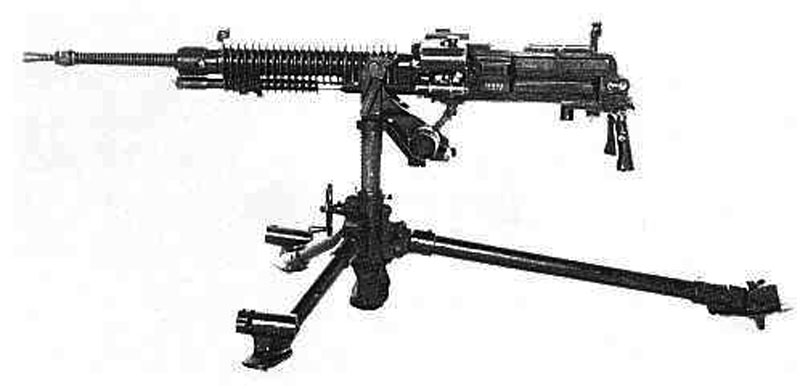
External design was conventional and utilitarian by early 1930s standards. Clearly identifiable was the ribbing located ahead of the receiver and aft of the barrel. The major workings were concentrated into the aft portions of the weapon and included the integrated downward handle grip. Ammunition was fed from the left side of the receiver and ejected from a port along the right side of the receiver. Unique to the Type 92 was the fact that its iron sights were offset slightly to the right as opposed to down center. Optional periscopic sights of various standard IJA types could be fitted as well for improved downfield accuracy.

The Type 92 was known to the Allies as the "Woodpecker" for her distinct stuttering sound when fired. As the German MG42 was to the Allied soldiers in Europe, so too was the Type 92 to the Allied soldiers in the Pacific - infantrymen soon learned to identify the weapon system merely by its firing operation and thusly knew something of their enemy when coming under attack. Some captured Type 92s were put back into action against their previous owners by United States Marines on Iwo Jima and other island conquests made by the Americans. Similarly, Chinese forces battling the invading Japanese made use of captured Type 92s as well.

Despite the end of its production run and Japan's capitulation in 1945, the Type 92 soldiered on in the upcoming Korean War by the North Korean Army who still found value with the aged system. The Type 92 received its Japanese military designation by the Japanese Imperial Year of "2592", signifying the year of introduction as "1932" to the rest of the world.
Text ©2003-2013 www.MilitaryFactory.com • All Rights Reserved • No Reproduction Permitted
MilitaryFactory.com does NOT sell equipment/weaponry. Material presented throughout this website is for historical and entertainment value and should not to be construed as usable for hardware restoration, maintenance or general operation. Please consult manufacturers for such information. Our disclaimer. Email corrections / Comments to MilitaryFactory at Gmail dot com.
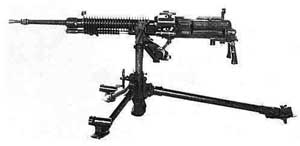
Picture of Type 92 Shiki Kikanju (HMG)
View All Images (1)

Specifications for the
Type 92 Shiki Kikanju (HMG)
Heavy Machine Gun


Country of Origin: Imperial Japan
Manufacturer: State Factories - Imperial Japan
Initial Year of Service: 1932


Overall Length: 1156mm (45.51in)
Barrel Length: 721.00mm (28.39in)
Weight (Empty): 121.92lbs (55.30kg)


Cartridge: 7.7mm Type 92
Action: Gas-Operated
Feed: 150-round metal strip
Muzzle Velocity: 2,400ft/sec (732m/sec)
Rate-of-Fire: 425 rounds per minute
Range: 2,624ft (800m; 875yds)
Sights: Standard Iron or optional Periscopic


Variants:
Type 92 - Base Production Series Designation


Operators: Imperial Japan

ALL SMALL ARMS CATEGORIES

BY YEAR:


1700 to 1799
1800 to 1899
1900 to 1909
1910 to 1919
1920 to 1929
1930 to 1939
1940 to 1949
1950 to 1959
1960 to 1969
1970 to 1979
1980 to 1989
1990 to 1999
2000 to 2009
2010 to 2019
VIEW ALL
Compare Guns


BY TYPE:


Anti-Aircraft Weapons
Anti-Material Rifles
Anti-Tank Weapons
Automatic Rifles
Bolt-Action Rifles
Carbine Guns
Flamethrowers
Flintlock Guns
Grenade Launchers
Hand Grenades
Lever-Action Rifles
Machine Guns
Mortars
Musket Guns
Pistols / Handguns
Recoilless Rifles
Revolvers
Rocket Launchers
Shotguns
Silenced Guns
Sniper Rifles
Special Weapon Systems
Submachine Guns
VIEW ALL


SPECIAL:


18th Century Warfare
3 Soldiers Statue
Battle of Mogadishu
Chainmail Armor
Firearm Types Defined
French Military Victories
Medieval Crossbow
Medieval Longbow
Vietnam War Casualties
Vietnam War Memorial

WORLD WAR 2:


British Guns
French Guns
German Guns (ALL)
German Rifles
Italian Guns
Japanese Guns
Soviet Guns
US Guns
US Infantry Regiment-Level Guns
Machine Guns
Pistols
Rifles
Submachine Guns
Sniper Rifles
VIEW ALL


WORLD WAR 1:

Pistols
Rifles
Machine Guns
Mortars
US Guns
VIEW ALL


KOREAN WAR:

Machine Guns
VIEW ALL


VIETNAM WAR:

Mortars
VIEW ALL


COLLECTIONS:


Ancient Weapons
British SAS Weapons
Civil War Guns
Colt Guns
Glock Guns
GROM Polish Special Forces
Guns of Libya
Guns of North Korea
Guns of Syria
Guns of WW1 & WW2
Heckler & Koch Guns
Kalashnikov Guns
Modern Russian Guns
Navy SEAL Weapons
Spetsnaz Weapons
Weapons of Desert Storm
Wild West Guns
Winchester Guns


HOLLYWOOD/GAMES:


Guns of the Walking Dead

Site Disclaimer | Privacy Policy | Site Map | MF Origins


©2013 www.MilitaryFactory.com • Content ©2003-2013 MilitaryFactory.com • All Rights Reserved • Site Contact Email: militaryfactory at gmail dot com. The "Military Factory" name and MilitaryFactory.com logo are registered ® trademarks and protected by all applicable domestic and international intellectual property laws.


Top MF Stuff: 2013 Military Pay Scale | Military Ranks | WW2 Weapons | Sniper Rifles | Kts to Mph | WW1 Aircraft | Automatic Rifles | Aircraft Cockpits | Vietnam War Weapons | Main Battle Tanks | Submachine Guns | Shotguns | French Military Victories


Most photographic images appearing on this site are courtesy of the United States Department of Defense and are approved for public use. Other images acquired through the public domain. Digital art work courtesy of Dan Alex. Business Consulting by Kyle Williams. Material presented throughout this website is for historical and entertainment value and should not to be construed as usable for hardware restoration, maintenance or general operation. Please consult manufacturers for such information.


eXTReMe Tracker