Military Factory
Military Pay Chart
Global Firepower
Military Industrial Complex
Second World War
Home
Military Pay Scale
Military Ranks
Small Arms
Aircraft
Land Systems
Navy
Education
Military Factory Facebook Logo
flag of United States

Winchester Model 1866 Lever-Action Repeating Rifle (1866)

Authored By Captain Jack | Last Updated: 8/15/2011

The Winchester Model 1866 was THE original Winchester lever-action rifle, addressing the limitations of the preceding Henry Rifle.

Find a School Near You
Follow Military Factory on Facebook:
Trending on Military Factory:
Recent Articles:
While the lever-action repeating Henry Rifle of 1860 proved revolutionary in its own right, it still held some limitations within its overall design that the now-Winchester firm soon sought to overcome. The resulting product - the Model 1866 - became an excellent and robust performer along the Western Frontier, offering up reliability and ease of use with accuracy and a 15-round magazine hold. The Winchester Model 1866 was THE Winchester rifle that started it all, beginning the long and successful line of lever-action systems that would become synonymous with the Winchester brand name and the Wild West. Some 720,000 Winchester rifles would eventually be produced during the lever-action market boom, earning the brand a special place in history and in the hearts and minds of its everyday users.

As majority investor, clothing businessman Oliver Winchester purchased the bankrupt assets of the Volcanic Repeating Arms - a firm founded in part by gunsmith's Horace Smith and Daniel Wesson to produce their limited-success Volcanic lever-action pistols and rifles. With complete ownership, Winchester moved the production plant to New Haven, Connecticut, and changed the operating name to the New Haven Arms Company. The firm continued production of the Henry Model 1860 repeating rifle for a time - the rifle named after its shop foreman - Benjamin Tyler Henry. Smith & Wesson eventually left NHAC to begin their own revolver manufacturing company. The Henry Rifle saw some action in the latter years of the American Civil War as well as in the Indian Wars, being produced in approximately 14,000 examples and generally thought of as an excellent rifle for its time. Henry gave the Union soldier lucky enough to acquire it (it was not officially accepted into Union Army use) a hefty 15-round ammunition supply before reloading occurred.

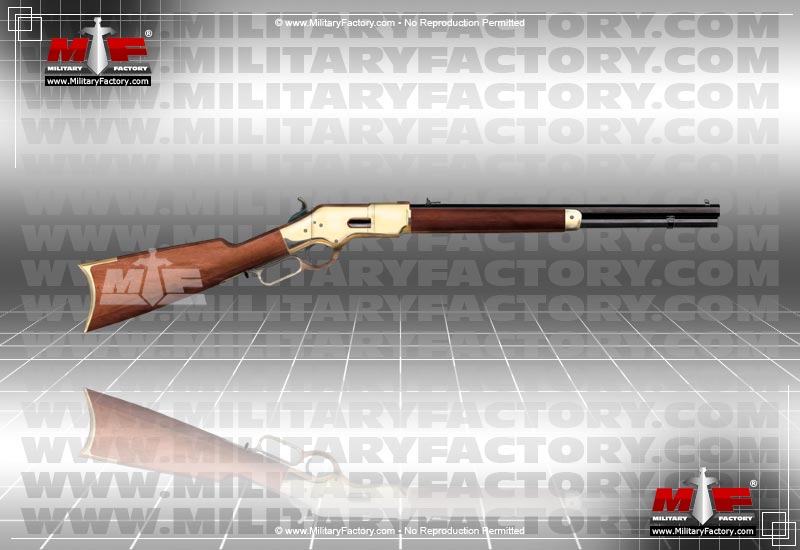
The New Haven Arms Company became the Winchester Repeating Arms Company after the Civil War. One of the first orders was in revising and improving the Henry Rifle. Despite its revolutionary approach to repeating fire, the Henry Rifle was not without limitations. A new rifle was envisioned and, with a partnership Winchester developed with another famous American Gunsmith - John Moses Browning - the new lever-action repeating Winchester Model 1866 was developed as an improved form of the Henry Rifle. The Model 1866 introduced a wooden forestock over the magazine tube as well as a revised sealed magazine chamber and a more robust bronze gunmetal frame. The identifiable Winchester-style loading gate was fitted to the side right side of the frame, easing the process of reloading the weapon. In fact, it was this loading gate that favorably distinguished the Model 1866 over the Henry. The new frame, yellow in appearance, granted the Model 1866 the nickname of "Yellow Boy".

The Model 1866 proved an immediate success for Winchester with some 170,000 examples going on to be manufactured. Furthermore, the weapon appeared in three distinct forms for the mass market - the carbine, rifle and musket. The carbine model was a shortened form, giving up some accuracy for the preferred smaller size, increasing its portability and use from horseback. It was offered with a round 20-inch barrel and became known as the "Saddle Ring Carbine". The carbine made up 127,000 production examples of the entire Model 1866 line, proving it the most popular. The base rifle was known as the "Sporting Rifle", fitting a 24.4-inch round or octagonal barrel as desired. Some 28,000 examples of this type were produced. Perhaps the lesser known of the three became the musket Model 1866 - fitting a rounded barrel and sporting the longer length of the three weapon systems.

Externally, the Model 1866 Sporting Rifle was a very similar design to the Henry Rifle preceding her but became the basic standard design to all those Winchester rifles that followed. The brass receiver made up a small part of the overall design but held the most important inner workings. The loading gate was set to the right side, just above and forward of the lever-action. The lever served as both the trigger guard and the cocking handle, featuring a large, oblong and open-finger loop for a precise hold during movement. The lever-action handle was pulled down and forward, this clearing the chamber of any spent shell casings while introducing a fresh round and cocking the hammer, making the rifle ready to fire. The hammer was typical Winchester, protruding out of the upper rear receiver and within easy reach of the trigger hand. The receiver tapered off into a wooden buttstock with a brass plate and forward-curved end, suitable for setting upon a shoulder during aimed fire. The barrel was octagonal or rounded (depending on the model - carbine, rifle or musket), protruding from the forward portion of the receiver and containing the rear graduated sight and the front post sight along its top facing. The tubular magazine was slung under the barrel, giving the Winchester rifle line their distinct appearance. The new forestock covered nearly have of the magazine tube, externally, and served to protect the operator from a hot barrel - a feature the Henry Rifle lacked.

The Winchester Model 1866 was originally chambered to fire the .44 Henry, the rimfire cartridge developed for the aptly-named Henry Rifle. Rimfire cartridges made use of the firing pin striking the cartridge rim as opposed to its center, as in centerfire cartridges. The cartridge would be produced with its own propellant powder and bullet. Once fired, only the empty "spent" cartridge remained. Later .44 Henry cartridges were made with brass as opposed to the early copper. Fifteen cartridges could be stored in the tubular magazine, each fed backwards via a compression spring with each cocking of the lever.
Text ©2003-2013 www.MilitaryFactory.com • All Rights Reserved • No Reproduction Permitted
MilitaryFactory.com does NOT sell equipment/weaponry. Material presented throughout this website is for historical and entertainment value and should not to be construed as usable for hardware restoration, maintenance or general operation. Please consult manufacturers for such information. Our disclaimer. Email corrections / Comments to MilitaryFactory at Gmail dot com.
Picture of Winchester Model 1866
View All Images (1)

Specifications for the
Winchester Model 1866
Lever-Action Repeating Rifle


Country of Origin: United States
Manufacturer: Winchester Repeating Arms Company - USA
Initial Year of Service: 1866


Overall Length: 1252mm (49.29in)
Barrel Length: 619.00mm (24.37in)
Weight (Empty): 9.48lbs (4.30kg)


Cartridge: .44 Henry
Action: Lever-Action; Repeating
Feed: 15-round tubular magazine
Muzzle Velocity: 1,100ft/sec (335m/sec)
Rate-of-Fire: 28 rounds per minute
Range: 300ft (91m; 100yds)
Sights: Graduated Rear; Fixed Front Post


Variants:
Model 1866 (Sporting Rifle) - Base rifle model; fitting 24.4-inch barrel; 28,000 examples produced; rounded or octagonal barrel as desired; .44 Henry rimfire cartridge.


Model 1866 (Carbine) - 20-inch barrel; also known as the Saddle Ring Carbine; 127,000 examples produced; rounded barrel.

Model 1866 (Musket) - Round Barrel; longest length of the three.


Operators: United States

ALL SMALL ARMS CATEGORIES

BY YEAR:


1700 to 1799
1800 to 1899
1900 to 1909
1910 to 1919
1920 to 1929
1930 to 1939
1940 to 1949
1950 to 1959
1960 to 1969
1970 to 1979
1980 to 1989
1990 to 1999
2000 to 2009
2010 to 2019
VIEW ALL
Compare Guns


BY TYPE:


Anti-Aircraft Weapons
Anti-Material Rifles
Anti-Tank Weapons
Automatic Rifles
Bolt-Action Rifles
Carbine Guns
Flamethrowers
Flintlock Guns
Grenade Launchers
Hand Grenades
Lever-Action Rifles
Machine Guns
Mortars
Musket Guns
Pistols / Handguns
Recoilless Rifles
Revolvers
Rocket Launchers
Shotguns
Silenced Guns
Sniper Rifles
Special Weapon Systems
Submachine Guns
VIEW ALL


SPECIAL:


18th Century Warfare
3 Soldiers Statue
Battle of Mogadishu
Chainmail Armor
Firearm Types Defined
French Military Victories
Medieval Crossbow
Medieval Longbow
Vietnam War Casualties
Vietnam War Memorial

WORLD WAR 2:


British Guns
French Guns
German Guns (ALL)
German Rifles
Italian Guns
Japanese Guns
Soviet Guns
US Guns
US Infantry Regiment-Level Guns
Machine Guns
Pistols
Rifles
Submachine Guns
Sniper Rifles
VIEW ALL


WORLD WAR 1:

Pistols
Rifles
Machine Guns
Mortars
US Guns
VIEW ALL


KOREAN WAR:

Machine Guns
VIEW ALL


VIETNAM WAR:

Mortars
VIEW ALL


COLLECTIONS:


Ancient Weapons
British SAS Weapons
Civil War Guns
Colt Guns
Glock Guns
GROM Polish Special Forces
Guns of Libya
Guns of North Korea
Guns of Syria
Guns of WW1 & WW2
Heckler & Koch Guns
Kalashnikov Guns
Modern Russian Guns
Navy SEAL Weapons
Spetsnaz Weapons
Weapons of Desert Storm
Wild West Guns
Winchester Guns


HOLLYWOOD/GAMES:


Guns of the Walking Dead

Site Disclaimer | Privacy Policy | Site Map | MF Origins


©2013 www.MilitaryFactory.com • Content ©2003-2013 MilitaryFactory.com • All Rights Reserved • Site Contact Email: militaryfactory at gmail dot com. The "Military Factory" name and MilitaryFactory.com logo are registered ® trademarks and protected by all applicable domestic and international intellectual property laws.


Top MF Stuff: 2013 Military Pay Scale | Military Ranks | WW2 Weapons | Sniper Rifles | Kts to Mph | WW1 Aircraft | Automatic Rifles | Aircraft Cockpits | Vietnam War Weapons | Main Battle Tanks | Submachine Guns | Shotguns | French Military Victories


Most photographic images appearing on this site are courtesy of the United States Department of Defense and are approved for public use. Other images acquired through the public domain. Digital art work courtesy of Dan Alex. Business Consulting by Kyle Williams. Material presented throughout this website is for historical and entertainment value and should not to be construed as usable for hardware restoration, maintenance or general operation. Please consult manufacturers for such information.


eXTReMe Tracker