Military Factory
Military Pay Chart
Global Firepower
Military Industrial Complex
Second World War
Home
Military Pay Scale
Military Ranks
Small Arms
Aircraft
Land Systems
Navy
Education
Military Factory Facebook Logo
flag of Soviet Union

PPS-42 / PPS-43 Submachine Gun (1942)

Authored By Staff Writer | Last Updated: 11/2/2009

The PPS-42 helped save the people of Leningrad while the PPS-43 became a cheaper production form of the successful submachine gun.

Find a School Near You
Follow Military Factory on Facebook:
Trending on Military Factory:
Recent Articles:
The PPS submachine gun was designed by Leningrad engineer A. I. Sudarev in 1942. Leningrad was encircled by the might of the German Army to the south and the German-allied Finns to the north. Since Leningrad represented an industrial region for the Soviet Union, the city - with many thousands dying to starvation - was still producing its Red Army tanks and guns in their factories across the city.

The PPS-42 was developed with cost-effectiveness in mind, utilizing sheet metal stampings wherever possible. The resulting weapon proved simple to use and operate and became a staple submachine gun for the Red Army up through the end of the war (its use still continues in some form today). More importantly, the weapon was quick to produce and get to the frontlines, so much so in fact, that many-a-tank and infantry weapon were shipped straight from the factories into the hands of Soviet soldiers. The PPS was produced in two major variants - as the PPS-42 and PPS-43 - both detailed below.

The PPS-42 was born out of need during the siege. The designation reflected the initial year of production for the weapon (1942). Specifications for the PPS-42 stated a weight of 6.5lbs. The submachine gun featured an overall length of 35.7 inches with the stock extended and a length of 25.2 inches with the stock folded. The weapon was fitted with a barrel (right-hand, 4-grooved) length of 10.7 inches. Over 45,000 PPS-42 systems were produced before eventual replacement by the more economic and improved PPS-43 series. An effective rate-of-fire of 100 rounds-per-minute was possible along with a cyclic rate-of-fire of 600 rounds-per-minute. The weapon held an effective range out to 492 feet with a maximum range out to 656 feet.

The PPS-43 represented an improved and cheaper-to-produce form of the base PPS-42. As success always dictated production in a time of war, the PPS-42 was forged into the equally successful PPS-43. Mass production began in the middle of 1943 and the PPS-43 became a standard Soviet Army weapon throughout the rest of World War 2. Cost-cutting methods included the use of less machine operations in the production process, bringing the overall production cost of the weapon down substantially. Other major modifications included the shortening of the barrel and folding stock.

Specifications for the PPS-43 reflected a weight of 6.7lbs. The submachine gun features an overall length of 32.3 inches with the stock extended and a length of 24.2 inches with the stock folded. The weapon has a barrel (right-hand, 4-grooved) length of 9.6 inches. Like the PPS-42, the PPS-43 had an effective rate-of-fire of 100 rounds-per-minute was possible along with a cyclic rate-of-fire of 600 rounds-per-minute. The weapon held an effective range out to 492 feet with a maximum range out to 656 feet.

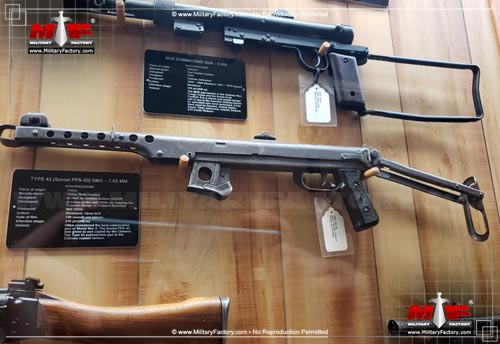
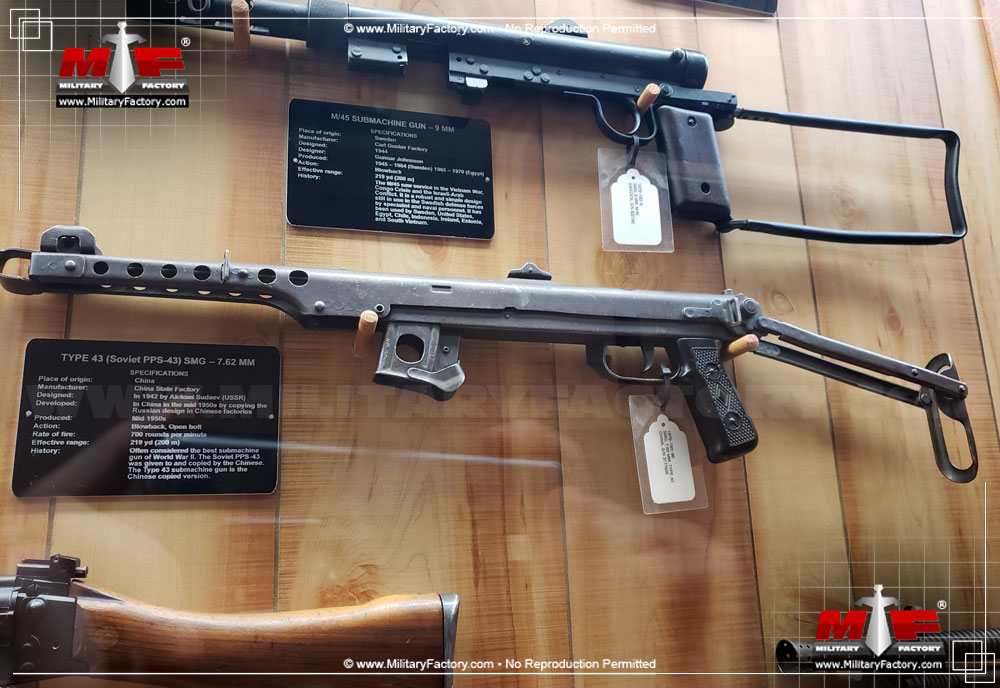
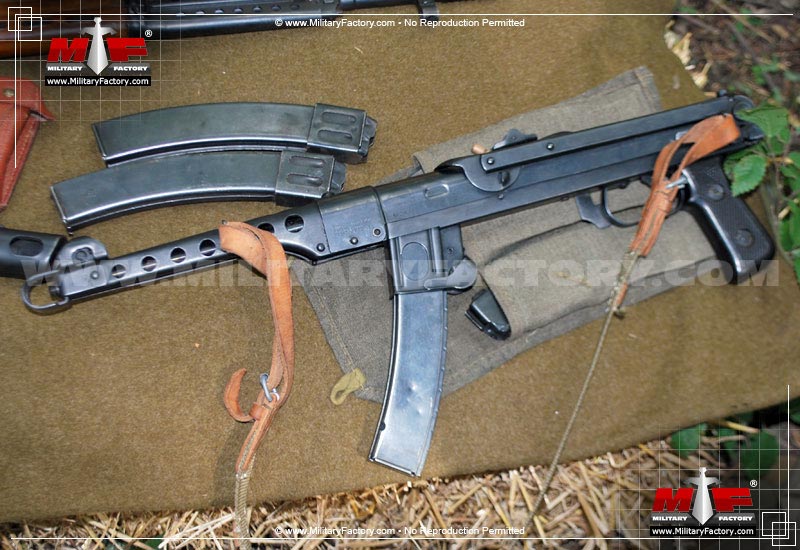
Both weapons fired the 7.62x25mm Tokarev cartridge - the same cartridge used in the Tokarev TT-30 (M1930) pistol. Fire operation was accomplished through automatic blowback with an open bolt. Both weapons also fired from the same curved 35-round detachable box magazine. Despite their similarities with the PPSh-41, neither of the PPS submachine guns were designed to accept the PPSh-41 magazines including its ammunition drum forms. The PPS-42 and PPS-43 models both featured a folding metal stock, which sat over the receiver and brought the overall length of the weapon down to a more compact manageable size. The magazine well was also extended from the body of the weapon to act as a makeshift foregrip for two-handed control. A distinct design feature of both PPS models was the forward position of the magazine, sitting a good distance away from the pistol grip and trigger group. A muzzle break and perforated heat shield were part of the integrated body components as were a pair of iron sights. The sights consisted of a forward-mounted fixed blade and a rear-fitted flip sight.

As can be expected with Soviet equipment achieving any level of success, the PPS series was produced in quantity throughout the Warsaw Pact as well as allied nations of the Soviet Union. The submachine gun was produced in China as the Type 54 and in Finland as the M/44. The M/44 served as the basis for the Spanish DUX-53 and DUX-59 submachine guns used in West Germany. Vietnam produced the submachine gun as the K-50M based on the Chinese Type 54. Poland produced the PPS-43 under license and also offered a modified form of the submachine gun as the PPS wz.43/52.
Text ©2003-2013 www.MilitaryFactory.com • All Rights Reserved • No Reproduction Permitted
MilitaryFactory.com does NOT sell equipment/weaponry. Material presented throughout this website is for historical and entertainment value and should not to be construed as usable for hardware restoration, maintenance or general operation. Please consult manufacturers for such information. Our disclaimer. Email corrections / Comments to MilitaryFactory at Gmail dot com.
Picture of PPS-42 / PPS-43
View All Images (1)

Specifications for the
PPS-42 / PPS-43
Submachine Gun


Country of Origin: Soviet Union
Manufacturer: State Factories - Soviet Union
Initial Year of Service: 1942


Overall Length: 907mm (35.71in)
Barrel Length: 273.00mm (10.75in)
Weight (Empty): 6.50lbs (2.95kg)


Cartridge: 7.62x25mm Tokarev
Action: Blowback; Open Bolt
Feed: 35-round detachable box magazine
Muzzle Velocity: 1,640ft/sec (500m/sec)
Rate-of-Fire: 600 rounds per minute
Range: 492ft (150m; 164yds)
Sights: Fixed Blade Front; Flip Rear


Variants:
PPS-42 - Chambered for 7.62x25mm Tokarev pistol cartridge; 35-round curved box magazine; muzzle brake and perforated heat shield; iron sights; metal folding stock.


PPS-43 - Modernized PPS-42 appearing in 1943; shortened barrel and stock; simplified stock locking mechanism; improved safety.

Type 54 - Chinese Production PPS

M/44 - Finnish Production PPS-43; 9x19mm Parabellum cartridge; box or drum magazines.

PPS wz. 43/52 - Poland development of modified PPS-43; fixed wooden buttstock with internal cleaning kit.

DUX-53 - Spanish copies of Finnish M/44.

DUX-59 - Spanish copies of Finnish M/44.

K-50M - Vietnamese submachine guns developed from the PPS.

M53 - Unsuccessful Hungarian version of the PPS-43 modified with bolt safety of the PPSh-41.


Operators: Albania; Bulgaria; Czechoslovakia; Nazi Germany; East Germany; West Germany; Hungary; Poland; Romania; Soviet Union; Russia

ALL SMALL ARMS CATEGORIES

BY YEAR:


1700 to 1799
1800 to 1899
1900 to 1909
1910 to 1919
1920 to 1929
1930 to 1939
1940 to 1949
1950 to 1959
1960 to 1969
1970 to 1979
1980 to 1989
1990 to 1999
2000 to 2009
2010 to 2019
VIEW ALL
Compare Guns


BY TYPE:


Anti-Aircraft Weapons
Anti-Material Rifles
Anti-Tank Weapons
Automatic Rifles
Bolt-Action Rifles
Carbine Guns
Flamethrowers
Flintlock Guns
Grenade Launchers
Hand Grenades
Lever-Action Rifles
Machine Guns
Mortars
Musket Guns
Pistols / Handguns
Recoilless Rifles
Revolvers
Rocket Launchers
Shotguns
Silenced Guns
Sniper Rifles
Special Weapon Systems
Submachine Guns
VIEW ALL


SPECIAL:


18th Century Warfare
3 Soldiers Statue
Battle of Mogadishu
Chainmail Armor
Firearm Types Defined
French Military Victories
Medieval Crossbow
Medieval Longbow
Vietnam War Casualties
Vietnam War Memorial

WORLD WAR 2:


British Guns
French Guns
German Guns (ALL)
German Rifles
Italian Guns
Japanese Guns
Soviet Guns
US Guns
US Infantry Regiment-Level Guns
Machine Guns
Pistols
Submachine Guns
Sniper Rifles
VIEW ALL


WORLD WAR 1:

Pistols
Rifles
Machine Guns
Mortars
US Guns
VIEW ALL


KOREAN WAR:

Machine Guns
VIEW ALL


VIETNAM WAR:

Mortars
VIEW ALL


COLLECTIONS:


Ancient Weapons
British SAS Weapons
Civil War Guns
Colt Guns
Glock Guns
GROM Polish Special Forces
Guns of Libya
Guns of North Korea
Guns of Syria
Guns of WW1 & WW2
Heckler & Koch Guns
Kalashnikov Guns
Modern Russian Guns
Navy SEAL Weapons
Spetsnaz Weapons
Weapons of Desert Storm
Wild West Guns
Winchester Guns


HOLLYWOOD/GAMES:


Guns of the Walking Dead

Site Disclaimer | Privacy Policy | Site Map | MF Origins


©2013 www.MilitaryFactory.com • Content ©2003-2013 MilitaryFactory.com • All Rights Reserved • Site Contact Email: militaryfactory at gmail dot com. The "Military Factory" name and MilitaryFactory.com logo are registered ® trademarks and protected by all applicable domestic and international intellectual property laws.


Top MF Stuff: 2013 Military Pay Scale | Military Ranks | WW2 Weapons | Sniper Rifles | Kts to Mph | WW1 Aircraft | Automatic Rifles | Aircraft Cockpits | Vietnam War Weapons | Main Battle Tanks | Submachine Guns | Shotguns | French Military Victories


Most photographic images appearing on this site are courtesy of the United States Department of Defense and are approved for public use. Other images acquired through the public domain. Digital art work courtesy of Dan Alex. Business Consulting by Kyle Williams. Material presented throughout this website is for historical and entertainment value and should not to be construed as usable for hardware restoration, maintenance or general operation. Please consult manufacturers for such information.


eXTReMe Tracker