Military Factory
Military Pay Chart
Global Firepower
Military Industrial Complex
Second World War
Home
Military Pay Scale
Military Ranks
Small Arms
Aircraft
Land Systems
Navy
Education
Military Factory Facebook Logo
flag of United States

USS Wasp (CV-7) Aircraft Carrier (1940)

Authored By Staff Writer | Last Updated: 5/9/2013

The USS Wasp CV-7 was lost to enemy actions on September 15th, 1942.

Find a School Near You
Follow Military Factory on Facebook:
Trending on Military Factory:
Recent Articles:
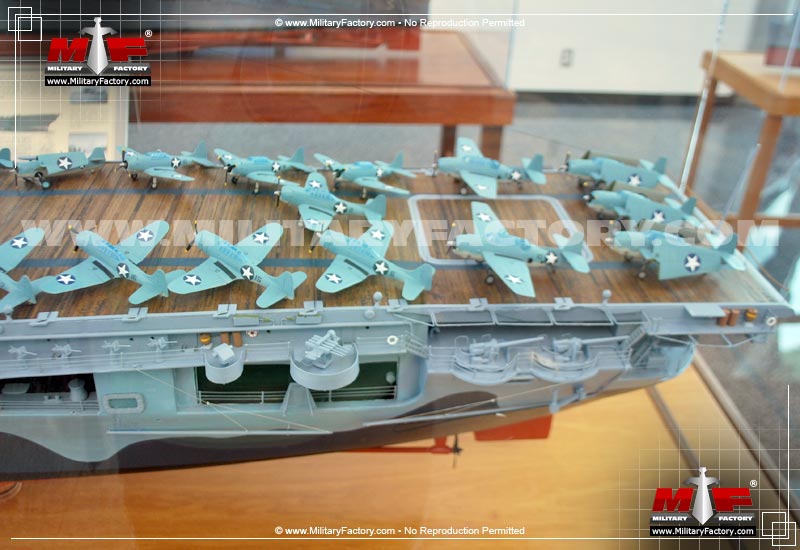
The USS Wasp (CV-7) was a conventionally aircraft carrier in service with the United States Navy during World War 2. She was classified as a "light" fleet aircraft carrier and was completed with light armor protection but could ferry, launch and recover over 70 aircraft of various types. She participated in Allied actions in Atlantic, Mediterranean and Pacific waters before ultimately meeting her end at the hand of the Imperial Japanese Navy in the fall of 1942. As such, she led a short operation tenure with the USN but her contributions to the early phases of the war for America could not be more recognized.

The Washington Naval Treaty and Its Limitations

The Washington Naval Treaty was a global pact signed by the world powers of the time - the United States, the United Kingdom, the Empire of Japan, France and Italy - in an attempt to head off another arms race that beget World War 1 (1914-1918). The ball was already rolling on ever more powerful ships in the inventories of the United States, Britain and Japan and another arms race was seemingly in the works. The idea was to limit the overall tonnage of warships as well as their inherent weaponry. The treaty was signed in February 1922 and modified as the London Naval Treaty in 1930 and, again, in 1936. Each of the participating five nations were assigned tonnage limitations for their capital warships and aircraft carriers - the United States and Britain were each limited to 525,000 tons while Japan was given 315,000 of tonnage. France and Italy each accepted 175,000 tonnage limitations. Germany, having been labeled the sole responsible party for World War 1, was already saddled by the restrictions imposed by the Treaty of Versailles.

Regardless, nations went to work behind the scenes to create powerful navies of the new age. The Empire of Japan bypassed the naval treaty's limitations and ultimately excluded their participation in the treaty altogether. Similarly, the German Navy was being reborn as Adolph Hitler rose to power, first as Chancellor of Germany, then as its dictator. The Empire of Japan ultimately fielded their impressive IJN Yamato battleship and Germany, their KMS Bismarck - both to make their own unique splash in the upcoming world war.

The USS Wasp

As such, the United States commissioned a new light fleet carrier to be built on speed and light armor protection but within the remaining tonnage limitations as stipulated by the Washington Naval Treaty. The result was the USS Wasp of 14,700 tons. The USS Wasp was laid down on April 1st, 1936 at the Fore River Shipyard in Quincy, Massachusetts. She was launched on April 4th, 1939 and formally commissioned on April 25th, 1940 with Captain John Reeves at the helm.

Dimensions and Machinery

When she was launched, the USS Wasp displaced upwards of 14,900 tons, just within the allowable limit of the Washington Naval Treaty. She featured a running length of 688 feet with a beam reaching out to 80 feet, 9 inches. Her draught was 20 feet. Dimensionally, the USS Wasp was one of the smaller carriers of the US Navy. Her machinery consisted of 6 x boilers feeding 2 x Parsons steam turbines powering 2 x propeller shafts developing 70,000 shaft horsepower. This allowed for a top speed of nearly 30 knots with a range of approximately 14,000 miles. The vessel was normally crewed by as many as 1,800 enlisted sailors and naval officers but this value easily ballooned to 2,100 during wartime.

USS Wasp Design

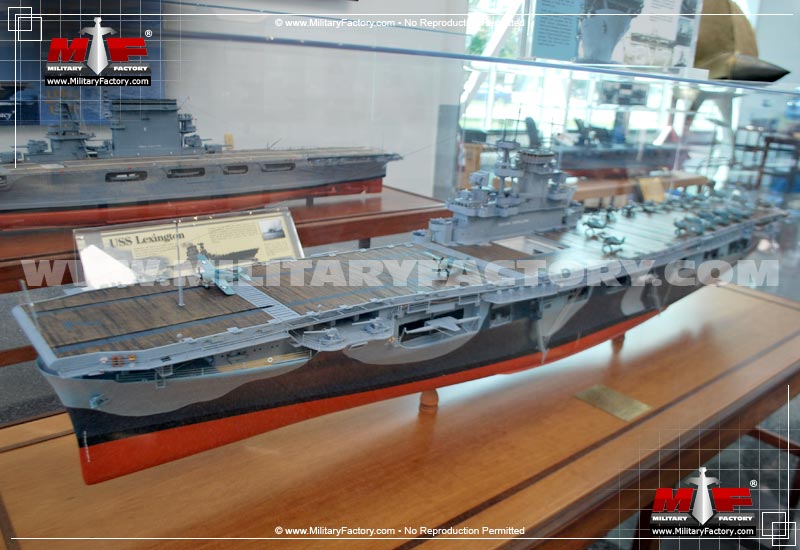
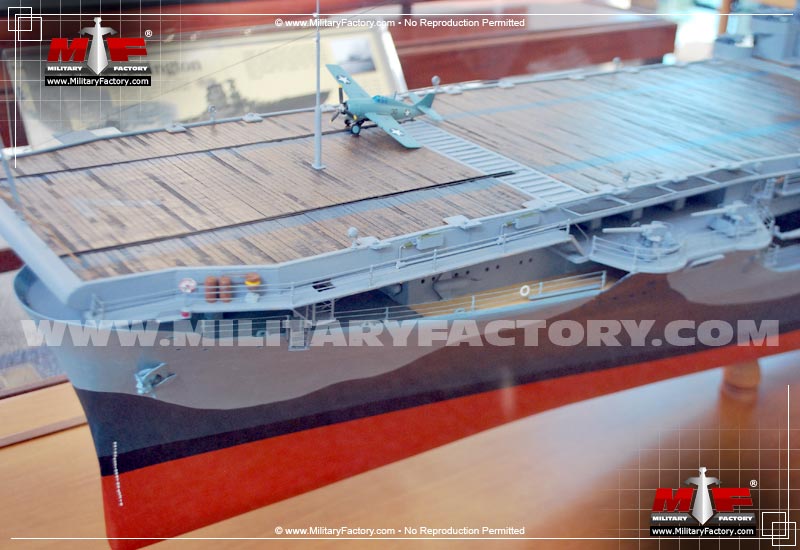
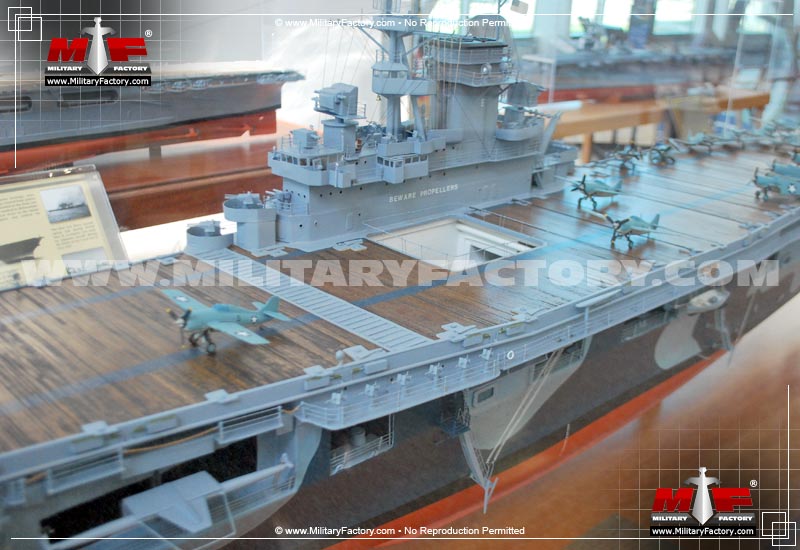
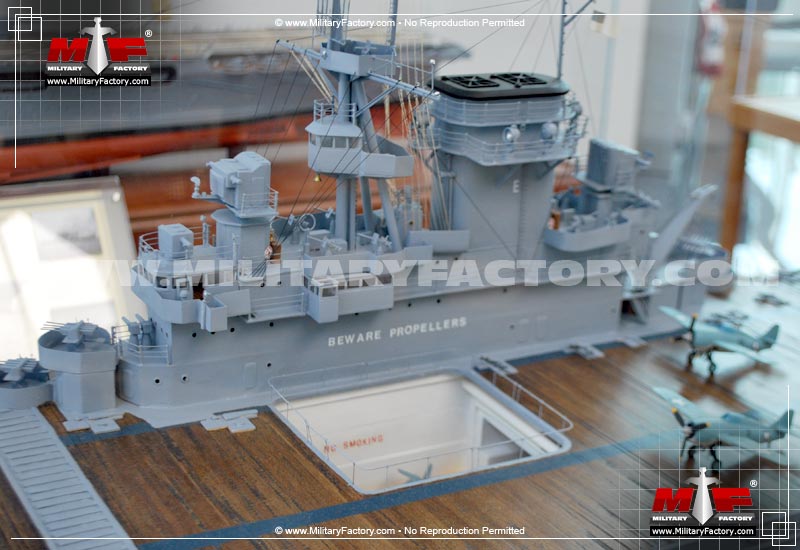
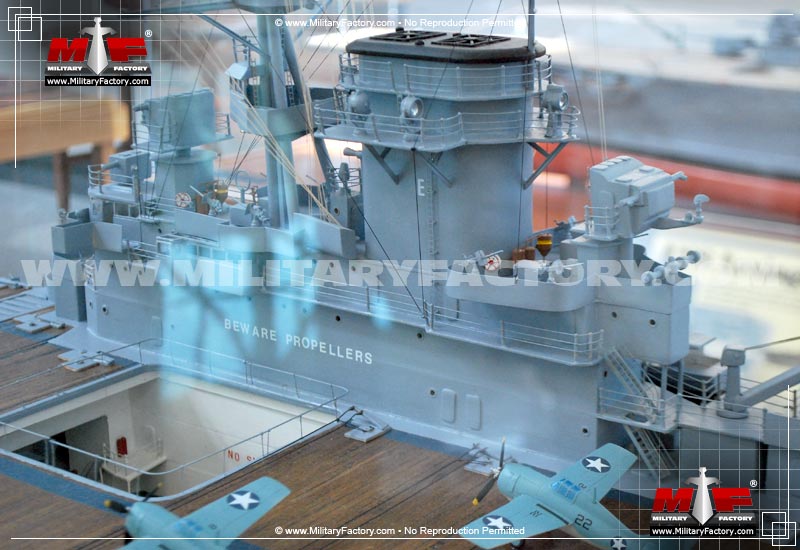
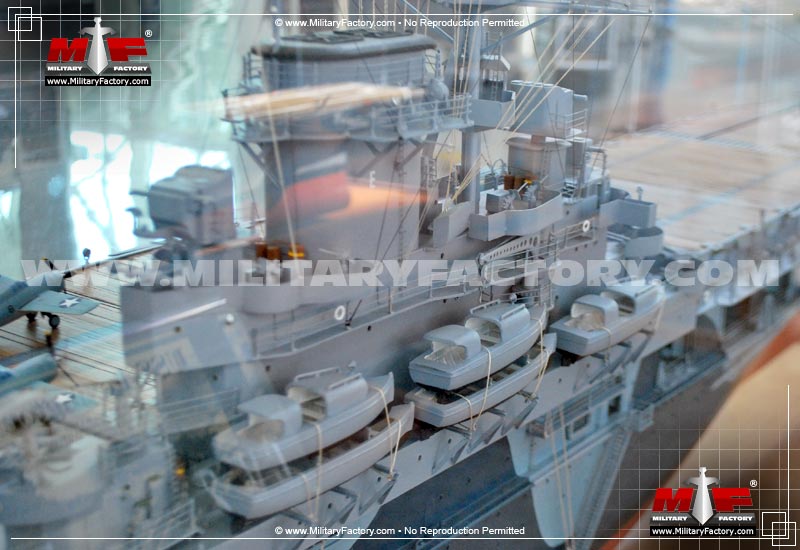
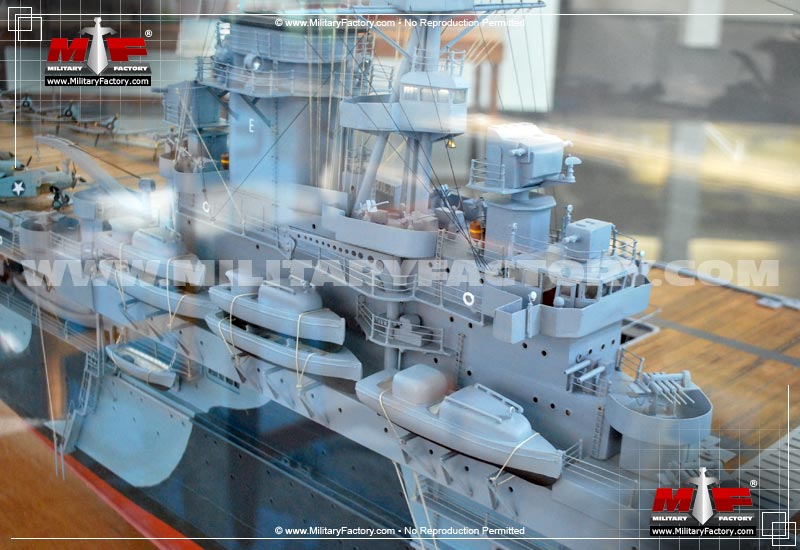
Externally, the design of the USS Wasp was quite conventional by any standard. The island superstructure was offset to the starboard side and centered at amidships. A distinct feature of the island was its rather tall smoke exhaust funnel. All communications arrays and main defensive armament was centered at or near the superstructure to keep the flight deck as open as possible. The flight deck itself was a flat rectangular shape from bow to stern.

Offensive Arrangement

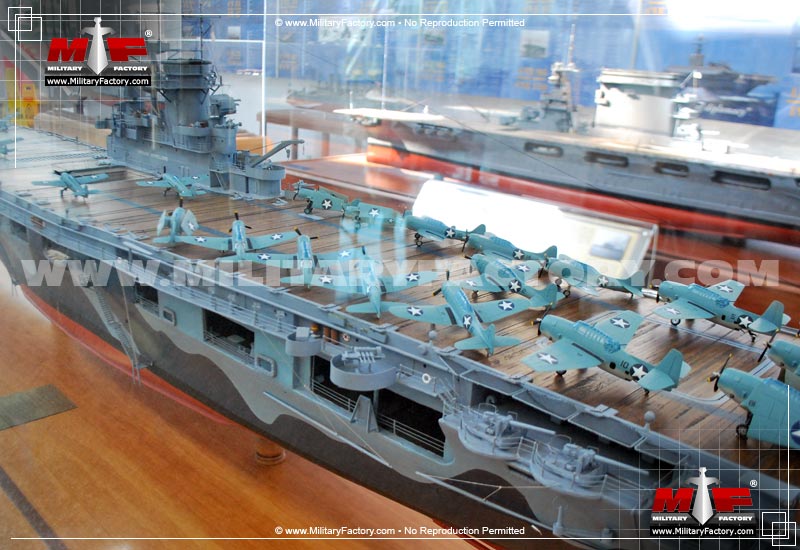
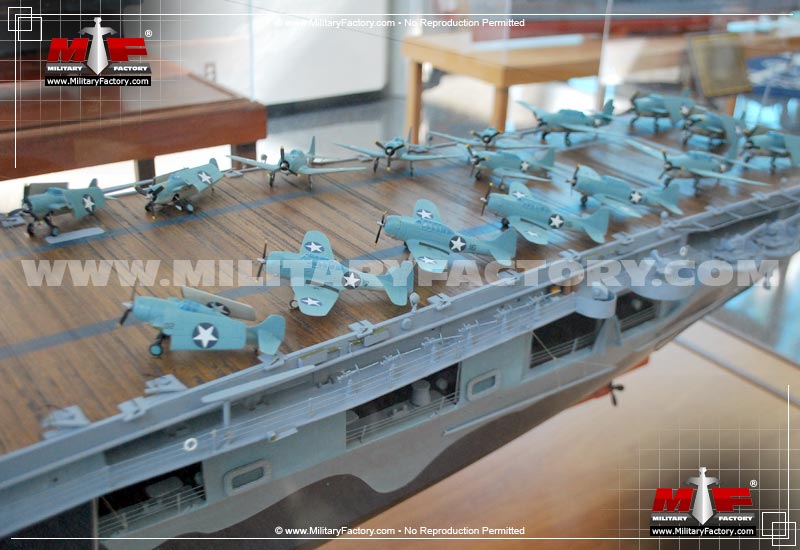
Offensively, the USS Wasp managed 75 to 80 aircraft of various types to include fighters (30), dive bombers (36) and torpedo bombers (14). Each played a distinct role in operations ranging from fleet protection, reconnaissance, bomber escort, anti-ship assaults and the like. Three powered elevators serviced the flight deck and four hydraulic catapults helped to send aircraft aloft and recover incoming flights. Aircraft could be launched from the two catapults atop the flight deck or the two catapults installed on the hangar deck.

Defensive Armament and Systems

Defensively, the USS Wasp was completed with CXAM-1 radar - the first such production surface radar installed on any US Navy ships. Defensive-minded armament consisted of 8 x 5" (130mm)/38 caliber main guns for dealing with enemy surface ships. Anti-aircraft aircraft protection began with the 16 x 1.1" (28mm)/75 caliber cannons which were further backed by no less than 24 x 0.50 caliber (12.7mm) heavy machine guns. Beyond fleet support vessels and aircraft cover, these weapons served as the last line of defense for the carrier crew from attacks delivered by enemy torpedo planes and dive bombers. Armor protection ran at 102mm (4 inches) at her belt while the flight deck and lower decks were allotted 38mm (1.5 inches) of armor plating. All told, the USS Wasp was completed with very little armor protection and even less protection from underwater torpedo attack.

America Enters the War

The world was already becoming an unsettling place by the late 1930s. The Empire of Japan attacked sovereign nations and colonial possessions to secure the natural resources it needed and to expand its position and influence in the Pacific region. In Europe, Germany and Italy both adopted empirical attitudes all their and preceded to conquer neighboring countries and territories in Africa. The Untied States, having adopted a rather stout policy of isolationism following their bloody involvement in World War 1, stood on the sidelines under the surprise Japanese attack on Pearl Harbor on December 7th, 1941 thrust them into the fold.
Continue to Page 2 (of 2) >>
Text ©2003-2013 www.MilitaryFactory.com • All Rights Reserved • No Reproduction Permitted
MilitaryFactory.com does NOT sell equipment/weaponry. Material presented throughout this website is for historical and entertainment value and should not to be construed as usable for hardware restoration, maintenance or general operation. Please consult manufacturers for such information. Our disclaimer. Email corrections / Comments to MilitaryFactory at Gmail dot com.
Picture of USS Wasp (CV-7)
Pic of the USS Wasp (CV-7)
Image of the USS Wasp (CV-7)
View All Images (8)

Specifications for the
USS Wasp (CV-7)
Aircraft Carrier


Country of Origin: United States
Initial Year of Service: 1940
Operators: United States


Crew: 2,167


Length: 741.2ft (225.92m)
Beam: 109ft (33.22m)
Draught: 20ft (6.10m)
Displacement: 14,900tons


Machinery: 6 x boilers with 2 x Parsons steam turbines delivering 70,000 shaft horsepower to 2 x shafts.

Surface Speed: 29.5kts (34mph)
Range: 14,000miles (22,531km)


Armament:
8 x 5-inch (130mm)/38 caliber Dual-Purpose cannons in single mounts.
16 x 1.1-inch (28mm)/75 caliber anti-aircraft cannons in single mounts.
24 x .50-inch (13mm) anti-aircraft machine guns.


Air Arm: 75 to 80 aircraft of various makes and types.

30 Fighters
36 Dive Bombers
14 Torpedo Bombers


Ship Class: Wasp-class
Number-in-Class: 1
Ships-in-Class: USS Wasp (CV-7)

ALL NAVY SHIP CATEGORIES
Site Disclaimer | Privacy Policy | Site Map | MF Origins


©2013 www.MilitaryFactory.com • Content ©2003-2013 MilitaryFactory.com • All Rights Reserved • Site Contact Email: militaryfactory at gmail dot com. The "Military Factory" name and MilitaryFactory.com logo are registered ® trademarks and protected by all applicable domestic and international intellectual property laws.


Top MF Stuff: 2013 Military Pay Scale | Military Ranks | WW2 Weapons | Sniper Rifles | Kts to Mph | WW1 Aircraft | Automatic Rifles | Aircraft Cockpits | Vietnam War Weapons | Main Battle Tanks | Submachine Guns | Shotguns | French Military Victories


Most photographic images appearing on this site are courtesy of the United States Department of Defense and are approved for public use. Other images acquired through the public domain. Digital art work courtesy of Dan Alex. Business Consulting by Kyle Williams. Material presented throughout this website is for historical and entertainment value and should not to be construed as usable for hardware restoration, maintenance or general operation. Please consult manufacturers for such information.


eXTReMe Tracker