Military Factory
Military Pay Chart
Global Firepower
Military Industrial Complex
Second World War
Home
Military Pay Scale
Military Ranks
Small Arms
Aircraft
Land Systems
Navy
Education
Military Factory Facebook Logo
flag of United States

USS San Diego (CL-53) (CLAA-53) Light Cruiser / Light Anti-Aircraft Cruiser (1942)

Authored By JR Potts, AUS 173d AB | Last Updated: 5/9/2013

The second-most decorative USN ship of World War 2 became the storied USS San Diego light cruiser.

Find a School Near You
Follow Military Factory on Facebook:
Trending on Military Factory:
Recent Articles:
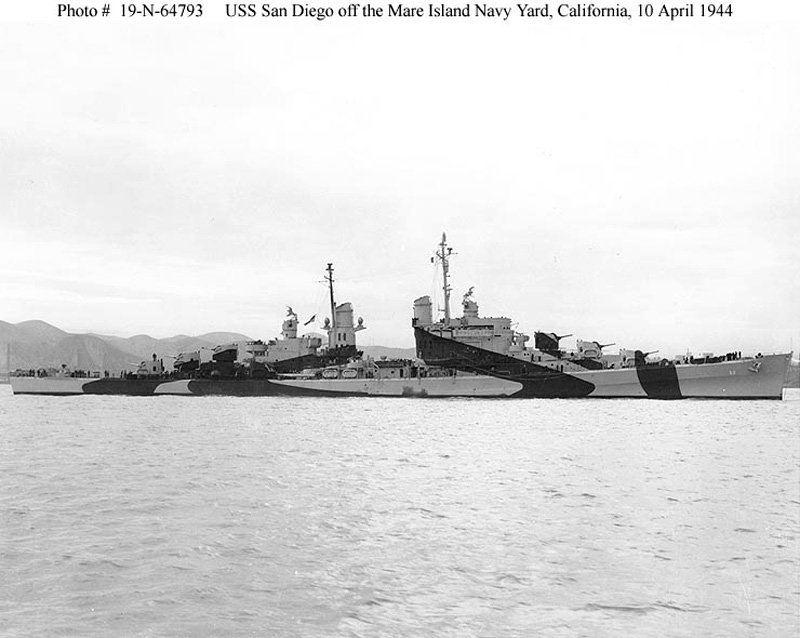
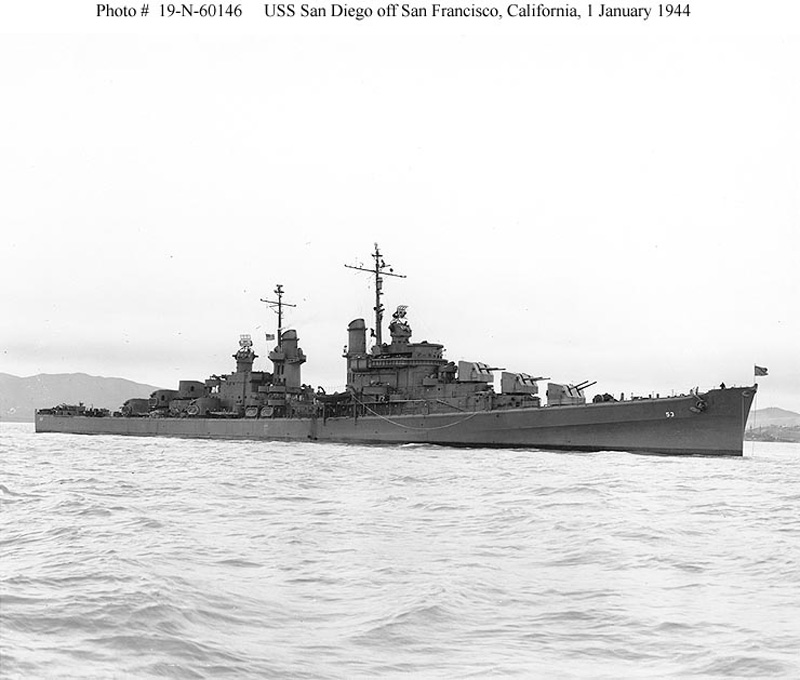
By the time World War 2 had ended in 1945, the USS San Diego (CL-53) would become the second-most decorated ship in the history of the United States Navy (USN). Prior to the war, a naval race was underway with both Germany and Japan building powerful navies in preparation for war. The War Department informed American President Franklin Delano Roosevelt of the threat to which, in 1938, the president signed an appropriations bill from Congress authorizing the building of new American warships. Citizens went to Washington D.C. to request that one of the new vessels be named after the city of San Diego, California. The President agreed and the Navy department formally commissioned one of their cruisers as the USS San Diego (CL-53).

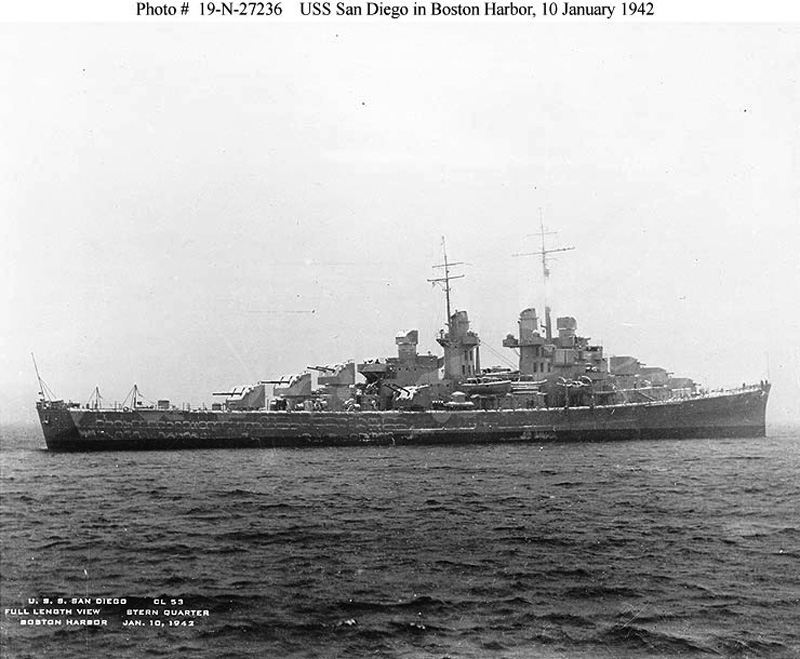
Her keel was laid down on March 27th, 1940, through the Bethlehem Steel Shipyard in Quincy, Massachusetts. The ship when then fitted out at the Boston Navy Yard and, about a month after Pearl Harbor attack (December 7th, 1941) the CL-53 was officially commissioned in a ceremony on a snowy January 10th, 1942. Her full complement of 650 men and officers had been assigned and were present on commissioning day - the crew consisted of green sailors and officers from the Naval Academy as well as reserve officers and experienced Navy petty officers.

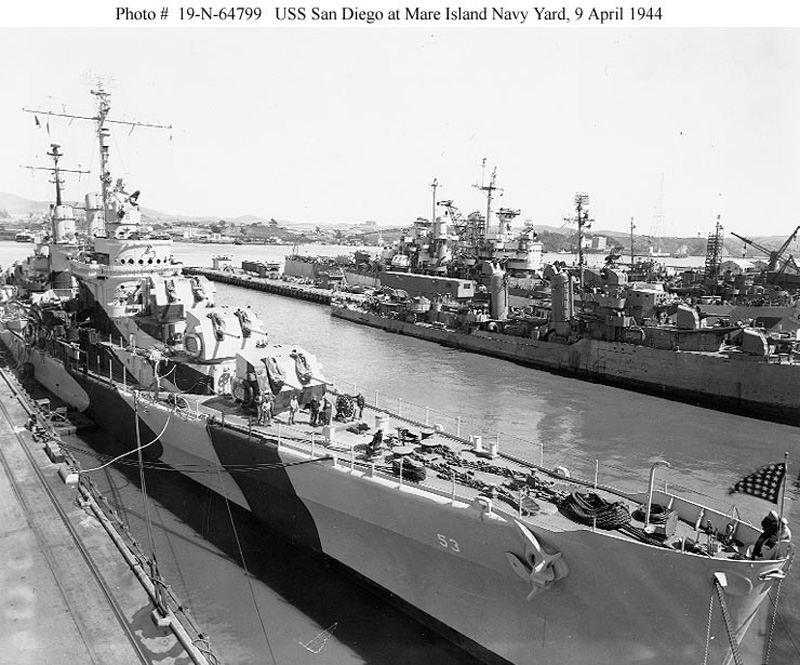
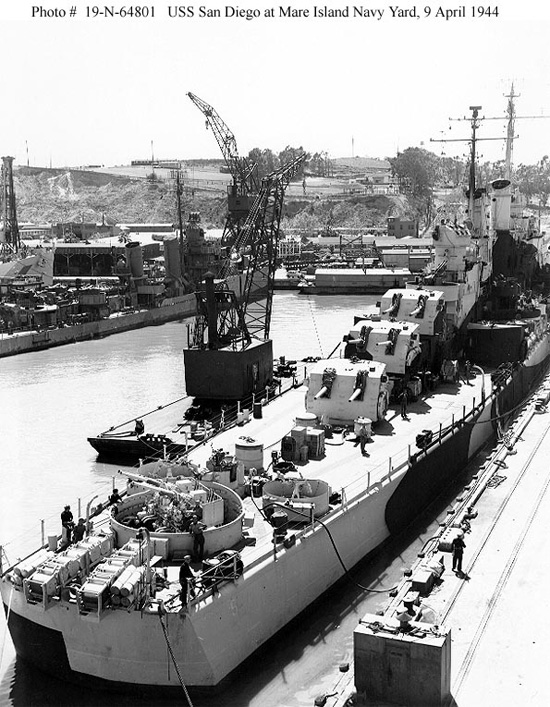
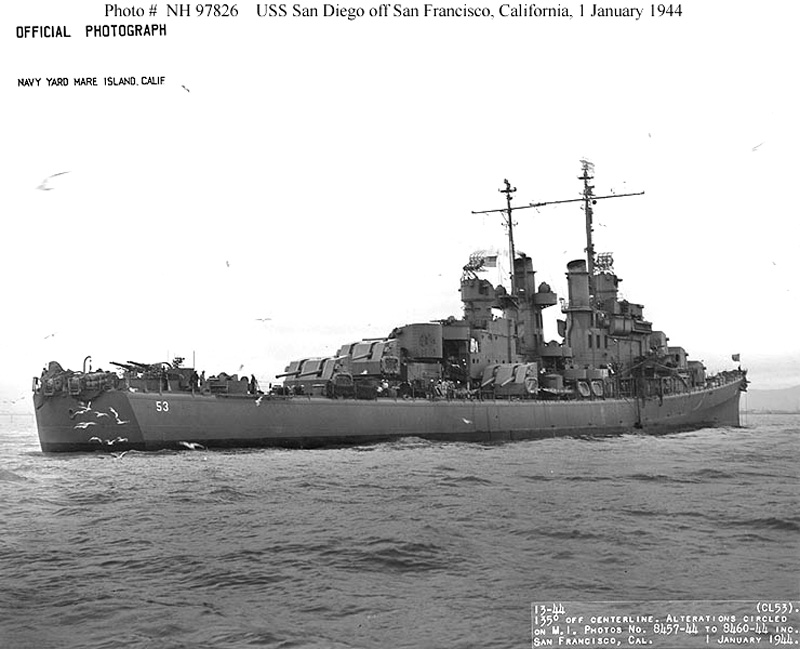
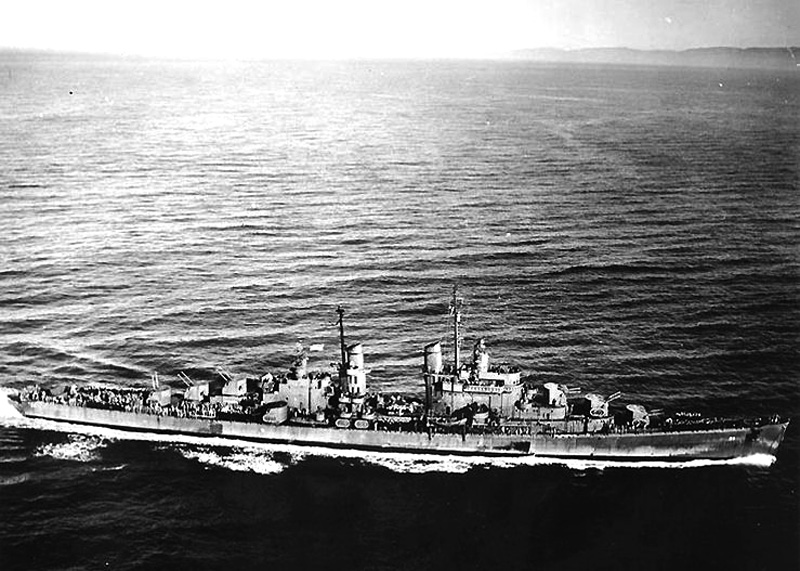
She was the third of eight ships in the Atlanta-Class, a new type of ocean-going cruiser designed to protect aircraft carriers and battleships from attacking enemy aircraft and surface ships through a network of heavy anti-aircraft guns and torpedo. This was a change from the previous 6-inch gun class cruisers built for ship and shore bombardment. Lighter anti-aircraft main guns were chosen; 16 x 5-inch (127mm) /38 cal guns were fitted in 8 x twin gun mounts - three forward and three aft - in a tired effect along centerline. The remaining two turrets were mounted at starboard and along port slightly aft of amidships. The Navy Department considered the dual mounts of the 5-inch (127 mm) /38 cal guns as more effective over the single mounted guns utilized prior. This also created a weight savings through use of eight fewer individual gun mounts distributed over the ship and not all being found on the center line. The complete battery could fire over 17,600 pounds (10,560 kg) of shells per minute, including the new radar-fused "VT" anti-aircraft projectile. This weight savings allowed for additional anti-aircraft weapons to be fitted so 16 x 1.1-inch (28mm) /75 cal guns and 6 x 28mm anti-aircraft cannons completed her arsenal. In a throwback to World War 1-era USN ship design, 8 x 21" torpedo tubes fitted across two quad launchers mounted fore and aft made the Atlanta-class the only USN ships built after 1940 to be armed with torpedoes tubes during the War.

The class was designed with a 3.5-inch armor belt with 2-inches of deck armor. The light cruiser was 541 feet in length with a beam of 53 feet and a draught of 24 feet. Her full load displacement was 8,200 tons full and she could make 30 knots through use of 2 x geared steam turbines generating 75,000 horsepower.

The USS San Diego was ordered to make her training shakedown cruise in the Chesapeake Bay In February of 1942 and, when her construction was wholly completed, she was transferred to the Port of San Diego via the Panama Canal in May of 1942 for final fitting out before reporting to the Pacific fleet. CL-53 left San Diego as an escort for the carrier USS Saratoga to join the carrier force at the Battle of Midway. Even at flank speed CL-53 and Saratoga were not able to reach Midway for the pivotal carrier battle in time, thus missing out on the Battle at Midway. CL-53 was then ordered to proceed to Pearl Harbor, Hawaii and, in mid-June 1942, was assigned as one of the escorts to the carrier USS Hornet (CV-8) for continued operations in the South Pacific.

In late July, the War Department learned that the Japanese were building an airfield on Guadalcanal and quickly rerouted Task Force 61 (TF61) to counter the threat. On August 7th, 1942 the Battle for Guadalcanal officially began as the task force approached Savo Island and Tulagi then to Guadalcanal to the south. This would be the first large scale American invasion force of the war. The Expeditionary Force of 82 ships was commanded by Vice-Admiral Frank Jack Fletcher. Assigned to protect the 23 transports and cargo ships carrying the 19,000 US Marine expeditionary force personnel and their supplies was the USS San Diego plus an additional seven cruisers and fifteen destroyers. The landing was a complete surprise to the Japanese but the defenders soon rebounded to fiercely challenge the American invasion on land, sea and in the air.

After the first phase of Guadalcanal, Task Force 61 was broken up into different commands and USS San Diego was assigned as the USS Hornet's screen when the aircraft carrier USS Wasp was sunk nearby on September 15th, 1942. During the Battle of Santa Cruz Island, the USS San Diego was stationed on the port side of the USS Hornet and unable to protect her starboard side as she was bombed and torpedoed. However, CL-35's five-inch AA guns shot down three enemy planes as they attacked Hornet and the carrier's own crew did their best but in defense but the vessel could not be saved. The USS San Diego moved alongside USS Hornet, making herself a target, and rescued 200 of Hornet's crew while continuing to provide protection from air attack.

USS San Diego then provided anti-aircraft protection to the aircraft carrier USS Enterprise during the definitive naval battle of Guadalcanal from November 12th-15th, 1942. On the morning of November 13th, the Japanese battleship IJN Hiei was attacked repeatedly by USN Grumman TBF Avenger torpedo planes from Henderson Field and additional TBFs and Douglas SBD Dauntless dive-bombers from USS Enterprise. The Hiei had taken a number of hits and started taking on water; the decision was made to have the IJN Kirishima battleship move in with her screen to save IJN Hiei and move her out of the combat zone under tow. Now both Japanese battleships were screened by the cruiser IJN Nagara and accompanying destroyers provided air and submarine protection during the salvage action. However, IJN Hiei continued to flounder and had to be abandoned. Planes from USS Enterprise, supported by USS San Diego, again found Hiei, hitting her with bombs and torpedoes. She sank by the stern north of Savo Island during the evening of November 13th, 1942. The naval battle of Guadalcanal concluded when the IJN retired following all of the eleven participating Japanese troop ships being sunk or beached on Guadalcanal with an estimated loss of 24,000 Japanese troops.
Continue to Page 2 (of 2) >>
Text ©2003-2013 www.MilitaryFactory.com • All Rights Reserved • No Reproduction Permitted
MilitaryFactory.com does NOT sell equipment/weaponry. Material presented throughout this website is for historical and entertainment value and should not to be construed as usable for hardware restoration, maintenance or general operation. Please consult manufacturers for such information. Our disclaimer. Email corrections / Comments to MilitaryFactory at Gmail dot com.
Picture of USS San Diego (CL-53) (CLAA-53)
Pic of the USS San Diego (CL-53) (CLAA-53)
Image of the USS San Diego (CL-53) (CLAA-53)
View All Images (7)

Specifications for the
USS San Diego (CL-53) (CLAA-53)
Light Cruiser / Light Anti-Aircraft Cruiser


Country of Origin: United States
Initial Year of Service: 1942
Operators: United States


Crew: 796


Length: 541.7ft (165.11m)
Beam: 53.3ft (16.25m)
Draught: 24ft (7.32m)
Displacement: 6,100tons


Machinery: 2 x Geared steam turbines developing 75,000 horsepower.


Surface Speed: 32kts (37mph)
Range: 0miles (0km)


Armament:
1942:
16 x 5" (127mm) /38 caliber guns in eight twin-mounted turrets (three port inline, three starboard inline, one port/starboard aft of amidships) (2x8).
16 x 1.1" (28mm) /75 caliber guns
8 x 21" (533mm) torpedo tubes

1943:
12 x 5" (127mm) /38 caliber guns in six twin-mounted turrets (three port inline; three starboard inline) (2x6).
16 x 40mm Bofors guns (replacing 1.1" guns)
8 x 21" (533mm) torpedo tubes


Ship Class: Atlanta-class
Number-in-Class: 8
Ships-in-Class: USS Atlanta (CL-51); USS Juneau (CL-52); USS San Diego (CL-53) (CLAA-53); USS San Juan (CL-54); USS Oakland (CL-95); USS Reno (CL-96); USS Flint (CL-97); USS Tucson (CL-98)

ALL NAVY SHIP CATEGORIES
Site Disclaimer | Privacy Policy | Site Map | MF Origins


©2013 www.MilitaryFactory.com • Content ©2003-2013 MilitaryFactory.com • All Rights Reserved • Site Contact Email: militaryfactory at gmail dot com. The "Military Factory" name and MilitaryFactory.com logo are registered ® trademarks and protected by all applicable domestic and international intellectual property laws.


Top MF Stuff: 2013 Military Pay Scale | Military Ranks | WW2 Weapons | Sniper Rifles | Kts to Mph | WW1 Aircraft | Automatic Rifles | Aircraft Cockpits | Vietnam War Weapons | Main Battle Tanks | Submachine Guns | Shotguns | French Military Victories


Most photographic images appearing on this site are courtesy of the United States Department of Defense and are approved for public use. Other images acquired through the public domain. Digital art work courtesy of Dan Alex. Business Consulting by Kyle Williams. Material presented throughout this website is for historical and entertainment value and should not to be construed as usable for hardware restoration, maintenance or general operation. Please consult manufacturers for such information.


eXTReMe Tracker