The historical beginning of the LPH ship - "Landing Platform Helicopter" was in World War 2 in the Pacific Theater of war when smaller escort carriers were produced to augment the first-line aircarft carriers. These escort carriers could also provide support and air cover for troop ships and landing vessels during the amphibious landing campaigns within the region. At times they provided an additional landing deck for the first-line carriers and provided replacement pilots and aircraft to cover battle losses. After World War 2 many of the escort carriers were scrapped to allow the military budget to sustain first-line carriers to be kept on duty. During the Korean War the "helicopter" started coming into its own within the inventory of the US Navy. Aircraft carriers used the helicopter for search and rescue work of downed pilots at sea and on land. The Marine Observation Squadron 6 (VMO-6) used HO35-1 helicopters to remove 154 wounded marines from the field at the Battle of the Chosion Reservoir in November 1950. This was the first time a planned "vertical operation" was used in war and the value of this military helicopter tactic was highlighted to the fullest extent.
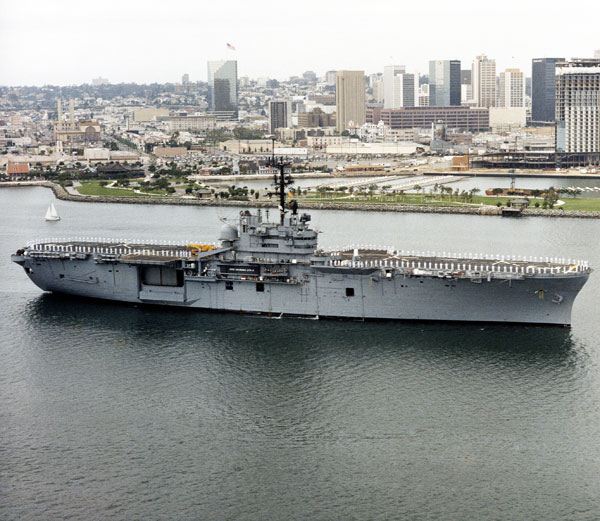
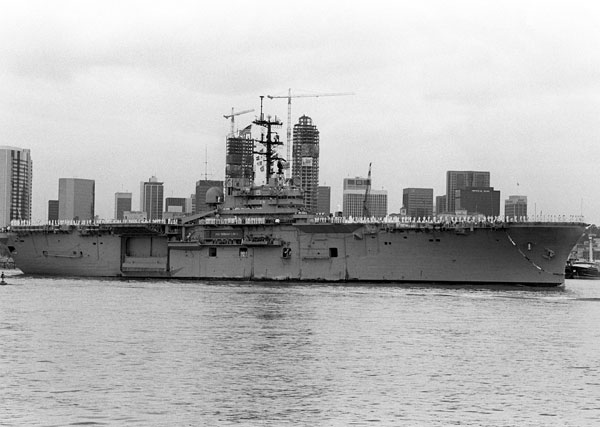
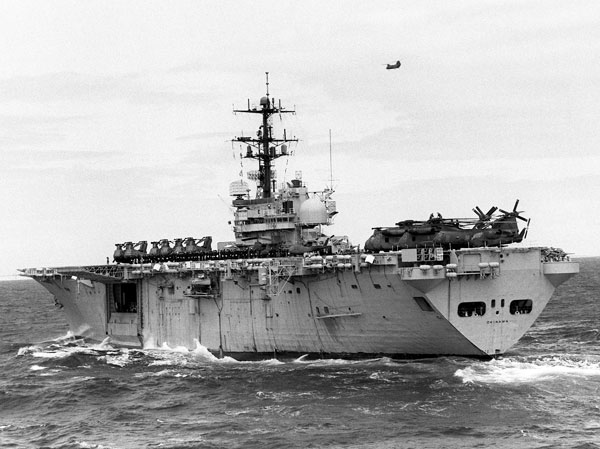
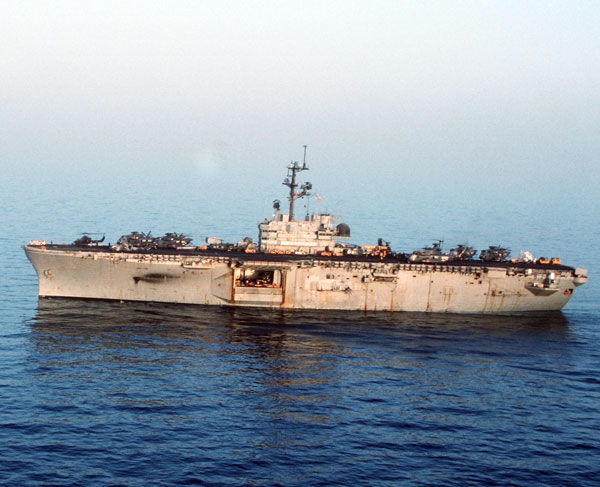
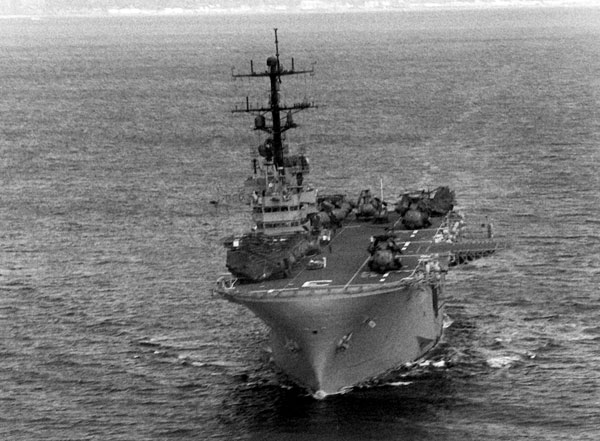
USS Okinawa (LPH-3) was laid down on the 15th anniversary of the invasion of Okinawa at the Philadelphia Naval Shipyard, Philadelphia, Pennsylvania and commissioned on April 14th, 1962 with Captain William E. Lemos at the helm. The Okinawa was the second ship of the Iwo Jima-class LPH. The original Landing Platform title was then replaced by "Amphibious Assault Ship (Helicopter)". The LPH was planned and built for amphibious assault by the vertical envelopment method. The ship was designed to carry 25 helicopters based on mission parameters with the number of helicopters increasing with new upgraded models becoming available. The primary mission of the ship was to deliver a Marine Battalion with its full complement of weapons and support equipment to a battle area by helicopter. Now beach obstructions, flooded fields and poor terrain could be vertically overcome and not delay ground forces for days - some delays requiring dedicated engineers to help traverse an area or clear altogether. The US Navy, being a big proponent of "multiple mission" capabilities, now had a perfect platform to combine fleet missions with that, in the past, had required their own ships to be committed. As combat always leads to casualties, the LPH also served as a Medical Duty Ship (MDS) complete with onboard medical personnel. Being the largest and most equipped ship of her type, the LPH-3 became the (ATFCS) Amphibious Task Force Control Ship for a mission commander to administer an entire operation.
The Iwo Jima-class had a powerplant consisting of two boilers and one geared turbine which turned a single shaft at 22,000 shaft horsepower. Its armament included 3-inch twin barrel cannons, a 20mm Vulcan/Phalanx Close-in Weapons System (CIWS) and a number of 0.50 caliber heavy machine guns. The crew complement consisted of 50 officers and some 650 enlisted personnel to support operations.
The USMC assault battalion made up the "big dog" detachment onboard the ship. To help run this well-oiled fighting machine, a full service headquarters and applicable support departments were deployed aboard as they would have been on land. The commanding officer was a full Colonel or a Lieutenant Colonel with a Major as second in line. A Sergeant Major plus staff comprised the balance of the headquarters company. To support the assault teams there were two artillery companies as well. A total of 1,200 to 2,000 marines could make up the USMC component onboard the vessel, though this varied based on the mission.
While LPH vessels were similar in most respects to their larger brethren - the aircraft carrier - the role of an amphibious assault ship was inherently different. It aviation wings managed helicopters to help deliver and support forces ashore rather than using fixed-wing strike aircraft in direct action. The marines needed a delivery system from sea; no longer would the bloody and vulnerable landing craft actions seen in World War 2 and the Korean War be repeated - in which the loading ramp fell down and exposed the troops to a hail of machine gun fire before they could react. The Vietnam War would instead be America's first "airmobile" helicopter war.
After completing her sea trials, the USS Okinawa sailed from Philadelphia in June of 1962 for her homeport, Norfolk. After a shakedown cruise out of Guantanamo Bay Cuba she returned to Norfolk. The ship departed for her first fleet exercise in the Caribbean in mid-October. Not too long after, Okinawa received the message from headquarters of the "Cuban Missile Crises" and was ordered to join the Cuban Quarantine until December 3rd. She then returned to Norfolk for needed corrective repairs discovered during her "shakedown" cruise. After some 30 days, she was made ready for fleet duty. Okinawa continued to cruse the Caribbean to train her crew and the marines with helicopter launching and recovery; she continued this deployment thru 1963 and into 1964. During June 1964 she sailed to New York for the World's Fair. When the gates opened for the fair 51 million people came to visit. Technology and progress was on full display and into New York harbor arrived the USS Okinawa with her new technology and a couple of thousand military visitors. This was also a demonstration of U.S. naval power to foreign participants at the fair - a sort of propoganda offering if you will.
After a goodwill stop in France and a visit to Plymouth, England, Okinawa arrived back in Norfolk at the end of November. In May of 1965 she was directed to provide support to the area around the Dominican Republic. Dominican armed forces seized the government radio stations in Santo Domingo and attempted to overthrow the ruling civilian junta in favor of deposed former president Juan Bosch. Accordingly, the U.S. government, while trying to arrange for a cease-fire locally and through the OAS Organization of American States in Washington, began immediate preparations for the evacuation of its citizens and other foreign nationals who might wish to leave the Dominican Republic. Okinawa was perfect for this operation and flew missions in support as needed.
In late 1964 Okinawa participated in "Operation Steel Pike I", an amphibious exercise with NATO in Spanish waters that was larger than any previous war game. An amphibious force gathered that consisted of some 60 ships stocked with 22,000 marines and 5,000 vehicles - Okinawa naturally played her part and the Soviets were, of course, closely watching.
Okinawa was then transferred to the Pacific Fleet and sailed on January 24th, 1967 for the West Coast, arriving at San Diego - her new home port - on February 8th. All onboard knew where the next deployment would be - trouble had been brewing in Vietnam for years following World War 2. This period proved a busy time for families of the crew moving to a new home port across the country (those readers having lived the "home front" of military life understand and accept the packing operations and saying goodbye scenarios all too well). Okinawa left on March 10th, 1967 for her first deployment to Vietnam waters. On April 13th, while sailing from Okinawa to Taiwan, the ship was diverted by a distress call and rescued 38 persons from the Panamanian vessel "Silver Peak" that had struck a reef and became grounded near the Sento Shosho Islands. While off Vietnam, Okinawa was served as a mobile base from which a well-equipped force of marines could quickly strike via helicopters at communist insurgent positions. While on station Okinawa was involved in "Operation Hickory" against NVA forces at Khe Sanh, Cam Lo and Hill 158. She continued to support marine operations for a further six years. The techniques developed by the Okinawa demonstrated the amphibious assault can take place at virtually any part of the coast, making defending against such actions almost impossible for the enemy.
USS Okinawa Vietnam War campaign participation included the Vietnamese Counteroffensive - Phase II (18 to 19 April 1967, 18 to 31 May 1967), the Vietnamese Counteroffensive - Phase III (1 to 12 June 1967, 27 June to 15 August 1967, 1 September to 1 November 1967), the Vietnamese Counteroffensive - Phase VI (8 December 1968 to 26 January 1969, 12 to 22 February 1969), the Tet/69 Counteroffensive (23 February to 30 March 1969, 14 April to 27 May 1969), the Sanctuary Counteroffensive (25 to 28 June 1970), the Vietnamese Counteroffensive - Phase VII (15 to 18 July 1970, 23 to 27 July 1970, 9 to 12 August 1970, 8 to 10 September 1970, 12 to 15 September 1970, 4 to 9 October 1970, 5 to 6 November 1970, 23 to 27 May 1971) and the Vietnam Ceasefire (27 April to 30 May 1972, 9 June to 2 July 1972, 9 July to 25 August 1972, 29 September to 1 October 1972, 5 to 20 October 1972, 21 to 22 November 1972).
On 4 April 1968, Okinawa took a break from combat operations in Vietnam to start a period of special training with NASA personnel in the recovery of the unmanned Apollo VI space capsule. The mission was designed as the final test before manned Apollo missions were enacted. The spacecraft was comprised of three stages - the Saturn V booster, the "Command and Service Module" (CSM) and the "Lunder Module" (LM). A problem during the flight occurred to which reentry took place with Okinawa on station 380 miles north of Kauai, Hawaii. The LM was recovered by US Navy SEALs and lifted with a special harness by a MH-53E Sea Stallion helicopter upon the deck of the Okinawa.
History has shown that at least one ship of the Iwo Jima Class has been deployed to all major conflicts since the Vietnam War. The LPH proved itself to be a formable ship and the Navy saw the need for an amphibious assault ship with longer range as well as greater helicopter capacity and began phasing out the current breed of LPHs. Okinawa was therefore decommissioned and stricken from the Naval Vessel Register on December 17th, 1992. The ship was unceremoniously sunk as a floating target in a COMSUBPAC ship sinking exercise (SINKEX) on June 6th, 2002 off the coast of Southern California in 2,020 fathoms. She was struck by an Mk 48 torpedo from SSN-707 Portsmouth. Incidentaly, June 6th also marked the anniversary of the Allied D-Day landings in Northern France to open up the West Front.
The USS Okinawa earned various military awards during her valiant service to the United States of America. These included 2 Combat Action Ribbons, 5 Navy Unit Commendations, 3 Navy Meritorious Unit Commendations, a Navy Battle "E" ribbon and Navy Expeditionary Medals (1 Cuba, 2 Iran/Indian Ocean). Additionally she was the recipient of the National Defense Service Medal, Armed Forces Expeditionary Medal (1 Cuba, 1 Dominican Republic, 1 Operation Eagle Pull, 1 Operation Frequent Wind, 2 Persian Gulf), the Vietnam Service Medal (7), Southwest Asia Service Medal, Humanitarian Service Medal (1 Eagle Pull, 1 Frequent Wind), Philippines Presidential Unit Citation, Republic of Vietnam Gallantry Cross Unit Citation (5), Republic of Vietnam Campaign Ribbons and the Kuwait Liberation Medal.
Power & Performance Those special qualities that separate one sea-going vessel design from another. Performance specifications presented assume optimal operating conditions for USS Okinawa (LPH-3).
2 x 600psi Oil-fired steam boilers powering 1 x geared steam turbine; 1 x shaft producing 22,000 shaft horsepower. Propulsion
22.0 kts 25.3 mph Surface Speed
Structure The bow-to-stern, port-to-starboard physical qualities of USS Okinawa (LPH-3).
700 Personnel Complement
592.0 ft 180.44 meters O/A Length
84.0 ft 25.60 meters Beam
27.0 ft 8.23 meters Draught
18,474 tons Displacement
Armament Available supported armament and special-mission equipment featured in the design of USS Okinawa (LPH-3).
ORIGINAL:
4 x 3" (76mm)(4x2) cannons
LATER:
2 x 20mm Vulcan Close-In Weapon System (CIWS) anti-aircraft cannons.
6 x 12.7mm Anti-Aircraft Machine Guns
Air Arm Available supported fixed-wing / rotary-wing aircraft featured in the design of USS Okinawa (LPH-3).
Mission-Specific aircraft can include:
20 x UH-46D Sea Knight helicopters
10 x MH-53E Sea Stallion helicopters
Ships-in-Class (7) Notable series variants as part of the USS Okinawa (LPH-3) family line as relating to the Iwo Jima LPH-3 class group.
USS Iwo Jima (LPH-2); USS Okinawa (LPH-3); USS Guadalcanal (LPH-7); USS Guam (LPH-9); USS Tripoli (LPH-10); USS New Orleans (LPH-11); USS Inchon (LPH-12)
Operators Global operator(s) of the USS Okinawa (LPH-3). Nations are displayed by flag, each linked to their respective national naval warfare listing.
The "Military Factory" name and MilitaryFactory.com logo are registered ® U.S. trademarks protected by all applicable domestic and international intellectual property laws. All written content, illustrations, and photography are unique to this website (unless where indicated) and not for reuse/reproduction in any form. Material presented throughout this website is for historical and entertainment value only and should not to be construed as usable for hardware restoration, maintenance, or general operation. We do not sell any of the items showcased on this site. Please direct all other inquiries to militaryfactory AT gmail.com. No A.I. was used in the generation of this content.