Military Factory
Military Pay Chart
Global Firepower
Military Industrial Complex
Second World War
Home
Military Pay Scale
Military Ranks
Small Arms
Aircraft
Land Systems
Navy
Education
Military Factory Facebook Logo
flag of United States

USS Monitor (1862) Ironclad Gunboat (1862)

Authored By JR Potts, AUS 173d AB | Last Updated: 5/9/2013

The USS Monitor became a legend when she tangled with the seemingly unstoppable Confederate CSS Virginia during the American Civil War.

Find a School Near You
Follow Military Factory on Facebook:
Trending on Military Factory:
Recent Articles:
Northern spies reported to the US War Department that the Merrimack was being rebuilt as an ironclad. Then Secretary of the Navy, Gideon Welles, confessed his fears that the reborn Merrimack would break through the imposed blockade at Hampton Roads, Virginia, and then steam up the Potomac River to shell the White House itself. Secretary Welles, an accomplished politician, was able to acquire the funding for building Northern ironclads within days and then created the "Ironclad Board" to oversee construction. Secretary Welles charged the board to review ironclad plans and propose to the Navy Department the most promising of these designs. Three were chosen: a casemate design like the French Gloire, eventually to become the USS New Ironsides; a small armored gunboat to be named the USS Galena; and a turreted ironclad to become the USS Monitor, this design brought forth by one John Ericsson. Ericsson maintained a history with the Navy Department, feeling that he had been cheated out of payment for work completed in the past. He was known as a difficult man to deal with but he gained respect by being the recorded inventor of the screw propeller. The board members, themselves a collection of shipbuilders and engineers, were unsure about the radical design submitted by Ericsson for the blueprint represented no other ship built up to that point in history. One of the board members suggested to Ericsson that he add masts and sails as additional propulsion. Ericson refused because he understood that warship building was currently undergoing a revolution of sorts, doing away with masts and sails in favor of self-propulsion. Many of the shipbuilding firms of the time were still tied to wood construction and canvas rigging. Welles spoke to Ericsson in support of his all-iron design and was told "the sea would ride over her and she would live in it like a duck". Still, many other Navy professionals disapproved of the unconventional design. Sitting American President Abraham Lincoln, however, overruled them all and Welles funded the three designs with work to begin immediately.

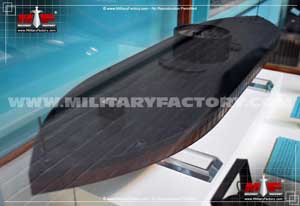
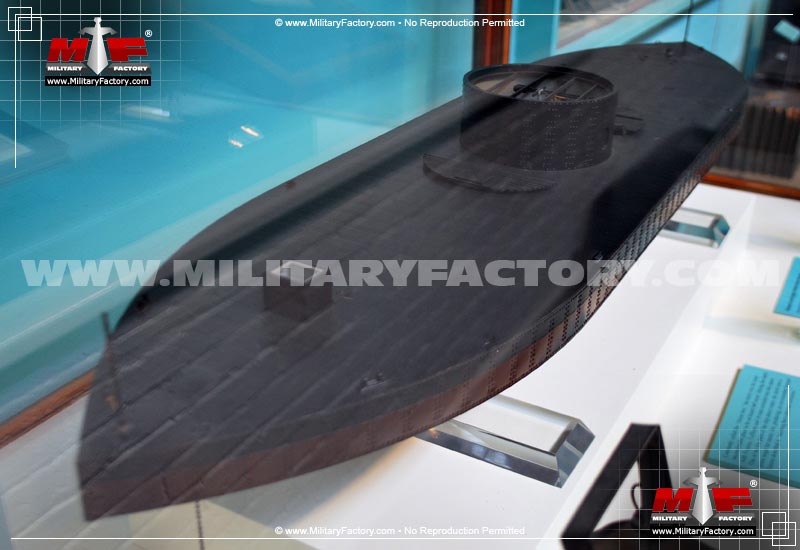
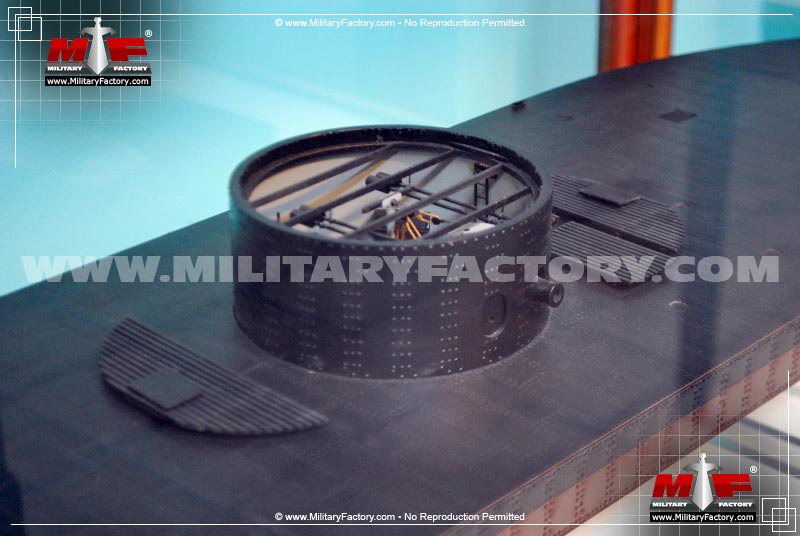
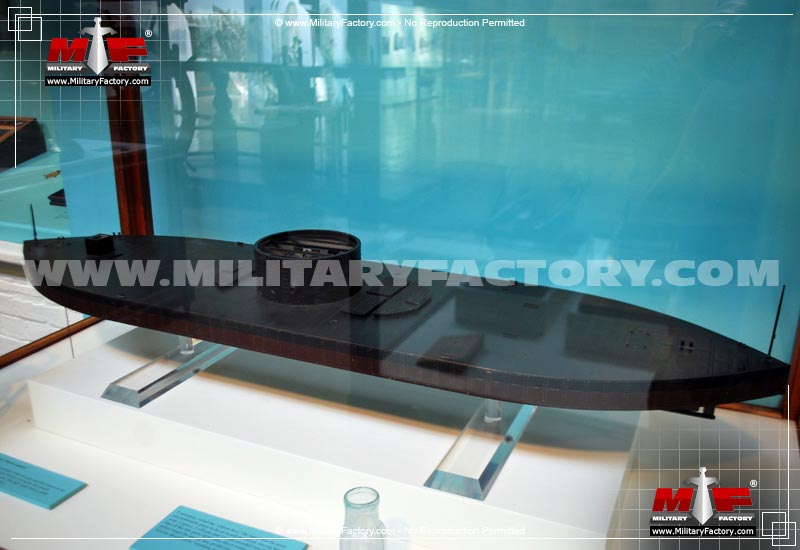
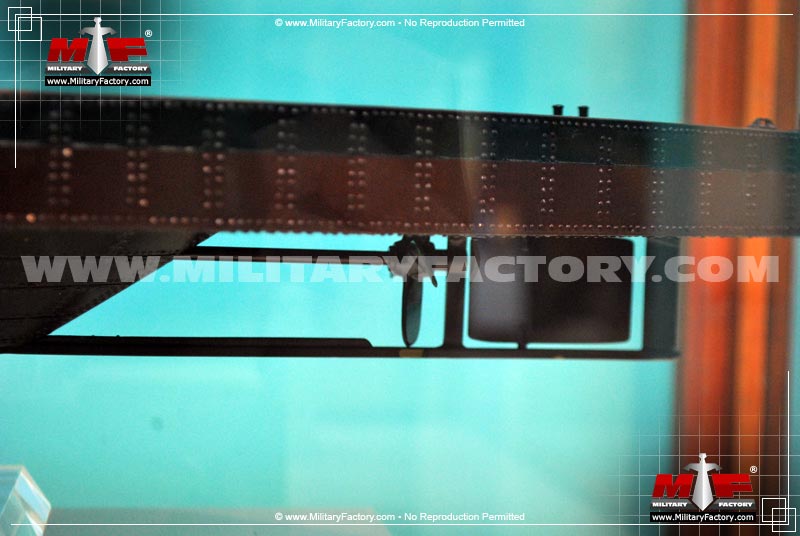
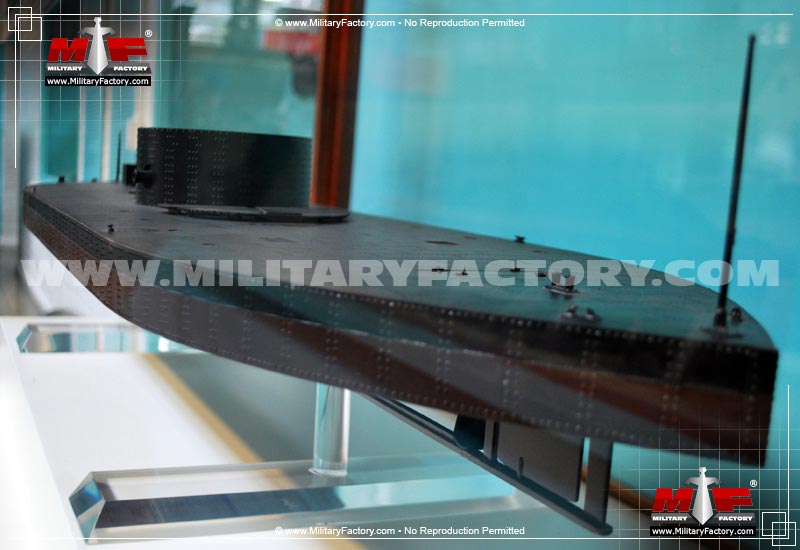
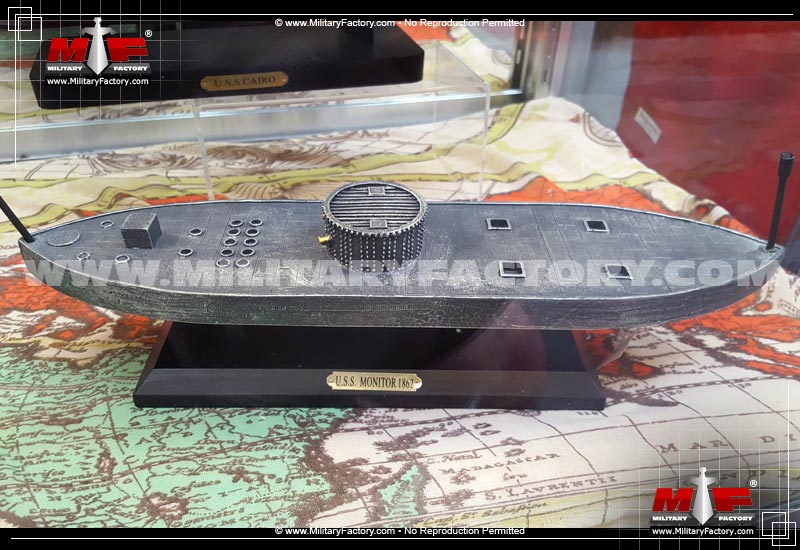
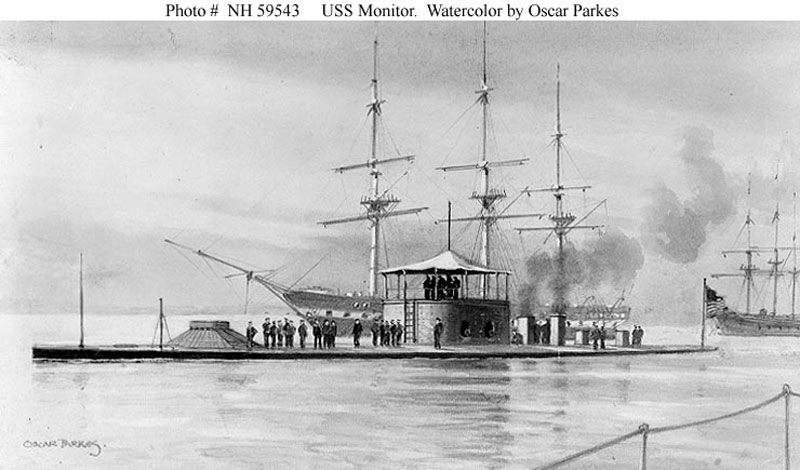
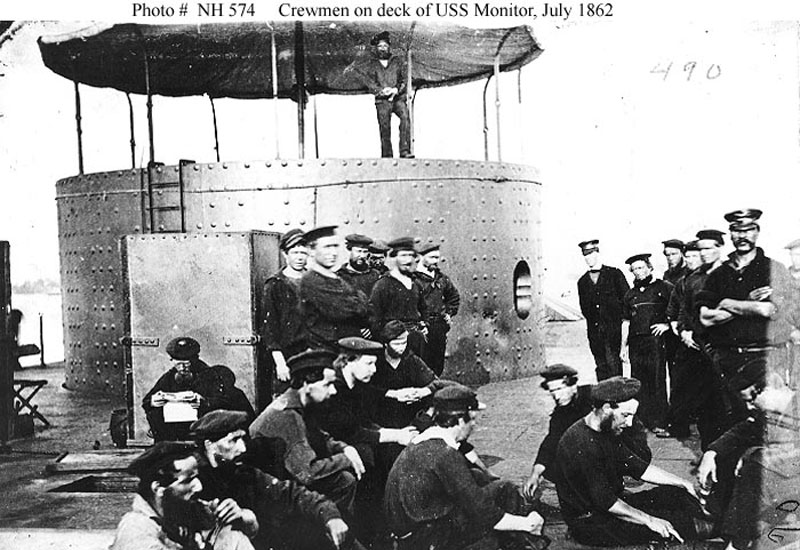
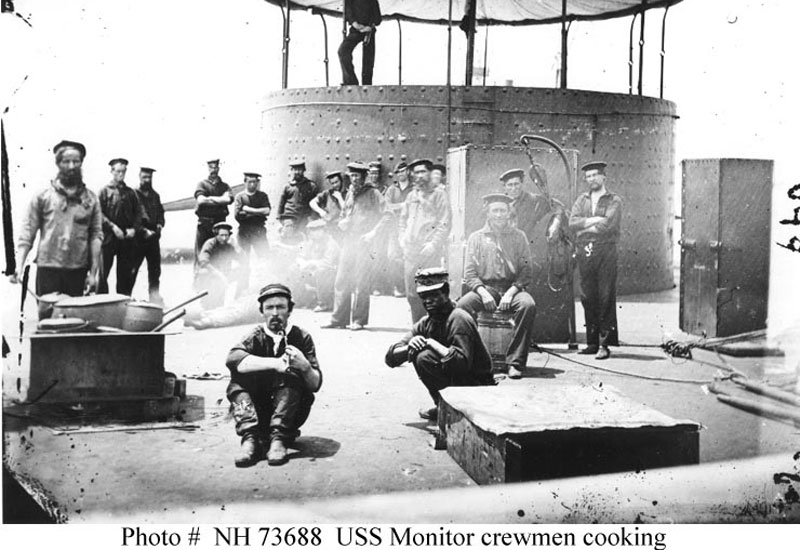
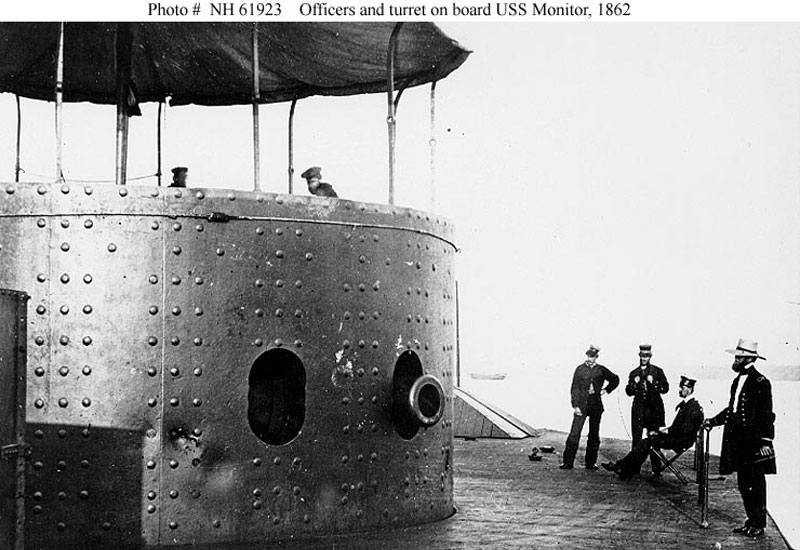
To this point, there was nothing like the USS Monitor on the seas - the vessel alone contained some forty-seven patentable inventions. She was a small, flat, armored-hulled ship with a hat box-looking revolving gun turret. The turret was protected by eight layers of one-inch curved iron plate. The hull was constructed in two parts: the upper deck with .05-inch flat iron plate bolted to iron beams. This deck was fitted to the bottom hull like that of a raft. The freeboard, made to reduce waves washing over the deck, was only 18-inches high and proved ineffective to the point that sea duty could be a crew hazard. The deck armor provided minimal protection from overhead "plunging" fire but she was built as a response to the Confederate CSS Virginia - and not defensive, projectile-lobbing shore batteries. The hull sides fielded 5-inches of iron plate, bolted to 24-inches of oak timbers.

The USS Monitor showcased a shallow draft, allowing her to operate in less than 11 feet of water. Ericsson developed the Monitor's engine, calling it a "vibrating lever", and outputted enough power for the vessel to make 6-knots. The 120-ton, 20-foot diameter turret was the most ingenious invention on the Monitor and was built to rotate a full 360-degrees in 24-seconds using a separate small "donkey" engine. The turret was supported on a central column, or spindle, and rode a few inches above the main deck. Ericsson designed the turret to support two 15-inch Dahlgren smoothbore cannons but, in the end, had to settle for 11-inch caliber Dahlgren types due to availability.

The New York Times called the Monitor "Ericsson's Folly" but one hundred days later on January 30, 1862, thousands came to watch the launching (or sinking as some would have had it) of the iron ship at the Greenpoint Brooklyn NY yard. Ericsson's Monitor was launched into Manhattan's East River before her two rival designs were completed. The hull floated and she looked like a drifting shingle along the surface of the river. She was launched sans turret at this point for the turret was to be mounted sometime later. After the turret was put in place, and when her crew came aboard, her brown water maiden voyage officially began. She steamed to the New York side of the river and turned towards Brooklyn, then back and forth like a drunken man; her crew finding that she would not respond to her rudder control. Adjustments were made onboard and additional short trips from Greenpoint were made until Lieutenant John Worden, commander of the USS Monitor, was fully satisfied.

Fearing the CSS Virginia would attack the Northern blockade, it was decided her blue water shakedown cruise would have to be made on the way to Hampton Roads. Her brave volunteer crew of 49 officers and enlisted men would have to drill and steam along the way at sea. As John Ericsson did not claim his design to be built for ocean going, a plan developed to maneuver her into shallow coastal waters like those found at Hampton Roads. On Thursday March 6th at 11AM, she was towed by the screw tug USS Seth Low out of New York Harbor between Staten Island and Long Island, accompanied by the two wood screw gunboats - the USS Sachem and the USS Currituck - as armed escorts. By 4PM, the flotilla rounded Sandy Hook and entered unprotected waters, steaming south down the New Jersey coast line for the 400-mile journey to Hampton Roads, Virginia.

The Monitor and her escort continued through the night in relatively calm waters. The waves came over the deck due to the low 18-inch freeboard and limited the crew from going out on deck with any degree of safety. By 6AM on Friday March 7th gale wings from the east hammered the Monitor as she was approaching Cape May at the southern end of New Jersey. Lt. Worden wrote in the ship's log "very heavy sea, and ship making heavy weather". The ship started leaking at the base of the turret and water flowed into the engine room. As water spilled into her design like a waterfall, the ventilator system failed and the ship filled with dangerous carbon dioxide fumes, some of the men beginning to faint. Worden was concerned the ship might flounder so the tug USS Seth Low towed Monitor back towards shore and into calmer waters. When Monitor got inside of protected waters, Chief Engineer Isaac Newton was able to vent the engine room of the carbon fumes and restart the engines and pumps, in effect saving the grand ship.

Monitor resumed her southward trip at 8pm Friday night with the gale having passed. The seas were reported as moderate with clear skies and she steamed on at 5 knots. However, by midnight off the Maryland coast, the weather worsened yet again and the seas were breaking over the air vents and smoke stack. As the sea pounded Monitor, the tiller ropes came loose and the Monitor turned broadside into the sea. Worden feared a rogue wave would capsize the ship but the tiller was repaired in time and she was able to steer once again. By dawn on Saturday March 8th, the sea had calmed and Worden had the tug tow her into shallow water so the crew could eat breakfast. Engineer Newton took advantage of the time to pump the Monitor out again and make repairs the best the crew could - the Monitor and her crew would need every ounce of perfection and luck when going into harm's way and facing off against the most powerful ship in the Confederate Navy.
Continue to Page 2 (of 2) >>
Text ©2003-2013 www.MilitaryFactory.com • All Rights Reserved • No Reproduction Permitted
MilitaryFactory.com does NOT sell equipment/weaponry. Material presented throughout this website is for historical and entertainment value and should not to be construed as usable for hardware restoration, maintenance or general operation. Please consult manufacturers for such information. Our disclaimer. Email corrections / Comments to MilitaryFactory at Gmail dot com.
Picture of USS Monitor (1862)
Pic of the USS Monitor (1862)
Image of the USS Monitor (1862)
View All Images (12)

Specifications for the
USS Monitor (1862)
Ironclad Gunboat


Country of Origin: United States
Initial Year of Service: 1862
Operators: United States


Crew: 59


Length: 179ft (54.56m)
Beam: 41.6ft (12.68m)
Draught: 10.5ft (3.20m)
Displacement: 987tons


Machinery: 1 x Vibrating Lever Steam Trunk engine; 1 x Screw Propeller

Surface Speed: 6kts (7mph)
Range: 200miles (322km)


Armament:
2 x 11-pdr (280mm) Dahlgren smoothbore cannons in a rotating turret.


Ship Class: Monitor-class
Number-in-Class: 1
Ships-in-Class: USS Monitor

ALL NAVY SHIP CATEGORIES
Site Disclaimer | Privacy Policy | Site Map | MF Origins


©2013 www.MilitaryFactory.com • Content ©2003-2013 MilitaryFactory.com • All Rights Reserved • Site Contact Email: militaryfactory at gmail dot com. The "Military Factory" name and MilitaryFactory.com logo are registered ® trademarks and protected by all applicable domestic and international intellectual property laws.


Top MF Stuff: 2013 Military Pay Scale | Military Ranks | WW2 Weapons | Sniper Rifles | Kts to Mph | WW1 Aircraft | Automatic Rifles | Aircraft Cockpits | Vietnam War Weapons | Main Battle Tanks | Submachine Guns | Shotguns | French Military Victories


Most photographic images appearing on this site are courtesy of the United States Department of Defense and are approved for public use. Other images acquired through the public domain. Digital art work courtesy of Dan Alex. Business Consulting by Kyle Williams. Material presented throughout this website is for historical and entertainment value and should not to be construed as usable for hardware restoration, maintenance or general operation. Please consult manufacturers for such information.


eXTReMe Tracker