Global Firepower | Military Industrial Complex | Second World War History
Home | Military Pay Scale Chart | Aircraft | Infantry Weapons | Military Vehicles | Navy Ships | Military Education | French Military Victories | Military Ranks | WW2 Weapons
Military Factory Latest from Military Factory
Thumbnail picture of the Dardo infantry fighting vehicle
Dardo IFV
Thumbnail picture of the Supermarine Scimitar fighter
Supermarine Scimitar
Thumbnail picture of the Centauro B1 8x8 tank killer
Centauro 8x8
Thumbnail picture of the Novi Avion fighter
Novi Avion
Thumbnail picture of the FR F2 bolt-action sniper rifle
FR F2
Thumbnail picture of the Lebel Model 1886 bolt-action rifle
Lebel Model 1886
2009 Military Pay Scale Chart - for Army, Navy, Air Force and Marines
  By Type
    · Age of Sail
    · Aircraft Carriers
    · Escort Carriers
    · Amphibious
    · Amphibious Assault
    · Battleships
    · 2nd Class Bttlshps
    · Cargo Ships
    · Cruisers
    · Destroyers
    · Dreadnoughts
    · Pre-Dreadnoughts
    · Frigates
    · Ironclads
    · Midget Submarines
    · Mine Sweepers
    · Patrol Craft
    · Pocket Battleships
    · Special Forces
    · View All Ships
  Submarines
    · Full List
    · Diesel-Electric
    · Ballistic Missile
    · Nuclear Attack
  World War 2
    · Full List
    · Aircraft Carriers
    · Battleships
    · Destroyers
    · Submarines
    · US Warships
  Vietnam War
    · Full List

MilitaryFactory > Navy Ships > USAV GEN Frank S. Besson, Jr. (LSV-1)
 
 
More Pictures CompareX2 Conversions Dictionary Acronyms

USAV GEN Frank S. Besson, Jr. (LSV-1)

Logistical support, as brought about through ships like the USAV Bessen, have always served as the backbone to any land army.
By JR Potts, AUS 173d AB

Bookmark and Share

Today, up to 90% of all supplies delivered to US forces are by waterborne logistics. Army watercraft help provide Army and joint forces in theater opening missions or resupply operations. The Army has close to 300 watercraft vessels, built for varied missions, ranging from tugs to LSV’s. The primary purpose is to provide delivery of all needed tonnage through fixed ports or beaches not accessible to deep draft vessels in order to sustain deployed forces.

In 1982, the US Army decided to officially name seagoing vessels built for, used by and manned by Army personnel. Up until that time, the US Army simply identified support vessels by their alpha-numeric assigned ID’s. Logistic vessels needing to support Army operations by sea were divided into three types - LVS (Logistics Support Vessel), FS (Freight Supply Ship) and BDL (Beach Discharge Lighter). The decision in 1984 was to combine all types into one class - this being LVS.

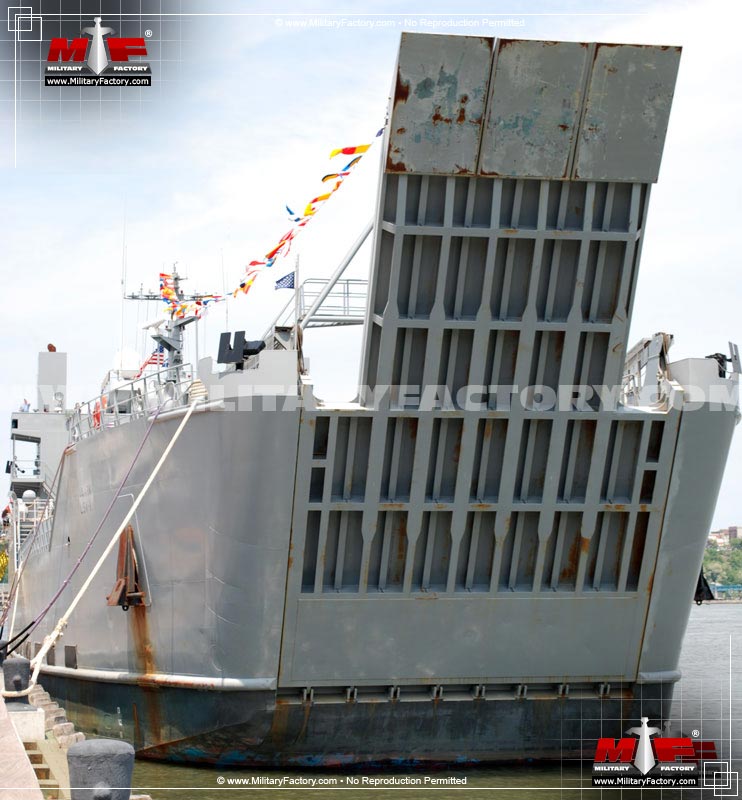
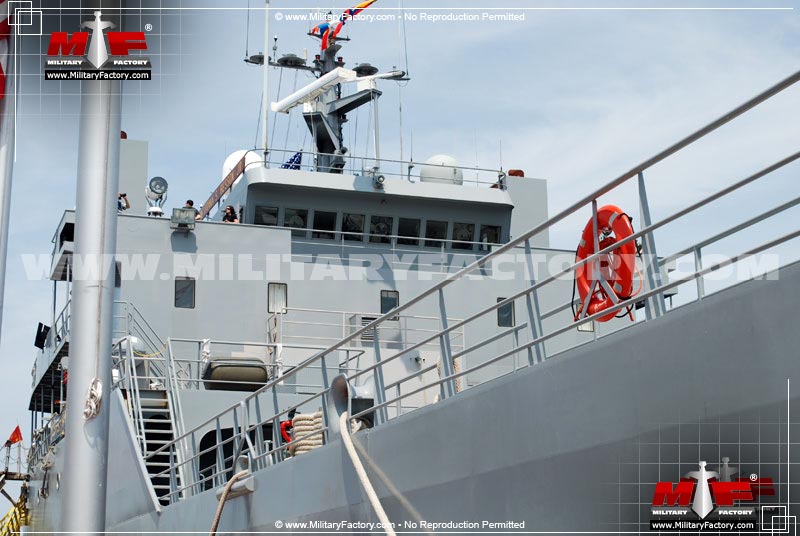
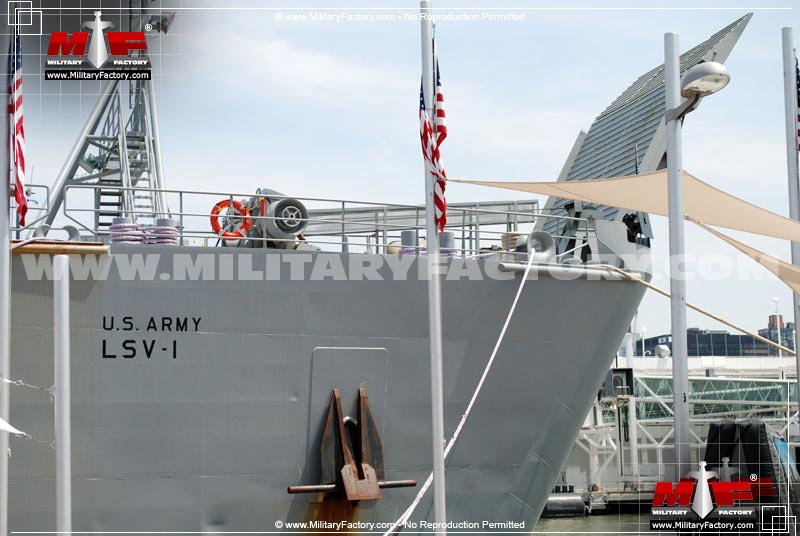
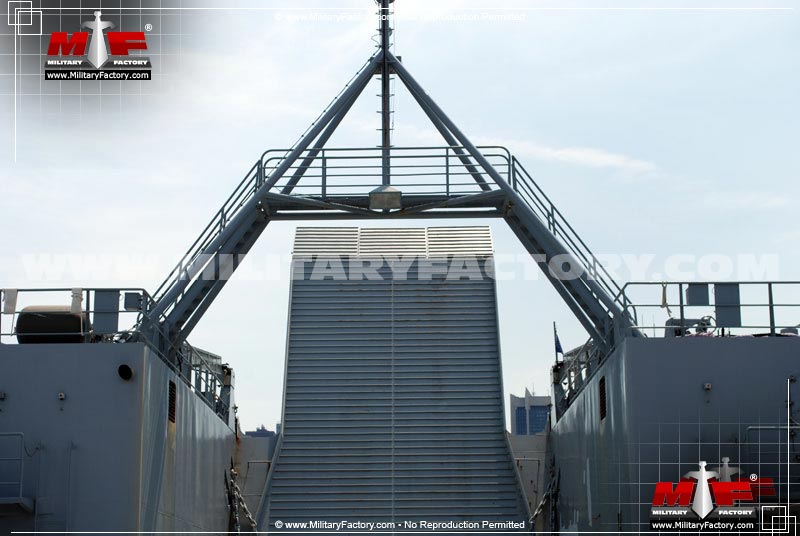
The General Frank S. Besson-class is a Logistics Support Vessel (LSV) able to complete a number of mission types - from delivering humanitarian aid to island countries like Haiti in the Caribbean to service in the Middle East such as Iraq. The Besson-class is the largest support vessel in the United States Army and is designed to give the Army a global strategic capacity to deliver vehicles and cargo with a maximum gross tonnage of 2,000 short tons (though some vessels in the class have greater capacity). The ship has a flat bottom with bow and stern ramps and the ability to beach in as little as 6 ft of water. Operations in underdeveloped countries often have limited ports and capacity’s to serve military sealift missions. The vessels that best support this type of use have shallow drafts able to transport varieties of cargoes with the ability to remain on station for long periods. The LSV has been built for supporting this mission. The bow, as advertised, was streamlined allowing the ship to move through rough water. When viewing the vessel from the front, the bow looks nearly flat and, with her flat bottom, the vessel's sea-keeping seems poor-to-average at best. She seems a perfect fit for costal missions and use in major rivers but perhaps not for those "deep blue" water voyages. However, her crew has already indicated two trips to Iraq with each crossing taking 45 days to complete from her home port.

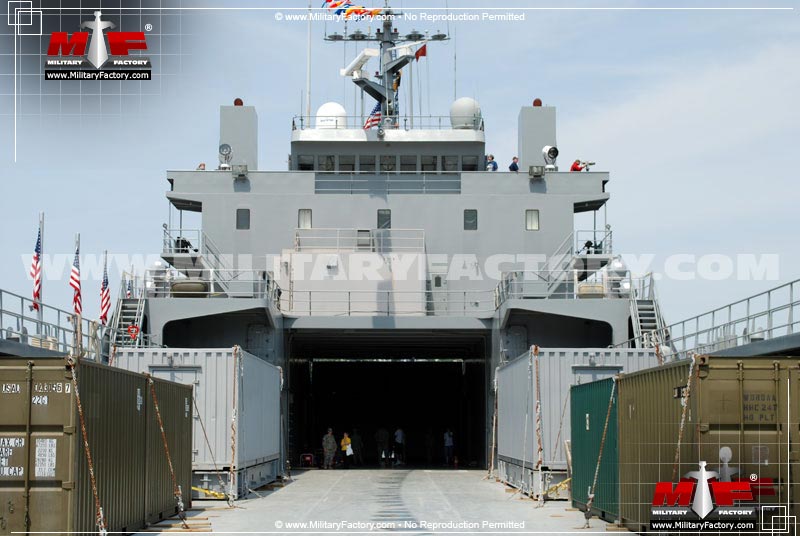
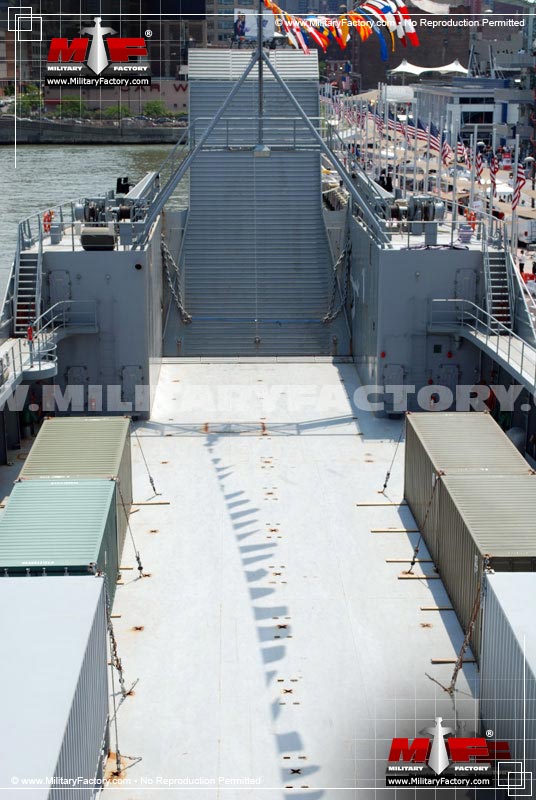
The vessel's cargo deck is 10,500 square feet and designed to handle any vehicle currently in the US Army inventory and can carry 26 x main battle tanks or 30 x M2/M3 Bradley’s. If the mission required it, the ship could hold 45+ x Light Armored Vehicles (LAV) or 37 x M1127 Strikers acting as an intra-theater line haul roll-on/roll-off cargo ship. On humanitarian-type missions, the load capacity can accommodate 48 or more 20 ft double-stacked cargo containers and, if needed, electrical power hook ups to handle refrigerated containers.

During Operation Desert Shield and Operation Desert Storm, Army watercraft delivered tanks, ammunition and food stuffs to many locations along the Persian Gulf Coast.

Logistics Over-the-Shore missions (LOTS) using the LSV’s moving at 12 knots or less meant getting nowhere fast. The US Army decided a need was at hand and the TSV (or Theater Support Vessel) was devised. The TSV will fill the same mission as the LSV’s except with a greater capacity (1,250-ton) and helicopter pads suitable for large military helicopters and a two-part, hydraulic vehicle ramp that allows rapid loading and discharge of vehicles from the stern or port/starboard sides. The greatest modification is speed increases up to four times as much as an LSV. Additional advantages include the ability to better maneuver at greater distances off shore than the LSV while also reducing the number of vessels needed for a particular mission. In 2002, the Army leased the ship "Spearhead" from an Australian company. If all works out, the fleet is expected to increase to 17 vessels.

Today, as with the men and women that have gone before them in times past, the US Army soldier needs to be resupplied with ammunition, food, parts and more in order to sustain the mission at hand. The US Army family of watercraft supplying this logistical need is just what the doctor ordered.

History text ©2003-2009 www.MilitaryFactory.com • All Rights Reserved
No Reproduction Without Permission • Corrections / Comments to MilitaryFactory at Gmail dot com

Last Updated: 6/25/2009


  Specifications for the USAV GEN Frank S. Besson, Jr. (LSV-1)
arrow downDimensions:
Length: 273ft (83.21m)
Beam: 60ft (18.29m)
Draught: 12ft (3.66m)

arrow downPerformance:
Surface Speed: 12kts (14mph)
Range: 14,816miles (23,844km)

arrow downStructure:
Complement: 31
Suface Displacement: 13,910tons
arrow downPower:
Engine(s): 2 x Electro motive Diesel engines (EMD) 16-646E2 producing 1,950 horsepower each at 999rpm driving 2 x shafts.
arrow downArmament Suite:
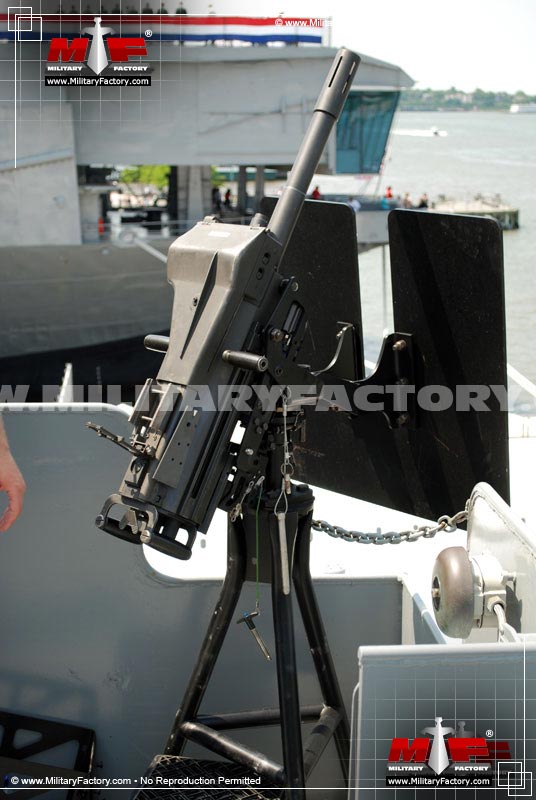
5 x Browning M2 .50 cal heavy machine guns with 3,400 rounds.
4 x M2 5.56mm light machine gun with 7,530 rounds
21 x M16A2 5.56mm semi-automatic assault rifles
2 x MK19 40mm automatic grenade launcher with 384 LKD grenades.
2 x M203 40mm grenade launcher attached to an M16A2 with 48 HEDP grenades.
8 x 9mm pistols with 360 rounds
4 x Shotguns with 80 00 buck shells

  Pictures of the USAV GEN Frank S. Besson, Jr. (LSV-1)
     
Picture of USAV GEN Frank S. Besson, Jr. (LSV-1)
Picture of the USAV GEN Frank S. Besson, Jr. (LSV-1)
Image of the USAV GEN Frank S. Besson, Jr. (LSV-1)
     
arrow upView All 10 Images

More Pictures CompareX2 Conversions Dictionary Acronyms

  Special Navy Ship Collections

Collections:
United States Navy Carriers
Modern Warships

World War 2:
Destroyers of World War 2
Navy Ships of World War 2
USN Warships of World War 2
Submarines of World War 2

Vietnam War:
Warhips of the Vietnam War

Miscellaneous:
Battle of Trafalgar
How Submarines Work
United States Navy Classification


  Recent Navy Ship Section Additions
Thumbnail picture of the USS New York LPD-21 amphibious support landing dock
USS New York (LPD-21)
Thumbnail picture of the Bell PACV/ACV hovercraft
Bell PACV/ACV
Thumbnail picture of the USS United States frigate of 1797
USS United States

  Contacting MilitaryFactory.com
We can only get better if you tell us how. You can contact MilitaryFactory.com at MilitaryFactory at gmail dot com (replace "at" with "@" and "dot with ".") with any questions, comments or corrections. We also accept related military imagery that you approve for us to use on our website. Keep in mind, however, that due to volume, we may not directly respond to your inquiry. Please add us to your list of non-blocked recipients!

Aircraft Carriers

  Navy Ship Profile:


Picture of the USAV GEN Frank S. Besson, Jr. (LSV-1).
Photo Courtesy of JR Potts, AUS 173d AB

flag of United States
1988
Designation: USAV GEN Frank S. Besson, Jr. (LSV-1)
Classification Type: Logistics Support Vessel
Ship Class: Besson LSV-class

Country of Origin: United States
Number in Class: 8

Operators: United States


  Ships in Class
GEN Frank S. Besson, Jr. (LSV-1); CW3 Harold C. Clinger (LSV-2); GEN Brehon B. Sommervell (LSV-3); LTG William B. Bunker (LSV-4); MG Charles P. Gross (LSV-5); SP/4 James A. Loux (LSV-6); SSGT Robert T. Kuroda (LSV-7); MG RObert Smalls (LSV-8)

  Collections
  • Dreadnoughts - Bigger Ships, Bigger Guns
  • Pocket Battleships
  • Destroyers - Power of One
  • Tall Ships
  • Carriers of the United States Navy
  • Cruisers
  • Battleships of World War 2


Free GI Bill Guide

Top MF Stuff: Military Pay Scale Chart | Military Ranks | World War 2 Weapons | Sniper Rifles | Conversion Calculators


©2009 www.MilitaryFactory.com • Content ©2003-2009 MilitaryFactory.com • All Rights Reserved • Disclaimer Privacy Policy Site Map Origins
Most photographic images appearing on this site are courtesy of the United States Department of Defense and are approved for public use.
Other images acquired through the public domain. Digital art work courtesy of Dan Alex.
Business Consulting by Kyle Williams

Material presented throughout this website is for historical and entertainment value and should not to be construed as usable for
hardware restoration, maintenance or general operation. Please consult manufacturers for such information.

Site Contact: militaryfactory at gmail dot com (replace "at" with "@" and "dot" with ".") eXTReMe Tracker