Global Firepower | Military Industrial Complex | Second World War History
Home | Military Pay Scale Chart | Aircraft | Infantry Weapons | Military Vehicles | Navy Ships | Military Education | French Military Victories | Military Ranks | WW2 Weapons
Military Factory Latest from Military Factory
Thumbnail picture of the Dardo infantry fighting vehicle
Dardo IFV
Thumbnail picture of the Supermarine Scimitar fighter
Supermarine Scimitar
Thumbnail picture of the Centauro B1 8x8 tank killer
Centauro 8x8
Thumbnail picture of the Novi Avion fighter
Novi Avion
Thumbnail picture of the FR F2 bolt-action sniper rifle
FR F2
Thumbnail picture of the Lebel Model 1886 bolt-action rifle
Lebel Model 1886
2009 Military Pay Scale Chart - for Army, Navy, Air Force and Marines
  By Type
    · Age of Sail
    · Aircraft Carriers
    · Escort Carriers
    · Amphibious
    · Amphibious Assault
    · Battleships
    · 2nd Class Bttlshps
    · Cargo Ships
    · Cruisers
    · Destroyers
    · Dreadnoughts
    · Pre-Dreadnoughts
    · Frigates
    · Ironclads
    · Midget Submarines
    · Mine Sweepers
    · Patrol Craft
    · Pocket Battleships
    · Special Forces
    · View All Ships
  Submarines
    · Full List
    · Diesel-Electric
    · Ballistic Missile
    · Nuclear Attack
  World War 2
    · Full List
    · Aircraft Carriers
    · Battleships
    · Destroyers
    · Submarines
    · US Warships
  Vietnam War
    · Full List

MilitaryFactory > Navy Ships > SMS Schleswig-Holstein
 
 
More Pictures CompareX2 Conversions Dictionary Acronyms

SMS Schleswig-Holstein

SMS Schleswig-Holstein served in World War 1 and fired the opening salvos against Poland in World War 2.
By JR Potts, AUS 173d AB

Bookmark and Share

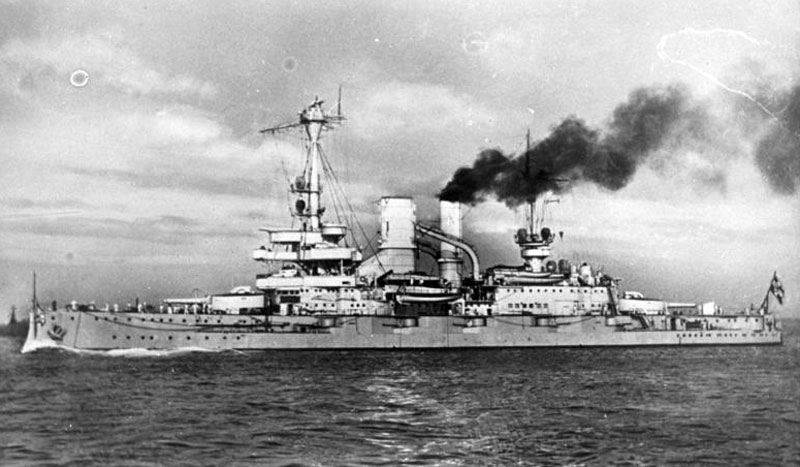
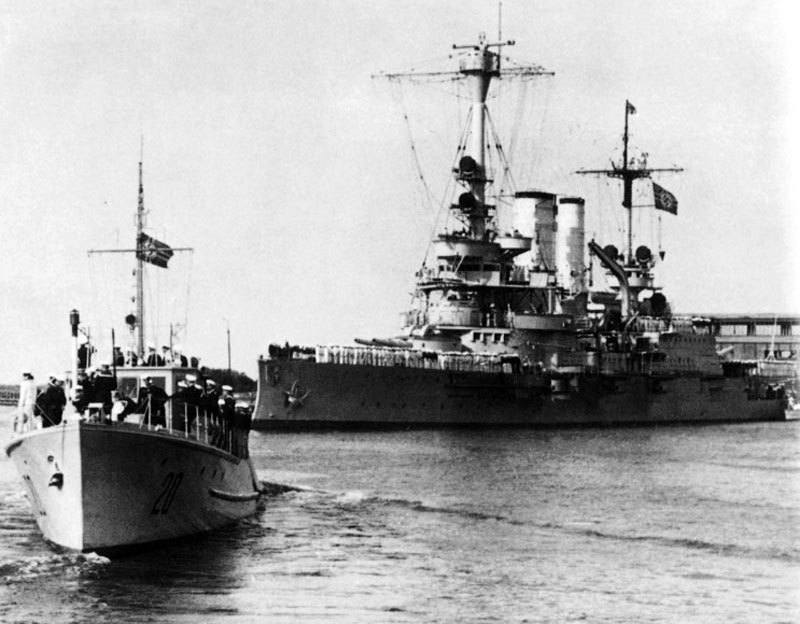
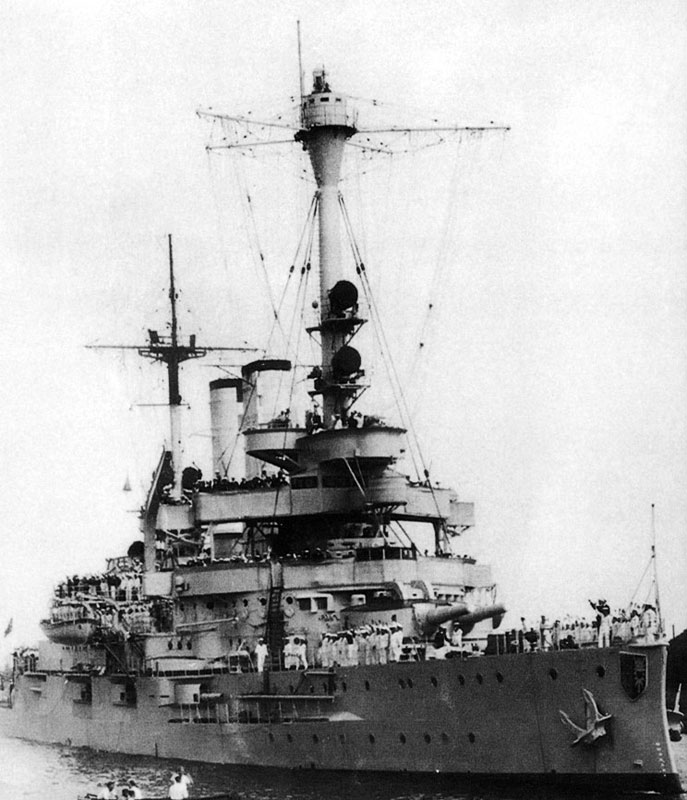
The battleship SMS Schleswig-Holstein was named after the northern-most region of Germany. She was the fifth of five vessles built for the Deutschland class of battleships beginning in 1906 under the hammers of Kaiserliche Marine and, as it turned out, they the last of the pre-Dreadnought class of battleships built due to the arrival of HMS Dreadnought.

Representing the final group of Germany’s pre-dreadnought battleships, the Deutschland class was laid down between 1903 and 1904 at the dockyards in Kiel, Szczecin, Wilhelmshaven and Danzig. They were similar to the Braunschweig-class preceding them however Schleswig-Holstein and the other Deutschland’s were mounted with heavier armor. The shipbuilder, Germaniawerft, built both the SMS Deutschland and Schleswig-Holstein. Each ship cost over 24 million marks at the time of construction and took three to four years to be completed.

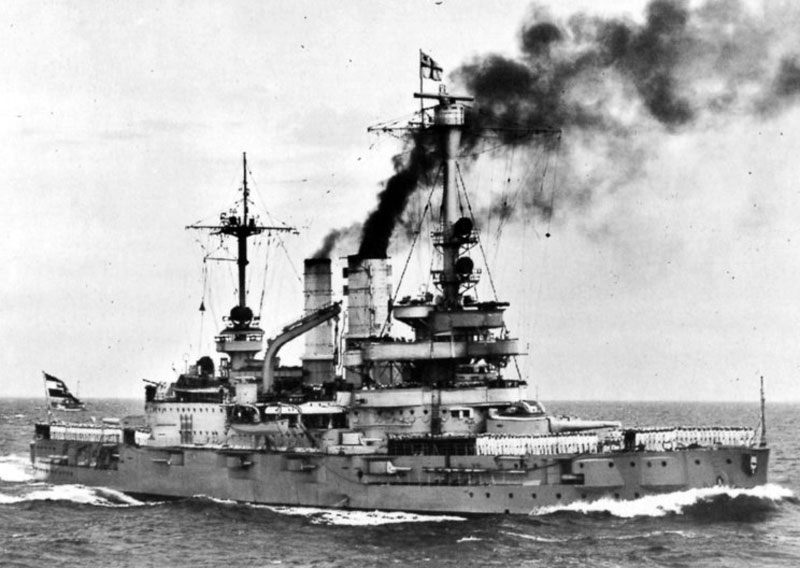
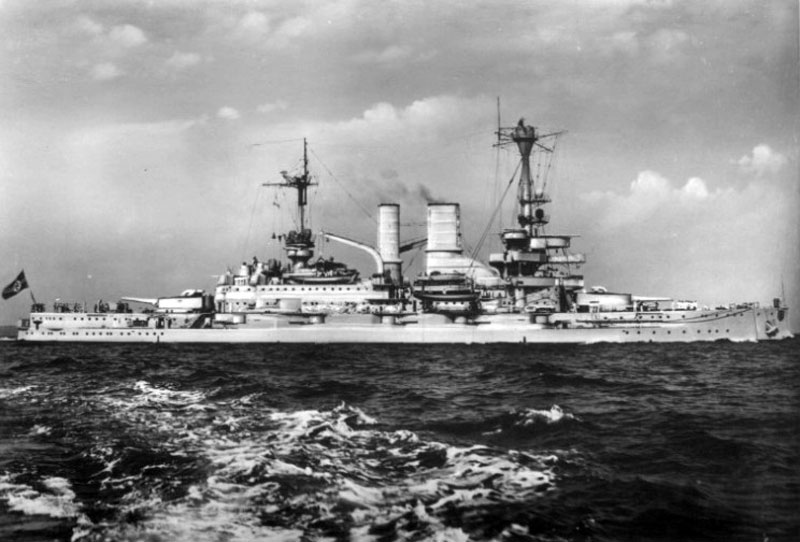
Schleswig-Holstein was 413 feet (126 meters) long at the waterline, and 419 feet (127.6 meters) overall. At her beam she was 73 feet (22.2 meters) and had a draft of 25 feet (7.7 meters), displacing 14,218 tons in full. She was powered by 3-shaft triple expansion engines, which produced 19,330 ihp, and a top speed of 17 knots (31 km/h). The triple expansion engines were powered by eight Marine type boilers and six cylinder boilers. After 1915, oil-firing capability was added to supplement the coal-fired boilers. The ship had a single rudder and three screws. The two outer propellers were three bladed, and 4.8 m (5.24 yd) in diameter. The center screw was four bladed and 4.5 m (4.92 yd) in diameter. She was fitted with two funnels.

Schleswig-Holstein's main armament consisted of 4 x 11-inch (28 cm) guns in twin turrets - one fore and one aft of the superstructure. Her secondary battery was comprised of 14 x 6.7-inch (17-cm) guns and 22 x 3.4-inch (8.6-cm) guns, all casemated along the length of the ship and concentrated amidships. The Deutschland class also mounted six 17.7-inch (45-cm) torpedo tubes. Schleswig-Holstein’s armored belt was 9 inches (23-cm) thick at its maximum center points and then tapered to 4 inches (10-cm) thick in less critical areas, most notably the bow and stern. The turrets had 11 inches (28 cm) of armor protection - a full inch thicker than the preceding class. The decks had 3 inches (7.6 cm) of armor plate to stop plunging fire.

SMS Schleswig-Holstein was present at the Battle of Jutland in World War I along with all of her sister ships. The SMS Pommern was hit at about 02:00 on June 1st, 1916, by a torpedo fired from the British destroyer HMS Faulknor. The torpedo hit and caused an explosion in one of the magazines and the ship quickly sank with the loss of the entire 839-men crew. SMS Schleswig-Holstein was hit by one shell during the battle and caused little damage. After the war, Germany was allowed to keep three of the remaining four battleships as part of the Treaty of Versailles. SMS Schlesien, SMS Schleswig-Holstein and the SMS Hannover were the chosen vessels while SMS Deutschland was scrapped in 1922. Schleswig-Holstein was modernized in the 1920s and served as flagship of the German Navy from 1926 to 1935.

By 1939 she and her sisters were considered obsolete but were powerful enough so that she could be used as a gun platform for land bombardments. With Captain Gustav Kleikamp in command of SMS Schleswig Holstein, she and her sister ship, SMS Schlesien, were on a planned visit to Poland. This subterfuge was meant to honour the sailors killed on the German cruiser Magdeburg in World War 1 and were buried in Danzig in 1914. The Magdeburg had run aground near the Odensholm lighthouse in the Baltic Sea. Efforts to refloat her failed and the Russian cruisers Bogatyr and Pallada appeared and destroyed her and most of her crew.

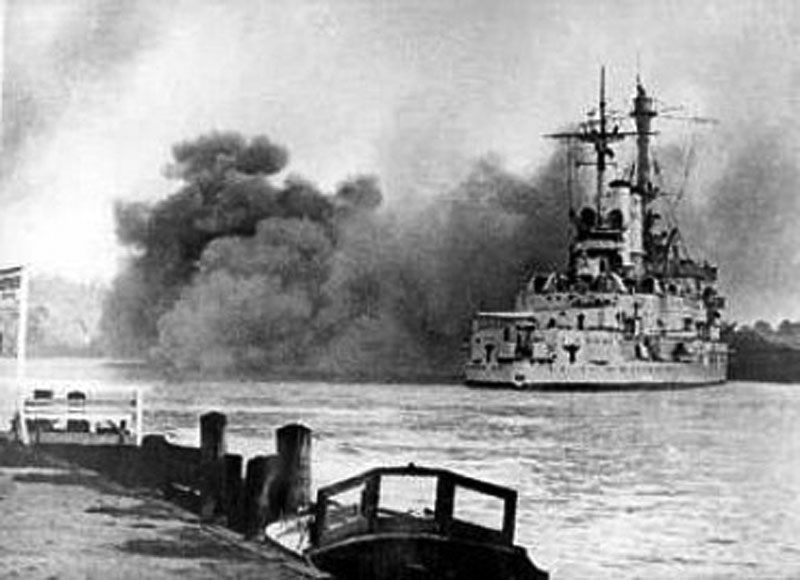
Schleswig Holstein and her small flotilla had anchored in Danzig harbour at the mouth of the River Vistula. At 4.30am on September 1st, 1939, she weighed anchor and moved down the canal, taking up a position opposite the Polish fort Westerplatte. Schlesien and the gun boats stayed and protected the mouth of the harbor. This had been the plan of the German High Command; Schleswig Holstein had her 11-inch guns at point blank range, while Captain Kleikamp, at 4.47am, gave the order to open fire on the Westerplatte in the name of Adolf Hitler. Germanys first shot fired by the SMS Schleswig Holstein of World War 2 in Europe was exactly 20 years, 9 months, 19 days and 18 hours after the last shot was fired in World War 1. World War II in Europe had begun.

The bombardment of the fort was joined by Stuka dive bombers of the German Luftwaffe and the few Polish garrison defenders were additionally attacked by larger numbers of German ground troops. The battle lasted for seven days before the Polish commander surrendered though the fort was never overrun by the German troops. In the first few weeks of the war, the Schleswig-Holstein and the Schlesien bombarded other Polish positions in Gdynia, Kepa Oksywska, and the Hel Peninsula.

The remaining Deutschland class battleships were returned to training duty following the occupation of Norway in 1940. Schleswig-Holstein became an anti-aircraft ship in 1944 at Gdynia to protect the port. The she berthed at Gdynia till the end of the war. Being a stationary target she was attacked by the RAF on December 18th, 1944, killing twenty eight of her crew members. The RAF attacked again and scored many bomb hits, leaving her burning and finally sinking in 39 feet of water near the port on March 21st, 1945. After World War 2, she was raised by the Soviet Union and towed to the Russian port of Tallinn where she was renamed Borodino. The Russian navy scuttled Borodino in shallow water near Osmussaar island in the Baltic Sea sometime in 1948 and was used as a target ship until the 1964. The remains of the ship have been protected by the Estonian National Heritage Board as a historic shipwreck since 2006.

The battleship Schleswig Holstein served Germany in both world wars and was the instrument used to begin the Second World War. A conflict, by some reports, that claimed the lives of 60 million people. It is doubtful that this number reflects all the peoples in all the far corners of the world where records were at best dubious. Nevertheless, the SMS Schleswig-Holstein earned her legacy - perhaps not as the operating nation first intended.

History text ©2003-2009 www.MilitaryFactory.com • All Rights Reserved
No Reproduction Without Permission • Corrections / Comments to MilitaryFactory at Gmail dot com

Last Updated: 8/21/2009


  Specifications for the SMS Schleswig-Holstein
arrow downDimensions:
Length: 419ft (127.71m)
Beam: 73ft (22.25m)
Draught: 25ft (7.62m)

arrow downPerformance:
Surface Speed: 17kts (20mph)
Range: 5,000miles (8,047km)

arrow downStructure:
Complement: 743
Suface Displacement: 14,218tons
arrow downPower:
Engine(s): 8 x Marine-type boilers; 6 x cylinder boilers; 3 x shaft triple expansion engines developing 19,330ihp; 3 x screws.
arrow downArmament Suite:
AT TIME OF CONSTRUCTION (1908):
14 x 11-inch 28cm (2x2) main guns
14 x 6.7-inch 17cm (casemated) guns
22 x 3.5-inch 8.8cm (casemated) guns
6 x 45cm 18-inch torpedo tubes

ARMAMENT IN 1939:
4 x 28-cm (11-inch) (2x2) main guns
2 x 8.8-cm (3.5-inch) guns
4 x 3.7-cm (1.5-inch) (2x2) guns
22 x 2.0-cm (0.8-inch) cannons

  Pictures of the SMS Schleswig-Holstein
     
Picture of SMS Schleswig-Holstein
Picture of the SMS Schleswig-Holstein
Image of the SMS Schleswig-Holstein
     
arrow upView All 6 Images

More Pictures CompareX2 Conversions Dictionary Acronyms

  Special Navy Ship Collections

Collections:
United States Navy Carriers
Modern Warships

World War 2:
Destroyers of World War 2
Navy Ships of World War 2
USN Warships of World War 2
Submarines of World War 2

Vietnam War:
Warhips of the Vietnam War

Miscellaneous:
Battle of Trafalgar
How Submarines Work
United States Navy Classification


  Recent Navy Ship Section Additions
Thumbnail picture of the USS New York LPD-21 amphibious support landing dock
USS New York (LPD-21)
Thumbnail picture of the Bell PACV/ACV hovercraft
Bell PACV/ACV
Thumbnail picture of the USS United States frigate of 1797
USS United States

  Contacting MilitaryFactory.com
We can only get better if you tell us how. You can contact MilitaryFactory.com at MilitaryFactory at gmail dot com (replace "at" with "@" and "dot with ".") with any questions, comments or corrections. We also accept related military imagery that you approve for us to use on our website. Keep in mind, however, that due to volume, we may not directly respond to your inquiry. Please add us to your list of non-blocked recipients!

Aircraft Carriers

  Navy Ship Profile:


Picture of the SMS Schleswig-Holstein.
Photo Courtesy of the Public Domain

flag of Imperial Germany
1908
Designation: SMS Schleswig-Holstein
Classification Type: Pre-Dreadnought Battleship
Ship Class: Deutschland-class

Country of Origin: Imperial Germany
Number in Class: 5

Operators: Imperial Germany


  Ships in Class
SMS Deutschland; SMS Hannover; SMS Pommenn; SMS Schlesien; SMS Schleswig-Holstein

  Collections
  • Dreadnoughts - Bigger Ships, Bigger Guns
  • Pocket Battleships
  • Destroyers - Power of One
  • Tall Ships
  • Carriers of the United States Navy
  • Cruisers
  • Battleships of World War 2


Free GI Bill Guide

Top MF Stuff: Military Pay Scale Chart | Military Ranks | World War 2 Weapons | Sniper Rifles | Conversion Calculators


©2009 www.MilitaryFactory.com • Content ©2003-2009 MilitaryFactory.com • All Rights Reserved • Disclaimer Privacy Policy Site Map Origins
Most photographic images appearing on this site are courtesy of the United States Department of Defense and are approved for public use.
Other images acquired through the public domain. Digital art work courtesy of Dan Alex.
Business Consulting by Kyle Williams

Material presented throughout this website is for historical and entertainment value and should not to be construed as usable for
hardware restoration, maintenance or general operation. Please consult manufacturers for such information.

Site Contact: militaryfactory at gmail dot com (replace "at" with "@" and "dot" with ".") eXTReMe Tracker