Global Firepower | Military Industrial Complex | Second World War History
Home | Military Pay Scale Chart | Aircraft | Infantry Weapons | Military Vehicles | Navy Ships | Military Education | French Military Victories | Military Ranks | WW2 Weapons
Military Factory Latest from Military Factory
Thumbnail picture of the Dardo infantry fighting vehicle
Dardo IFV
Thumbnail picture of the Supermarine Scimitar fighter
Supermarine Scimitar
Thumbnail picture of the Centauro B1 8x8 tank killer
Centauro 8x8
Thumbnail picture of the Novi Avion fighter
Novi Avion
Thumbnail picture of the FR F2 bolt-action sniper rifle
FR F2
Thumbnail picture of the Lebel Model 1886 bolt-action rifle
Lebel Model 1886
2009 Military Pay Scale Chart - for Army, Navy, Air Force and Marines
  By Type
    · Age of Sail
    · Aircraft Carriers
    · Escort Carriers
    · Amphibious
    · Amphibious Assault
    · Battleships
    · 2nd Class Bttlshps
    · Cargo Ships
    · Cruisers
    · Destroyers
    · Dreadnoughts
    · Pre-Dreadnoughts
    · Frigates
    · Ironclads
    · Midget Submarines
    · Mine Sweepers
    · Patrol Craft
    · Pocket Battleships
    · Special Forces
    · View All Ships
  Submarines
    · Full List
    · Diesel-Electric
    · Ballistic Missile
    · Nuclear Attack
  World War 2
    · Full List
    · Aircraft Carriers
    · Battleships
    · Destroyers
    · Submarines
    · US Warships
  Vietnam War
    · Full List

MilitaryFactory > Navy Ships > HIJMS RO-100 (Kaisho / Type KS)
 
 
More Pictures CompareX2 Conversions Dictionary Acronyms

HIJMS RO-100 (Kaisho / Type KS)

None of the RO-100 class of Japanese submarines lasted the war.
By Staff Writer

Bookmark and Share

Development and production of the RO-100 series (sometimes referred to as "Kaisho" or "small" or simply Type "KS") of Japanese submarines was started in earnest beginning in 1940. The vessels (eighteen in total) were designed as short-ranged coastal submarines, originally charged with protection of the homeland coast but her service extended with the reach of the Empire as required. The RO-100 were produced with several design faults that would eventually do the type in by limiting her capabilities immensely when facing off against Allied firepower - be it from the sea or air. Amazingly, because of glaring design drawbacks, none of the 18 total RO-100 class of submarines would last through to the end of the war, most falling prey to Allied aircraft attacks and not navy vessels.

Categorized as coastal submarines - and designed as such - the RO-100 series was allowed a shallow overall operating depth limited to just 245 feet. Additionally, the type carried only eight total torpedoes of 533mm size firing from four bow-positioned tubes. A 76mm deck cannon was almost always removed. Power was derived from surface diesels generating 1,100bhp and electric motors producing 760 horsepower and powering two shafts. The smallish internal workings made accommodations for up to 38 sailors and officers.

As the Empire expanded, the requirements of the RO-100 class grew, often forcing it to operate in deep waters against armored targets that it was never intended to come up against. The system could, however, hold its own against the basic merchant vessels on the seas but it became David and Goliath scenarios when the RO-100 class was called to take on the heavily armored and armed US destroyers operating in Pacific waters. This became increasingly the norm as the war progresses. As a result, losses for the type were horrendous, with many being sunk from the air and a handful by a single US Navy destroyer (the USS England to be exact). The RO-100-class was also not helped by its noted poor handling capabilities.

The KO-35 (Type K6) appeared alongside the RO-100 through production and was a larger (and more improved) variant of the base RO-100 class. Only one KO-35 survived the war with no fewer than 60 of the type being canceled before production was underway.

The RO-106 was credited with the sinking of the LST-342 landing ship off the coast of New Georgia while the RO-108 was credited with the sinking of the American destroyer USS Henley off of New Guinea, both actions occurring in 1943. Beyond that, the class was responsible for sinking a total of 35,200 tons of Allied cargo. Production of the KO-100 was undertaken at the Kure Navy Yard and the Kawasaki Yard at Kobe.

History text ©2003-2009 www.MilitaryFactory.com • All Rights Reserved
No Reproduction Without Permission • Corrections / Comments to MilitaryFactory at Gmail dot com

Last Updated: 10/29/2008


  Specifications for the HIJMS RO-100 (Kaisho / Type KS)
arrow downDimensions:
Length: 199.9ft (60.93m)
Beam: 20ft (6.10m)
Draught: 11.5ft (3.51m)

arrow downPerformance:
Surface Speed: 14kts (16mph)
Submerged Speed: 8kts (9mph)
Range: 4,040miles (6,502km)

arrow downStructure:
Complement: 38
Suface Displacement: 782tons
arrow downPower:
Engine(s): 2 x surface diesel engines generating 1,100bhp (surface) with 2 x electric motors generating 760hp powering (submerged) to 2 x shafts.
arrow downArmament Suite:
4 x 21" (553mm) torpedo tubes (bow mounted; 8 total torpedoes)
1 x 76mm deck gun (optional)

More Pictures CompareX2 Conversions Dictionary Acronyms

  Special Navy Ship Collections

Collections:
United States Navy Carriers
Modern Warships

World War 2:
Destroyers of World War 2
Navy Ships of World War 2
USN Warships of World War 2
Submarines of World War 2

Vietnam War:
Warhips of the Vietnam War

Miscellaneous:
Battle of Trafalgar
How Submarines Work
United States Navy Classification


  Recent Navy Ship Section Additions
Thumbnail picture of the USS New York LPD-21 amphibious support landing dock
USS New York (LPD-21)
Thumbnail picture of the Bell PACV/ACV hovercraft
Bell PACV/ACV
Thumbnail picture of the USS United States frigate of 1797
USS United States

  Contacting MilitaryFactory.com
We can only get better if you tell us how. You can contact MilitaryFactory.com at MilitaryFactory at gmail dot com (replace "at" with "@" and "dot with ".") with any questions, comments or corrections. We also accept related military imagery that you approve for us to use on our website. Keep in mind, however, that due to volume, we may not directly respond to your inquiry. Please add us to your list of non-blocked recipients!

Aircraft Carriers

  Navy Ship Profile:


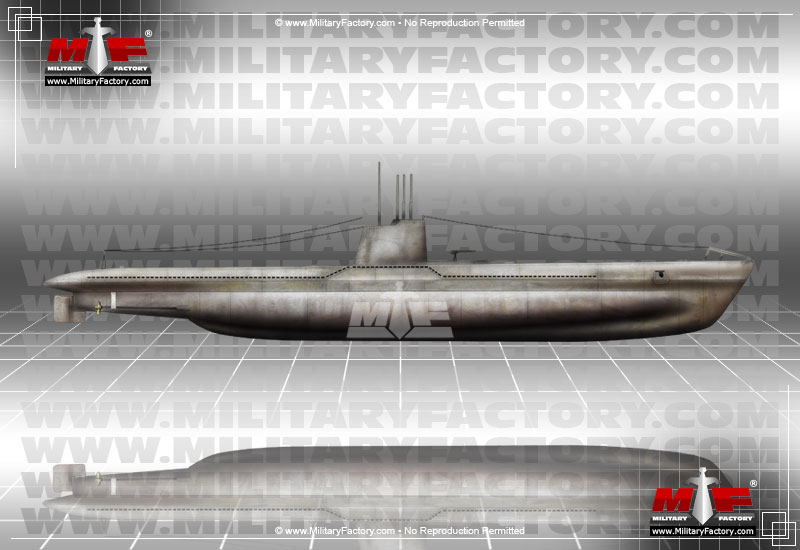
Picture of the HIJMS RO-100 (Kaisho / Type KS).
Photo Courtesy of Dan Alex

flag of Imperial Japan
1942
Designation: HIJMS RO-100 (Kaisho / Type KS)
Classification Type: Short-Range Coastal Submarine
Ship Class: RO-100

Country of Origin: Imperial Japan
Number in Class: 18

Operators: Imperial Japan


  Ships in Class
RO-100; RO-101; RO-102; RO-103; RO-104; RO-105; RO-106; RO-107; RO-108; RO-109; RO-110; RO-111; RO-112; RO-113; RO-114; RO-115; RO-116; RO-117

  Collections
  • Dreadnoughts - Bigger Ships, Bigger Guns
  • Pocket Battleships
  • Destroyers - Power of One
  • Tall Ships
  • Carriers of the United States Navy
  • Cruisers
  • Battleships of World War 2


Free GI Bill Guide

Top MF Stuff: Military Pay Scale Chart | Military Ranks | World War 2 Weapons | Sniper Rifles | Conversion Calculators


©2009 www.MilitaryFactory.com • Content ©2003-2009 MilitaryFactory.com • All Rights Reserved • Disclaimer Privacy Policy Site Map Origins
Most photographic images appearing on this site are courtesy of the United States Department of Defense and are approved for public use.
Other images acquired through the public domain. Digital art work courtesy of Dan Alex.
Business Consulting by Kyle Williams

Material presented throughout this website is for historical and entertainment value and should not to be construed as usable for
hardware restoration, maintenance or general operation. Please consult manufacturers for such information.

Site Contact: militaryfactory at gmail dot com (replace "at" with "@" and "dot" with ".") eXTReMe Tracker