Global Firepower | Military Industrial Complex | Second World War History
Home | Military Pay Scale Chart | Aircraft | Infantry Weapons | Military Vehicles | Navy Ships | Military Education | French Military Victories | Military Ranks | WW2 Weapons
Military Factory Latest from Military Factory
Thumbnail picture of the Dardo infantry fighting vehicle
Dardo IFV
Thumbnail picture of the Supermarine Scimitar fighter
Supermarine Scimitar
Thumbnail picture of the Centauro B1 8x8 tank killer
Centauro 8x8
Thumbnail picture of the Novi Avion fighter
Novi Avion
Thumbnail picture of the FR F2 bolt-action sniper rifle
FR F2
Thumbnail picture of the Lebel Model 1886 bolt-action rifle
Lebel Model 1886
2009 Military Pay Scale Chart - for Army, Navy, Air Force and Marines
  By Type
    · Age of Sail
    · Aircraft Carriers
    · Escort Carriers
    · Amphibious
    · Amphibious Assault
    · Battleships
    · 2nd Class Bttlshps
    · Cargo Ships
    · Cruisers
    · Destroyers
    · Dreadnoughts
    · Pre-Dreadnoughts
    · Frigates
    · Ironclads
    · Midget Submarines
    · Mine Sweepers
    · Patrol Craft
    · Pocket Battleships
    · Special Forces
    · View All Ships
  Submarines
    · Full List
    · Diesel-Electric
    · Ballistic Missile
    · Nuclear Attack
  World War 2
    · Full List
    · Aircraft Carriers
    · Battleships
    · Destroyers
    · Submarines
    · US Warships
  Vietnam War
    · Full List

MilitaryFactory > Navy Ships > Napoleon I
 
 
More Pictures CompareX2 Conversions Dictionary Acronyms

Napoleon I

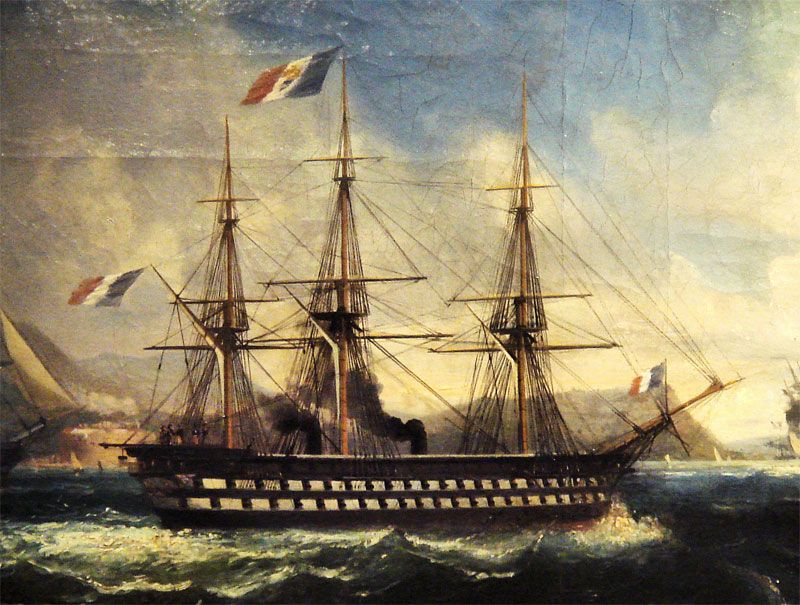
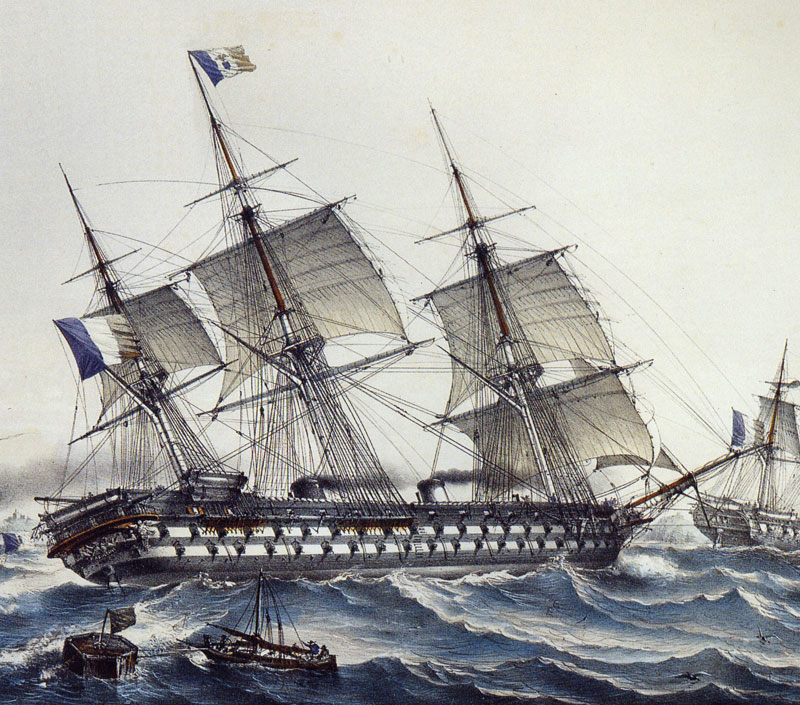
France jumped ahead of the naval show-of-force game being played out with Britain, introducing their revolutionary Napoleon I screw-driven, steam-powered battleship.
By JR Potts, AUS 173d AB

Bookmark and Share

The screw propeller was first used on a military vessel in 1852 by the French with the introduction of the Napoleon a 90-gun ship-of-the-line as part of the French Navy - becoming the very first screw-driven steam battleship in the world. Before the adoption of screw propulsion in warships during the 1850s, the technology of choice was steam used to drive a paddle wheel attached to the side of the warship. This arrangement formulated several distinct disadvantages. Firstly, the size of the wheel reduced the number of guns that could be mounted for a broadside along that particular side of the ship. Secondly, enemy cannon shot could easily render the wheel out of commission making it a vulnerable target in any attack. New technology was needed to place the driving force of a military warship out of harm’s way. It was the invention of screw propulsion that finally made steam-powered warships practical. Cannon fire would not be obstructed and the underwater propeller would be well-protected from both shot and shell. The screw propeller was a radical leap forward and started one of the major arms races in naval history.

France and England were the two major sea powers of the day and were always trying to evolve a major naval technological advantage in an effort to gain sea-going superiority over the one another. Over the next decade, at least 100 wooden steam battleships were built in France and Britain alone. Launched in 1850, the Napoleon was the lead ship of a class of 9 battleships built over a 10 year period under the watchful eyes of naval designer Dupuy de Lôme. She was 239ft (73m) in length and 55ft (17m) in breadth while displacing 5,120 tons. She was fitted with two gun decks and featured a 45-gun-strong broadside. The height of the battery above the waterline was 6ft 4in. Under full steam and sail, she could make 13 knots ( 8.089mph) across short distances with a sail area of 3,411 square yards. Napoleon's success made the fleets of the world turn completely to a steam screw, such was her revolutionary inception. She was launched in 1850 and, during the Crimean War in 1852, her design execution attracted world attention with the introduction of steam power and a large coal supply giving her longer range than her contemporaries. Her engine gearing created maintenance problems (common to most early geared-screw machinery) and new direct-drive engines were ultimately fitted. She was the only French ship-of-the-line with two funnels.

Warships made of wood and powered by steam engines were the dominate ship of the world's navies by the early 19th century. In the 1820s and 1830s, steam engines were first tried in tugs, gunboats and sloops. Larger engines were built by the 1840s, making them usable in medium-sized ships like frigates. In the 1850s, steam-powered wooden battleships combined their steam engines with a sailing rig, just in case the coal ran out. Many nations did not have worldwide coaling stations.

In the late 1830s the screw propeller attracted naval interest not only in Britain and France but also in American where experimentation was underway. The American USS Princeton was being built at the same time as the British HMS Rattler, both ships were sloops and their respective navy departments felt they performed their mission rather well. France jumped ahead in 1845 with the first screw steam-powered frigate - the Pomone. By the end of the decade, both Britain and France were building steam-powered versions of the ship-of-the-line, leaving America was somewhat behind.

In 1850, the British Admiralty decided that no more sailing warships would be built and the government committed 100,000 pounds for machinery for its new steam battle fleet. Most of the world’s navies were essentially forced to follow suit. Britain converted 41 sail-only ships-of-the-line to steam and built 18 new ones. France fell behind by converting only 28 ships to steam and built an additional 10. Russia learned the hard way, losing her sailing fleet during the Crimean War and built just 9 steam-powered ship-of-the-line battle ships.

History text ©2003-2009 www.MilitaryFactory.com • All Rights Reserved
No Reproduction Without Permission • Corrections / Comments to MilitaryFactory at Gmail dot com

Last Updated: 8/17/2009


  Specifications for the Napoleon I
arrow downDimensions:
Length: 239.6ft (73.03m)
Beam: 55.8ft (17.01m)
Draught: 26.4ft (8.05m)

arrow downPerformance:
Surface Speed: 13kts (15mph)
Range: Essentially Unlimited

arrow downStructure:
Complement: 910
Suface Displacement: 5,120tons
arrow downPower:
Engine(s): Wind-Powered Sail; 1 x 2-cylinder, Infret-geared, coal-fired boiler making 960nbp (574ihp); 1 x shaft 3-blade propeller.
arrow downArmament Suite:
32 x 30-pdr GD No.1 guns
26 x 30-pdr UD No.2 guns
4 x 22-pdr guns No.1 shell
4 x 22-pdr guns No.2 shell
14 x 16-cm SD shell
10 x Carronades

  Pictures of the Napoleon I
     
Picture of Napoleon I
Picture of the Napoleon I
     
arrow upView All 2 Images

More Pictures CompareX2 Conversions Dictionary Acronyms

  Special Navy Ship Collections

Collections:
United States Navy Carriers
Modern Warships

World War 2:
Destroyers of World War 2
Navy Ships of World War 2
USN Warships of World War 2
Submarines of World War 2

Vietnam War:
Warhips of the Vietnam War

Miscellaneous:
Battle of Trafalgar
How Submarines Work
United States Navy Classification


  Recent Navy Ship Section Additions
Thumbnail picture of the USS New York LPD-21 amphibious support landing dock
USS New York (LPD-21)
Thumbnail picture of the Bell PACV/ACV hovercraft
Bell PACV/ACV
Thumbnail picture of the USS United States frigate of 1797
USS United States

  Contacting MilitaryFactory.com
We can only get better if you tell us how. You can contact MilitaryFactory.com at MilitaryFactory at gmail dot com (replace "at" with "@" and "dot with ".") with any questions, comments or corrections. We also accept related military imagery that you approve for us to use on our website. Keep in mind, however, that due to volume, we may not directly respond to your inquiry. Please add us to your list of non-blocked recipients!

Aircraft Carriers

  Navy Ship Profile:


Picture of the Napoleon I.
Photo Courtesy of the Public Domain

flag of France
1852
Designation: Napoleon I
Classification Type: Screw Ship-of-the-Line (2nd Class)
Ship Class: Napoleon Class 90-Gun Battleship

Country of Origin: France
Number in Class: 9

Operators: France


  Ships in Class
Napoleon; Algesiras; Arcole; Redoutable; Imperial; Intrepide; Ville De Nantes; Ville De Bordeaux; Ville de Lyon

  Collections
  • Dreadnoughts - Bigger Ships, Bigger Guns
  • Pocket Battleships
  • Destroyers - Power of One
  • Tall Ships
  • Carriers of the United States Navy
  • Cruisers
  • Battleships of World War 2


Free GI Bill Guide

Top MF Stuff: Military Pay Scale Chart | Military Ranks | World War 2 Weapons | Sniper Rifles | Conversion Calculators


©2009 www.MilitaryFactory.com • Content ©2003-2009 MilitaryFactory.com • All Rights Reserved • Disclaimer Privacy Policy Site Map Origins
Most photographic images appearing on this site are courtesy of the United States Department of Defense and are approved for public use.
Other images acquired through the public domain. Digital art work courtesy of Dan Alex.
Business Consulting by Kyle Williams

Material presented throughout this website is for historical and entertainment value and should not to be construed as usable for
hardware restoration, maintenance or general operation. Please consult manufacturers for such information.

Site Contact: militaryfactory at gmail dot com (replace "at" with "@" and "dot" with ".") eXTReMe Tracker