Global Firepower | Military Industrial Complex | Second World War History
Home | Military Pay Scale Chart | Aircraft | Infantry Weapons | Military Vehicles | Navy Ships | Military Education | French Military Victories | Military Ranks | WW2 Weapons
Military Factory Latest from Military Factory
Thumbnail picture of the Dardo infantry fighting vehicle
Dardo IFV
Thumbnail picture of the Supermarine Scimitar fighter
Supermarine Scimitar
Thumbnail picture of the Centauro B1 8x8 tank killer
Centauro 8x8
Thumbnail picture of the Novi Avion fighter
Novi Avion
Thumbnail picture of the FR F2 bolt-action sniper rifle
FR F2
Thumbnail picture of the Lebel Model 1886 bolt-action rifle
Lebel Model 1886
2009 Military Pay Scale Chart - for Army, Navy, Air Force and Marines
  By Type
    · Age of Sail
    · Aircraft Carriers
    · Escort Carriers
    · Amphibious
    · Amphibious Assault
    · Battleships
    · 2nd Class Bttlshps
    · Cargo Ships
    · Cruisers
    · Destroyers
    · Dreadnoughts
    · Pre-Dreadnoughts
    · Frigates
    · Ironclads
    · Midget Submarines
    · Mine Sweepers
    · Patrol Craft
    · Pocket Battleships
    · Special Forces
    · View All Ships
  Submarines
    · Full List
    · Diesel-Electric
    · Ballistic Missile
    · Nuclear Attack
  World War 2
    · Full List
    · Aircraft Carriers
    · Battleships
    · Destroyers
    · Submarines
    · US Warships
  Vietnam War
    · Full List

MilitaryFactory > Navy Ships > KMS Bismarck
 
 
More Pictures CompareX2 Conversions Dictionary Acronyms

KMS Bismarck

When commissioned in 1940, the battleship Bismarck was the largest ship of her type in the world.
By Staff Writer

Bookmark and Share

The KMS Bismarck is undoubtedly one of the most famous sea-going vessels of the 20th Century. The Germany super battleship was single-handedly responsible for tying a good portion of the British Royal Navy who dedicated themselves and their available resources to the hunting down and sinking of Hitler's most powerful symbol of supremacy. Packed with an astounding array of guns and armored to the core, the Bismarck took a good licking before succumbing to her damages in 1941. The design was in some ways a throw-back to the designs of the First World War and were highly based on the "pocket battleship" design lessons taken from that conflict.

The KMS Bismarck - a product of Blohm & Voss in Hamburg, Germany - was a giant leap forward in the rebuilding of the Germany Navy following the tight restrictions set forth on military build up following the First World War (of which Germany was the loser). With Adolph Hitler's finagling of the Versailles Treaty, the KMS Bismarck was born (along with her sister ship, the KMS Tirpitz) as a 50,000 ton monster - well above the treaty's limitations. Though strangely in tune with the preceding war's design methodology, no expense was spared in making this class a truly potent force on the high seas.

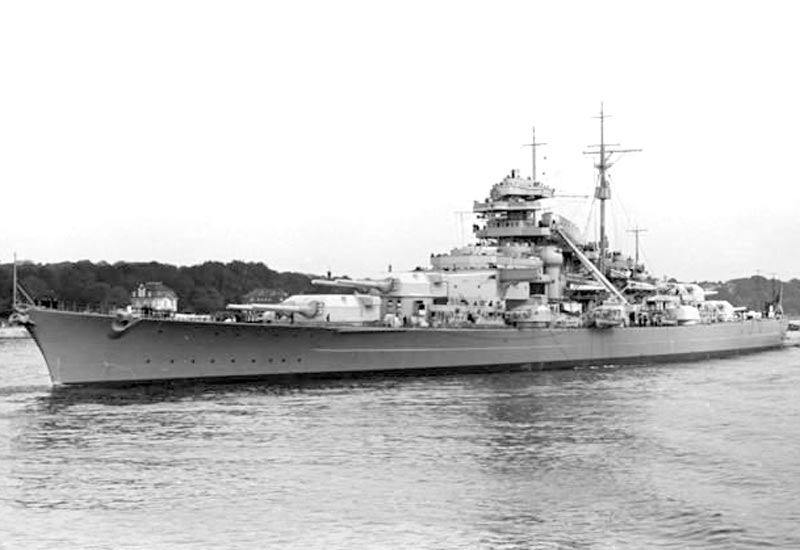
Of particular note were her massive batteries of 15" guns of which eight were positioned in four heavily armored turrets - two guns to a turret. Two turret emplacements were positioned forward while the remaining two were held aft. Assisting the main guns were a collection of 12 x 5.9" cannons positioned around the midship superstructure, three turrets per side with two guns each. The guns were aptly named Anton, Bruno, Caesar and Dora from front to rear. 105mm and 37mm cannons complimented the main gun array and anti-aircraft defense was augmented by a plethora of 20mm quadruple and single-mounted cannons. The midship section was of a wide berth area containing the superstructure, masts, communications equipment, life boats and a two-way catapult. The Bismarck also carried up to four Arado-type Ar 196 floatplanes for reconnaissance and patrol duties though a full load of six aircraft could be carried if need be.

Armor was the key to the Bismarck's survival. Such attention was dedicated to the component that nearly half of the vessels overall weight constituted protection of the vital areas from shelling, bombing and torpedo hits. Vast amounts of armor were devoted to the belt and decks along with the hull and the aforementioned turret assemblies. The armor was a step behind her contemporaries serving in the American and British navies but was formidable by sheer thickness.

Power for the massive ship was derived from Blohm & Voss 3-shaft geared steam turbines generating an impressive 138,000 to 150,000 shaft horsepower. The Bismarck had a listed top speed of 31 knots from its three massive shafts which spun three-blade propellers. The turbines were fed by no fewer than 12 x Wagner brand high-pressure steam-heated boilers which were set amidships for maximum protection and were fitted into six watertight compartments as an added measure.

The Bismarck was unleashed onto the Atlantic after a lengthy eight month training period in the Baltic. On May 23, 1941, British ships attempted to intercept the mighty Bismarck and the heavy cruiser KMS Prinz Eugen on their way to Bergen. The two Royal Navy vessels, the HMS Prince of Wales and the HMS Hood were quick to respond though the German guns closed in quicker. As a result, the Hood suffered a catastrophic fire leading to an explosion thanks to the shells landed on her by the Prinz Eugen. The Prince of Wales suffers a direct hit to her bridge from the guns of the Bismarck. With the odds in Germany's favor, the British vessels were called off.

Seeing very little standing in their way, the Bismarck proceeded to enter the Atlantic playground until it was noticed that her lower structure took a hit and the system was leaking fuel. In an attempt to rectify the problem before the damage got out of hand, the captain of the Bismarck changed course for Brest and the fate of the Bismarck was sealed.

Despite eluding contact with British forces, several attacks were launched against the Bismarck when it was spotted, though these would lead to very little in the way of damage, allowing the Bismarck to live another day. Day in and day out, the Bismarck swam the waters towards safety until a transmission from her was intercepted by British forces, in effect allowing enemy forces to circle in on her position. On the night of May 26th, Fairey Swordfish torpedo aircraft struck the mighty ship again and delivered two direct hits, damaging the her steering.

The crippled vessel continued on despite the damage though her speed was severely limited and she couldn't turn whatsoever. At dawn the next day, the HMS Rodney and HMS King George V appeared and opened fire on the crippled ship and in as little as 30 minutes, the KMS Bismarck was no longer returning fire. By now, the Bismarck was a shell of the ship she was when she had left port, managing only to score a single hit on the Rodney in the process. A final torpedo from the HSM Dorsetshire finally sunk (no doubt aided by the German's own efforts to sink her than to be captured) the greatest battleship of the European Theater at 10:40 AM. Hitler's pride of the seas had finally been put in her place.

Differing reports of the account have surfaced leading most to believe in the notion that the sinking was attributed more to the German effort to sink their own ship. Research has backed this theory up to the extent that very little critical damage appears under the waterline of the vessel from torpedo damage though heavy damage to the superstructure is apparent. These findings would indicate that the Bismarck was in fact sunk by her owners than on any direct action of the Royal Navy - though one can imaging the ferocity of the shelling involved on their part. In any case, one can suppose the torpedo sinking of the greatest German battleship still remains a romantic scene than giving the Germans the last laugh.

The KMS Bismarck was crewed by nearly 2,200 personnel consisting of over 100 officers. The vessel was ordered in 1935, laid down in 1936, launched in 1939 and officially commissioned in 1940. Today, the Bismarck rests some 15,700 feet below the ocean's surface off the coast of Brest, France. The wreckage was discovered by Dr. Robert Ballard of Titanic fame in 1989. The battleship was the focus of the Hollywood motion picture Sink the Bismarck! in 1960.

History text ©2003-2009 www.MilitaryFactory.com • All Rights Reserved
No Reproduction Without Permission • Corrections / Comments to MilitaryFactory at Gmail dot com

Last Updated: 6/17/2008


  Specifications for the KMS Bismarck
arrow downDimensions:
Length: 824ft (251.16m)
Beam: 118ft (35.97m)
Draught: 32ft (9.75m)

arrow downPerformance:
Surface Speed: 30kts (35mph)
Range: 9,320miles (14,999km)

arrow downStructure:
Complement: 2,192
Suface Displacement: 50,900tons
arrow downPower:
Engine(s): 3 x three-shaft Blohm & Voss geared steam turbines generating 138,000shp - 150,000shp; 12 x Wagner high-pressure steam-heated boilers.
arrow downAir Arm:
4 x Arado Ar 196 floatplane aircraft
arrow downArmament Suite:
8 x 15" L47 main guns
12 x 5.9" L55 SK-C/28 guns
16 x 105mm L65 SK-C/37 / SK-C/33 guns
16 x 37mm L83 SK-C/30 cannons
12 x 20mm L65 MG C/30 anti-aircraft cannons in single mounts
8 x 20mm L65 MG C/32 anti-aircraft machine guns in quadruple mounts

More Pictures CompareX2 Conversions Dictionary Acronyms

  Special Navy Ship Collections

Collections:
United States Navy Carriers
Modern Warships

World War 2:
Destroyers of World War 2
Navy Ships of World War 2
USN Warships of World War 2
Submarines of World War 2

Vietnam War:
Warhips of the Vietnam War

Miscellaneous:
Battle of Trafalgar
How Submarines Work
United States Navy Classification


  Recent Navy Ship Section Additions
Thumbnail picture of the USS New York LPD-21 amphibious support landing dock
USS New York (LPD-21)
Thumbnail picture of the Bell PACV/ACV hovercraft
Bell PACV/ACV
Thumbnail picture of the USS United States frigate of 1797
USS United States

  Contacting MilitaryFactory.com
We can only get better if you tell us how. You can contact MilitaryFactory.com at MilitaryFactory at gmail dot com (replace "at" with "@" and "dot with ".") with any questions, comments or corrections. We also accept related military imagery that you approve for us to use on our website. Keep in mind, however, that due to volume, we may not directly respond to your inquiry. Please add us to your list of non-blocked recipients!

Aircraft Carriers

  Navy Ship Profile:


Picture of the KMS Bismarck.
Photo Courtesy of the Public Domain

flag of Nazi Germany
1940
Designation: KMS Bismarck
Classification Type: Battleship
Ship Class: Bismarck-class

Country of Origin: Nazi Germany
Number in Class: 2

Operators: Imperial Germany


  Ships in Class
KMS Bismarck; KMS Tirpitz

  Collections
  • Dreadnoughts - Bigger Ships, Bigger Guns
  • Pocket Battleships
  • Destroyers - Power of One
  • Tall Ships
  • Carriers of the United States Navy
  • Cruisers
  • Battleships of World War 2


Free GI Bill Guide

Top MF Stuff: Military Pay Scale Chart | Military Ranks | World War 2 Weapons | Sniper Rifles | Conversion Calculators


©2009 www.MilitaryFactory.com • Content ©2003-2009 MilitaryFactory.com • All Rights Reserved • Disclaimer Privacy Policy Site Map Origins
Most photographic images appearing on this site are courtesy of the United States Department of Defense and are approved for public use.
Other images acquired through the public domain. Digital art work courtesy of Dan Alex.
Business Consulting by Kyle Williams

Material presented throughout this website is for historical and entertainment value and should not to be construed as usable for
hardware restoration, maintenance or general operation. Please consult manufacturers for such information.

Site Contact: militaryfactory at gmail dot com (replace "at" with "@" and "dot" with ".") eXTReMe Tracker