Military Factory
Military Pay Chart
Global Firepower
Military Industrial Complex
Second World War
Home
Military Pay Scale
Military Ranks
Small Arms
Aircraft
Land Systems
Navy
Education
Military Factory Facebook Logo
flag of Please Select

Higgins PT Boat (Patrol Torpedo) Patrol Boat / Motor Torpedo Boat (1942)

Authored By Staff Writer | Last Updated: 5/9/2013

While less of the Higgins PT Boats were produced than the competing ELCO series, many more of the type survived the test of wear and tear.

Find a School Near You
Follow Military Factory on Facebook:
Trending on Military Factory:
Recent Articles:
The American side of the PT boat ("Patrol Torpedo") wars of World War 2 are primarily remembered through the exploits of the men governing their ELCO PT systems against the vessels of the mighty Japanese Navy. However, the USN held two major designs as their standard PT boat and this included the ELCO 80-footer and the Higgins 78-foot. While ELCO represented most of the PT boats produced for the US Navy - with 326 total units in play - Higgins Industries of New Orleans was next with production totaling 199. A third manufacturer - Huckens Yacht Corporation - managed just 18 examples and these were mostly reserved for training crews and active patrolling in Hawaiian waters or near the Panal Canal Zone - never seeing combat like her sisters. As such, the ELCO and Higgins boats bore the brunt of the PT boat wars wherever they were needed - and they did operate all around the world - from the Mediterranean to the English Channel and across the Pacific Theater.

PT boats were a unique class of fighting ships, designed to counter ships of larger classes through firepower and speed. Primary armament was their torpedoes which could be launched at range. This could then be followed up by cannon, rocket, mortar or machine gun attacks if needed. Their shallow drafts allowed them to go where other larger, deeper warships could not go. Additionally, these smaller vessels were harder to spot along the horizon and against the back drop of the deep blue sea. PT boats - built of wood - held inherently potent firepower and were, by and large, much cheaper to produce than her larger steel sisters.

Prior to the American involvement in World War 2, the USN did not field a PT boat squadron. It was not until the late 1930s that the USN began an initiative to select a dedicated PT boat design and began work with the ELCO concern. The resulting design was adequate but lacked much in the way of what the USN required of its official PT boat squadrons. Both Higgins and Huckins were already at work on their own designs but these were formulated as private ventures utilizing each company's own resources. The USN then responded with an open competition to select the new PT boat it desired. Seven boats were entered including three by Higgins - a 70-footer, 76-footer and an 81-footer. The competition would trial all of these boats off the coast of New London on a week in July of 1941 and include the all-important test of open-sea travel. This event came to be known to history as the "Plywood Derby" despite the fact that the PT boats were constructed of mahogany.

In the end, the USN was sold on boats from all three manufacturers - ELCO, Higgins and Huckins - and offered defense contracts to all three. The Higgins design of choice became an 82.5-foot submission (based on a Sparkman & Stevens design) that was eventually shortened by USN request to 78-feet and would make up no fewer than three classes as the PT-71, PT-235 and the PT-625. Of note concerning the Higgins design is that it did maintain the same engines, internal working components, cabin spaces, displacement and beam as her ELCO boat sister. In fact, all US PT boats of the war were propelled by the same 3 x Packard 2500-series 12-cylinder gasoline engines which were progressively uprated from the original 3M-2500 to the 4M-2500 and, finally, the 5M-2500. The engines held origins dating back to the US Army's "Liberty" bomber aircraft but were of course modified for marine service. Early Higgins boats were sent overseas to fulfill Lend-Lease commitments to both the British and the Soviet Union. As such, ELCO was the primary PT boat of the early American effort in the war.

All of the chosen PT boat designs were to field the same armament as well and this included provision for 4 x 533mm torpedo launchers and defense by 4 x 0.50 caliber Browning heavy machine guns - the latter weaponry held in two individual, open-air, trainable dual-mountings (turrets) fitted to either side of the cockpit superstructure. Top speed was approximately 40 knots in ideal conditions though this was largely controlled by the environment. A typical Higgins boat crew of 1943 was made up of 11 personnel to include 2 officers. In 1945, this had expanded to become 17 personnel to include three officers. The 1943 Higgins boats were issued with 3 x 1,350 horsepower engines and displaced at 43 tons. By 1945, the series had graduated to 3 x 1,500 horsepower engines and displaced at 48 tons. Remarkably, the vessel's top speed was still listed at 40 knots and all other dimensional measurements remained the same. Amazingly, no major modifications were made to either the Higgins or ELCO boat series in the whole of the war - a testament to their stellar initial designs.

The USN ordered 24 Higgins 78-footers for immediate service and they were made available in the latter half of 1942. However, the Japanese attack on Pearl Harbor on December 7th, 1941 thrust the American Navy into open war by early 1942 - leaving just the ELCO boats as the earliest PT participants. The twenty-four Higgins boats were made into two squadrons though some early production vessels were shipped overseas - six examples were sent to the British Royal Navy and a further four sent to the Soviet Navy.

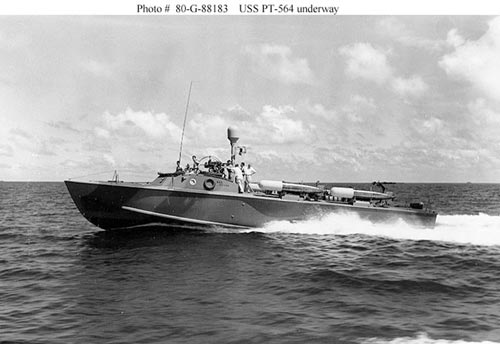
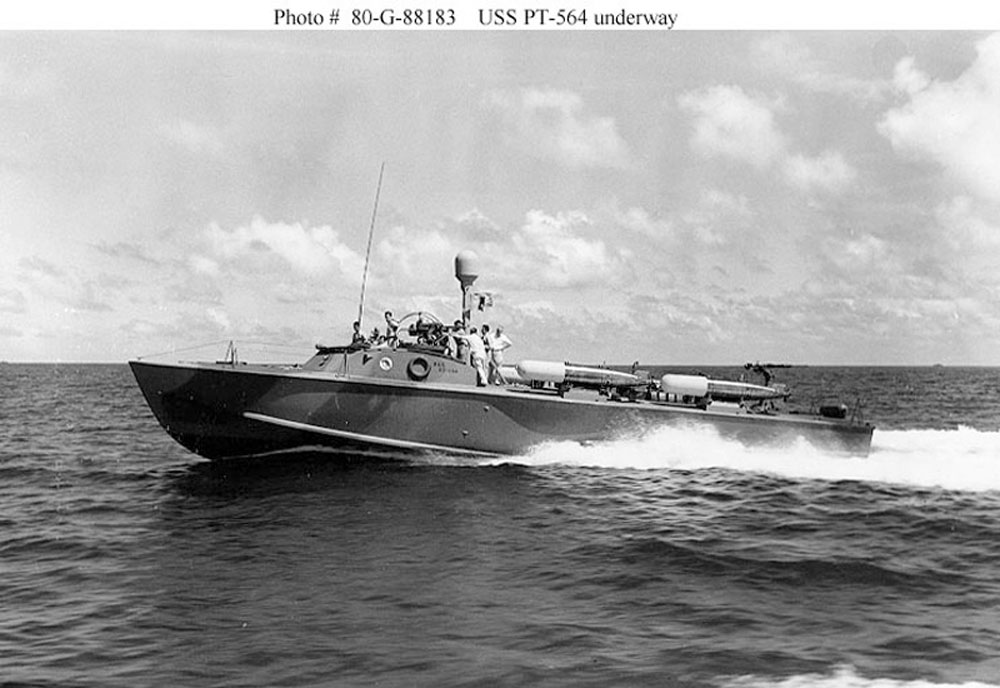
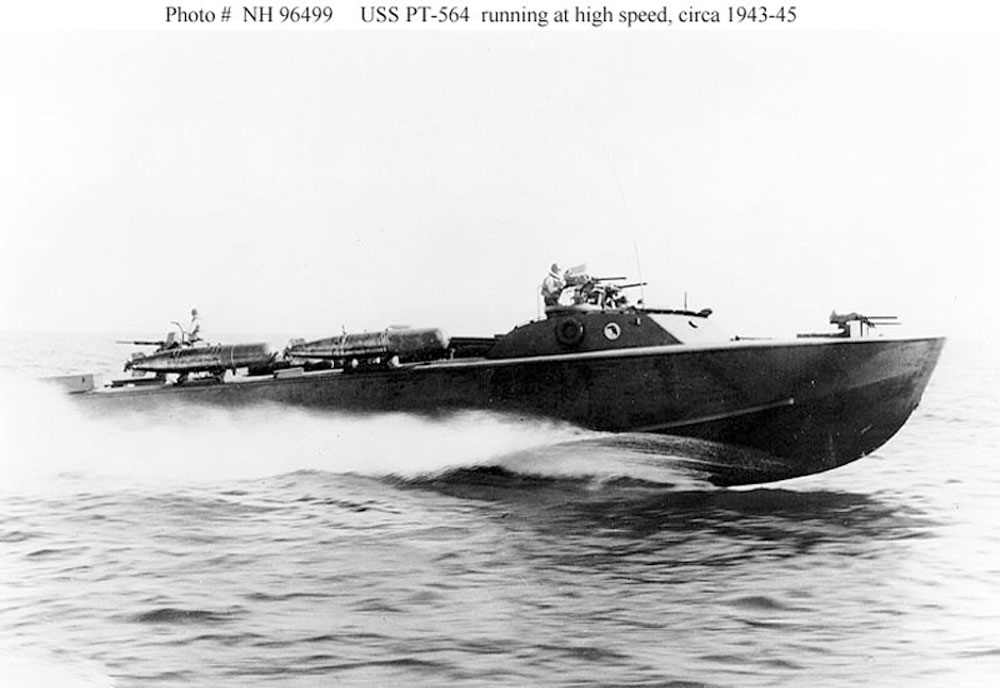
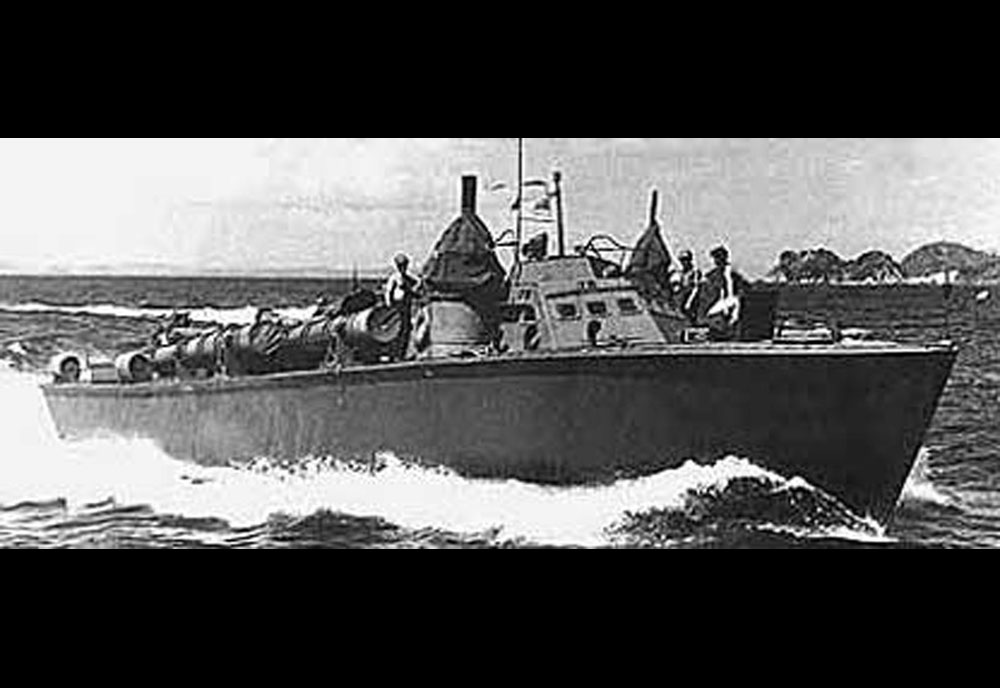
Design-wise, the Higgins boat managed a rather conventional appearance and layout. Often confused with the ELCO and Huckins boats they competed with, and operated alongside, Higgins boats were clearly distinguished by their well-forward set cockpit superstructures aft of a short forecastle. Armament was situated to the starboard side of the cockpit cabin structure, at amidships and at the stern. The four torpedo tubes were set along the sides of the vessel and angled outwards of the vessel's centerline. A small life raft was carried ahead of the cockpit and offset to the portside. Various hatches allowed for crew entry/exit of the vessel from virtually any area of the top deck. Like their ELCO brethren, the Higgins boat armament were always in the process of being modified "in-the-field" per mission requirements - even standardized USN armament changed based on successes encountered with ad hoc weapon arrangements.

First American combat actions of Higgins PT boat crews took place in the oft-forgotten battles of the Aleutian Islands campaign near Alaska. The Japanese invaded the island chain in an effort to attract the attention of US Navy forces away from Midway but American code-breaking prowess revealed the move to be nothing more than a strategic ruse. As such, the campaign to take back the islands received little in the way of attention and it was a combined Canadian-American military effort that ultimately won back control of the island chain from the Japanese - though not without loss of life and equipment in this unforgiving part of the world.

Other Higgins boat crews operated their 78-footers in the Mediterranean region and these proved highly effective in managing control of waterways important to the Axis. Supply lines running from southern Europe into northern Africa were critical to Axis success on the African continent and Allied control of these waterways would play just as important a role when the Allies would move to retake these key strategic areas en route to their final assault on Italy and Germany proper. Primary adversaries in these waters became the German Navy "E-Boot" and "S-Boot" class vessels of similar design scope. Higgins boats were also active on the morning of the Allied D-Day invasion into Northern France. These vessels were used to screen potential German naval presence away from the landing forces and offered due protection to the amphibious operation as a whole.
Continue to Page 2 (of 2) >>
Text ©2003-2013 www.MilitaryFactory.com • All Rights Reserved • No Reproduction Permitted
MilitaryFactory.com does NOT sell equipment/weaponry. Material presented throughout this website is for historical and entertainment value and should not to be construed as usable for hardware restoration, maintenance or general operation. Please consult manufacturers for such information. Our disclaimer. Email corrections / Comments to MilitaryFactory at Gmail dot com.
Picture of Higgins PT Boat (Patrol Torpedo)
Pic of the Higgins PT Boat (Patrol Torpedo)
Image of the Higgins PT Boat (Patrol Torpedo)
View All Images (3)

Specifications for the
Higgins PT Boat (Patrol Torpedo)
Patrol Boat / Motor Torpedo Boat


Country of Origin: Please Select
Initial Year of Service: 1942
Operators: Soviet Union; United Kingdom; United States


Crew: 11


Length: 78.5ft (23.93m)
Beam: 20.1ft (6.13m)
Draught: 5.2ft (1.58m)
Displacement: 43tons


Machinery: 3 x Packard 3M-2500 / 4M-2500 / 5M-2500 12-cylinder gasoline engines delivering 1,350 to 1,500 horsepower each to 3 x shafts.


Surface Speed: 40kts (46mph)
Range: 282miles (454km)


Armament:
4 x 21-inch (533mm) torpedo tubes for 4 x Mark 8/13 torpedoes, launchers arranged as inline pairs along port and starboard sides.
1 x 37mm OR 40mm Dual-Purpose cannon fitted on forecastle.
1 x 20mm Oerlikon anti-aircraft cannon
4 x 0.50 caliber (12.7mm) anti-aircraft, air-cooled heavy machine guns in dual mounts (2x2), one emplacement amidships and one forward, offset to starboard.

Optional 0.30 caliber machine guns, mortar launchers, rocket projectors and additional 20mm cannons (and captured 23mm anti-tank guns) as required/available.


Ship Class: PT 71, PT 235 and PT625-class
Number-in-Class: 199
Ships-in-Class: PT 71-94; PT 197-254; PT 265-313; PT 450-485; PT 564 (experimental); PT 625-660 (PT 657-660 cancelled)

ALL NAVY SHIP CATEGORIES
Site Disclaimer | Privacy Policy | Site Map | MF Origins


©2013 www.MilitaryFactory.com • Content ©2003-2013 MilitaryFactory.com • All Rights Reserved • Site Contact Email: militaryfactory at gmail dot com. The "Military Factory" name and MilitaryFactory.com logo are registered ® trademarks and protected by all applicable domestic and international intellectual property laws.


Top MF Stuff: 2013 Military Pay Scale | Military Ranks | WW2 Weapons | Sniper Rifles | Kts to Mph | WW1 Aircraft | Automatic Rifles | Aircraft Cockpits | Vietnam War Weapons | Main Battle Tanks | Submachine Guns | Shotguns | French Military Victories


Most photographic images appearing on this site are courtesy of the United States Department of Defense and are approved for public use. Other images acquired through the public domain. Digital art work courtesy of Dan Alex. Business Consulting by Kyle Williams. Material presented throughout this website is for historical and entertainment value and should not to be construed as usable for hardware restoration, maintenance or general operation. Please consult manufacturers for such information.


eXTReMe Tracker