Military Factory
Military Pay Chart
Global Firepower
Military Industrial Complex
Second World War
Home
Military Pay Scale
Military Ranks
Small Arms
Aircraft
Land Systems
Navy
Education
Military Factory Facebook Logo
flag of United Kingdom

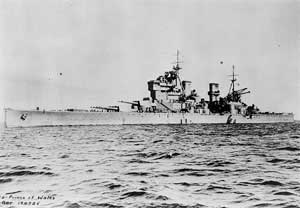
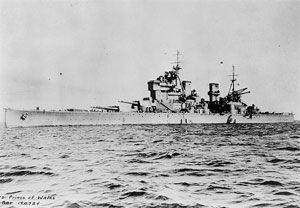
HMS Prince of Wales (53) Battleship (1941)

Authored By Staff Writer | Last Updated: 6/9/2011

The HMS Prince of Wales was partially responsible for the containment and eventual sinking of the KMS Bismarck.

The HMS Prince of Wales served the British Navy for a few short years in World War 2 taking part in the damaging that would lead to the eventually sinking of the mythical KMS Bismarck. She was a class of five King George V-class ships that included the HMS Duke of York, HMS Howe, HMS King George V and the HMS Anson. Together with the HMS Hood, she took part in the initial cat and mouse engagement of the mighty German battleship. The HMS Prince of Wales (or "PoW") survived long enough to ferry Prime Minister Winston Churchill to Newfoundland to meet with US President Roosevelt for the Atlantic Charter and suffered her fate at the hands of Japanese torpedo bombers on her way out of Singapore in the Pacific Theater.

By battleship standards in World War 2, the HMS Prince of Wales was slight in design considering the naval treaty-violating monsters that became the German KMS Bismarck and the Japanese IJN Yamato. She was fielded with 10 x 14" main guns, putting her power behind even the American Iowa-class battleships being laid down but offering up of a higher rate of sustained fire as a result. Whereas the Germans, Japanese and Americans had the luxury of either operating in secrecy to create their new battleships, bending or completely disregarding treaty limitations or designing battleships with the war in full swing, the Prince of Wales was built and adhered to the naval treaties in place that limited battleship construction to around 35,000 tons.

Armament was a mix of offensive and defensive systems starting with the 14" main guns held in two forward and one aft turrets. This was augmented by the addition of no fewer than 16 x 5.25 guns for added effect. Defensive capabilities were accomplished through 32 x 2-pounder "pom-pom" dual-purpose cannons and 16 x 12.7mm (.50 caliber) anti-aircraft heavy machine guns. Power was derived from 4 x Parsons geared turbines fed by 8 x Admiralty three-drum small-tube superheated boilers. Total output was 110,000 shaft horsepower providing an adequate 28 knot surface speed. Two Supermarine Walrus type amphibious aircraft were carried aboard and used for patrol, reconnaissance and search & rescue duty and launched from a double-ended catapult system amidships. Twin masts characterized the type and mounted each superstructure.

The HMS Prince of Wales, just barely out of construction, was called to action almost immediately with her new technology, unbroken systems and untrained gunnery crew. The Prince of Wales was joined by the HMS Hood in a battle of mythical and historical proportions. In the heat of the Bismarck battle, the HMS Hood was placed out of commission by the KMS Prinz Eugen, leaving the Prince of Wales to defend herself against the two German ships. The HMS Prince of Wales caught a disastrous direct hit to her bridge that forced her to retire from the fight to live another day. All was not at a loss however, as the HMS Prince of Wales managed to score hits on the Bismarck that would contaminated its fuel supply, forcing it to head towards Brest for repairs. This seemingly random act would become the undoing for Hitler's pride as the Bismarck would soon be hunted down and sunk miles away from her French destination.

The HMS Prince of Wales was later stationed in the Pacific off Singapore by October of 1941. In December of that year, she was caught with the HMS Repulse by over 80 Japanese bombers and torpedo bombers. A critical hit by an enemy torpedo against her port propeller shaft forced the spinning propeller to cut into the hull. This began uncontrollable flooding and furthermore cut power to her 5.25" gun batteries along with power to her pumps leaving a blind, helpless and shocked Prince of Wales crew on the brink. Without the ability to maneuver, the HMS Prince of Wales was at the mercy of more torpedo attacks, catching four more into her side. The Prince of Wales was officially out of action and would sink in a short hour and twenty minutes time taking with her hundreds of British souls and her Admiral (Phillips) and Captain (Leach).

The HMS Prince of Wales was ordered in 1936 and laid down by the Cammell Laird and Company in 1937. She was launched in 1939 and officially commissioned in March of 1941 surviving till December of that year.
Text ©2003-2013 www.MilitaryFactory.com • All Rights Reserved • No Reproduction Permitted
MilitaryFactory.com does NOT sell equipment/weaponry. Material presented throughout this website is for historical and entertainment value and should not to be construed as usable for hardware restoration, maintenance or general operation. Please consult manufacturers for such information. Our disclaimer. Email corrections / Comments to MilitaryFactory at Gmail dot com.
Picture of HMS Prince of Wales (53)
View All Images (1)

Specifications for the
HMS Prince of Wales (53)
Battleship


Country of Origin: United Kingdom
Initial Year of Service: 1941
Operators: United Kingdom


Crew: 1,422


Length: 745.1ft (227.11m)
Beam: 112.5ft (34.29m)
Draught: 32.6ft (9.94m)
Displacement: 43,350tons


Machinery: 8 x Admiralty three-drum small-tube superheated boilers with 4 x Parsons geared turbines generating 110,000shp.

Surface Speed: 28kts (32mph)
Range: 3,566miles (5,739km)


Armament:
10 x 14" main guns
16 x 5.25" guns
32 x 2-pdr anti-aircraft guns
16 x 12.7mm anti-aircraft machine guns


Air Arm: 2 x Supermarine Walrus amphibious aircraft


Ship Class: King George V-class
Number-in-Class: 5
Ships-in-Class: HMS Duke of York (17); HMS Howe (32); HMS King George V (41); HMS Prince of Wales (53); HMS Anson (79)

ALL NAVY SHIP CATEGORIES
Site Disclaimer | Privacy Policy | Site Map | MF Origins


©2013 www.MilitaryFactory.com • Content ©2003-2013 MilitaryFactory.com • All Rights Reserved • Site Contact Email: militaryfactory at gmail dot com. The "Military Factory" name and MilitaryFactory.com logo are registered ® trademarks and protected by all applicable domestic and international intellectual property laws.


Top MF Stuff: 2013 Military Pay Scale | Military Ranks | WW2 Weapons | Sniper Rifles | Kts to Mph | WW1 Aircraft | Automatic Rifles | Aircraft Cockpits | Vietnam War Weapons | Main Battle Tanks | Submachine Guns | Shotguns | French Military Victories


Most photographic images appearing on this site are courtesy of the United States Department of Defense and are approved for public use. Other images acquired through the public domain. Digital art work courtesy of Dan Alex. Business Consulting by Kyle Williams. Material presented throughout this website is for historical and entertainment value and should not to be construed as usable for hardware restoration, maintenance or general operation. Please consult manufacturers for such information.


eXTReMe Tracker