Military Factory
Military Pay Chart
Global Firepower
Military Industrial Complex
Second World War
Home
Military Pay Scale
Military Ranks
Small Arms
Aircraft
Land Systems
Navy
Education
Military Factory Facebook Logo
flag of Imperial Japan

IJN Akagi Aircraft Carrier (1927)

Authored By Staff Writer | Last Updated: 7/10/2012

The Akagi served the Japanese Empire through the assault on Pearl Harbor only to be sunk some seven months later in the Battle of Midway.

Find a School Near You
Follow Military Factory on Facebook:
Trending on Military Factory:
Recent Articles:
The IJN Akagi was born from a battlecruiser class design consisting of the Akagi and the Amagi. These cruisers were under construction by the time of the end of the First World War and the Washington Naval Treaty signed enacted after the conflict limited naval production throughout the globe in an effort to thwart a new arms race. As such, construction of these battlecruisers was stopped and consideration was given to their dismantling. The Imperial Japanese Navy, however, proceeded to transform the Akagi and Amagi battlecruisers into full-fledged fleet carriers (the Amagi would later be destroyed in the Great Kanto earthquake of 1923).

The Akagi was ordered in 1920 and laid down later that year. The vessel was launched five years later and commissioned in 1927. She featured two hangar decks with stacked flight decks which, the thinking being, allowed fighters the ability to scramble directly from their hangars and land on the top-most flight deck when returning. On paper this seemed a sound idea but, when put into practice, the results were not as effective. As such, the Akagi was taken back into port for some re-working from 1935 up to 1938. Through this new effort, the additional flight decks were eliminated which allowed for more space to carry additional aircraft. A more contemporary island superstructure was also added to the design though this was placed along the not-so-traditional portside of the vessel.

With the Akagi fully ready she was put into action for the surprise attack on the American fleet at Pearl Harbor, Hawaii on December 7th, 1941. Akagi served a collection of torpedo bombers, dive bombers and fighter planes during the attack. With America no officially in the war, the Doolittle Raid (launched from the USS Hornet) caused quite a stir in Japan, showing that the Empire was not immune to the reach of the American military. The Akagi was sent in, unsuccessfully, to find and destroy the carrier. Shortly thereafter the Akagi was called to take part in the invasion of the island of Java and several actions against British Royal Navy cruisers off India by 1942.

The Akagi's involvement in World War 2 came to an abrupt end at the Battle of Midway on June 4th, 1942. Facing off against the USS Enterprise and her band of fighters and bombers, the Akagi was assaulted by American navy warplanes and struck once - thought critically - by dive bombers. The explosion ignited an inferno aboard her hangar decks (containing fuel and fully-laden aircraft ready for take-off). A second American bomb landed externally - though close enough - to jam her rudder and the Akagi became a helpless vessel burning throughout the following night. By the morning of June 5th, 1942, with most of her crew evacuated to other ships, the Akagi was ordered sunk by her own destroyers and was eventually torpedoed. Some 267 personnel perished with her. Strategically important to the Allies was the loss of four Japanese carriers at the Battle of Midway, taking away much of the "reach" of the IJN in one fatal blow.
Text ©2003-2013 www.MilitaryFactory.com • All Rights Reserved • No Reproduction Permitted
MilitaryFactory.com does NOT sell equipment/weaponry. Material presented throughout this website is for historical and entertainment value and should not to be construed as usable for hardware restoration, maintenance or general operation. Please consult manufacturers for such information. Our disclaimer. Email corrections / Comments to MilitaryFactory at Gmail dot com.
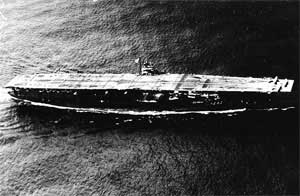
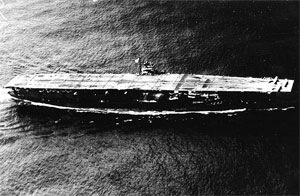
Picture of IJN Akagi
View All Images (1)

Specifications for the
IJN Akagi
Aircraft Carrier


Country of Origin: Imperial Japan
Initial Year of Service: 1927
Operators: Imperial Japan


Crew: 2,000


Length: 816ft (248.72m)
Beam: 100ft (30.48m)
Draught: 27ft (8.23m)
Displacement: 33,800tons


Machinery: 19 x Kampon water-tube boilers; 4 x Kampon geared steam turbines; 4 x shafts


Surface Speed: 32kts (37mph)
Range: 9,196miles (14,800km)


Armament:
6 x 20cm/50 caliber (7.9-inch) guns
6x2 120mm (4.7-inch) anti-aircraft guns
14x2 25mm (1-inch) anti-aircraft guns


Air Arm: 1941:
18 x Mitsubishi A6M "Zero" fighters
18 x Aichi D3A "Val" dive bombers
27 x Nakajima B5N "Kate" torpedo bombers

1942:
21 x Mitsubishi A6M "Zero" fighters
21 x Aichi D3A "Val" dive bombers
21 x Nakajima B5N "Kate" torpedo bombers


Ship Class: Akagi-class
Number-in-Class: 2
Ships-in-Class: IJN Akagi; IJN Kaga (half-sister)

ALL NAVY SHIP CATEGORIES
Site Disclaimer | Privacy Policy | Site Map | MF Origins


©2013 www.MilitaryFactory.com • Content ©2003-2013 MilitaryFactory.com • All Rights Reserved • Site Contact Email: militaryfactory at gmail dot com. The "Military Factory" name and MilitaryFactory.com logo are registered ® trademarks and protected by all applicable domestic and international intellectual property laws.


Top MF Stuff: 2013 Military Pay Scale | Military Ranks | WW2 Weapons | Sniper Rifles | Kts to Mph | WW1 Aircraft | Automatic Rifles | Aircraft Cockpits | Vietnam War Weapons | Main Battle Tanks | Submachine Guns | Shotguns | French Military Victories


Most photographic images appearing on this site are courtesy of the United States Department of Defense and are approved for public use. Other images acquired through the public domain. Digital art work courtesy of Dan Alex. Business Consulting by Kyle Williams. Material presented throughout this website is for historical and entertainment value and should not to be construed as usable for hardware restoration, maintenance or general operation. Please consult manufacturers for such information.


eXTReMe Tracker