Global Firepower | Military Industrial Complex | Second World War History
Home | Military Pay Scale Chart | Aircraft | Infantry Weapons | Military Vehicles | Navy Ships | Military Education | French Military Victories | Military Ranks | WW2 Weapons
Military Factory Latest from Military Factory
Thumbnail picture of the Dardo infantry fighting vehicle
Dardo IFV
Thumbnail picture of the Supermarine Scimitar fighter
Supermarine Scimitar
Thumbnail picture of the Centauro B1 8x8 tank killer
Centauro 8x8
Thumbnail picture of the Novi Avion fighter
Novi Avion
Thumbnail picture of the FR F2 bolt-action sniper rifle
FR F2
Thumbnail picture of the Lebel Model 1886 bolt-action rifle
Lebel Model 1886
2009 Military Pay Scale Chart - for Army, Navy, Air Force and Marines
  By Type
    · Age of Sail
    · Aircraft Carriers
    · Escort Carriers
    · Amphibious
    · Amphibious Assault
    · Battleships
    · 2nd Class Bttlshps
    · Cargo Ships
    · Cruisers
    · Destroyers
    · Dreadnoughts
    · Pre-Dreadnoughts
    · Frigates
    · Ironclads
    · Midget Submarines
    · Mine Sweepers
    · Patrol Craft
    · Pocket Battleships
    · Special Forces
    · View All Ships
  Submarines
    · Full List
    · Diesel-Electric
    · Ballistic Missile
    · Nuclear Attack
  World War 2
    · Full List
    · Aircraft Carriers
    · Battleships
    · Destroyers
    · Submarines
    · US Warships
  Vietnam War
    · Full List

MilitaryFactory > Navy Ships > Admiral Kuznetsov (CV Project 1143-5/6)
 
 
More Pictures CompareX2 Conversions Dictionary Acronyms

Admiral Kuznetsov (CV Project 1143-5/6)

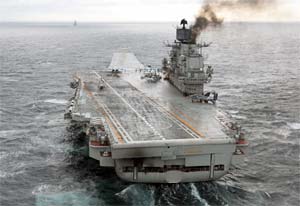
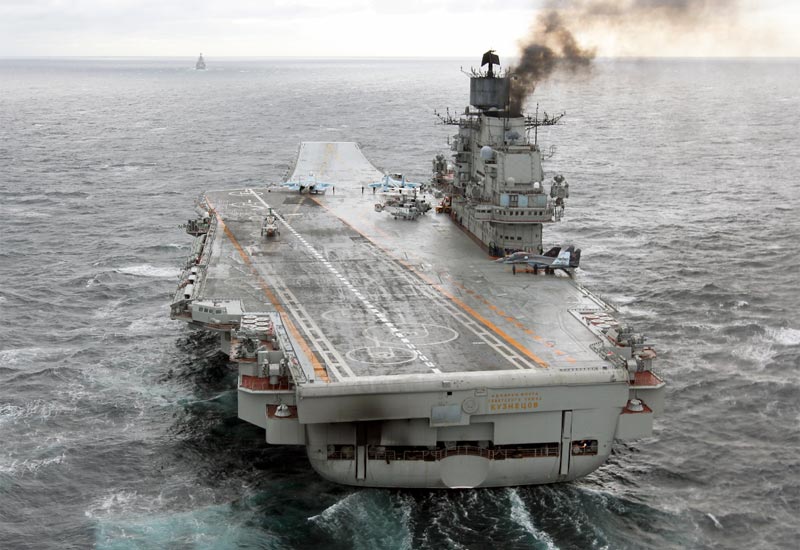
The Admiral Kuznetsov is the only ship in her class, as her sister ship Varyag was never completed
By JR Potts, AUS 173d AB

Bookmark and Share

Do to historical and political considerations carrier development got off to a slow start in the Soviet Union. The debate over large decked carriers has been ongoing for decades starting the 1930’s with Stalin; however two carriers were planned but cancelled with the start of WW II with the ground war being the major consideration. After the war the Soviet Navy saw how the aircraft carrier played a pivotal role in defeating Japan. In 1945 the Soviets drafted plans to construct a new class of carriers by the 1950’s. With Stalin’s death in 1953, Khrushchev took over the Soviet state and announced deep military cuts. The plans to construct a new class of carriers were stopped by Khrushchev feeling that a nuclear strike would eliminate a carrier as a viable weapon so the carrier program became a prime target for cancellation.

In the early 1960’s when the Brezhnev regime took over, the carrier became a reality with the Moskva and the Leningrad built between 1965 and 1968. However they were not true aircraft carriers supported only with helicopters, no fixed wing aircraft. This concept was one of antisubmarine vessels used as a weapon suite that protected against the American nuclear submarine threat. Again the compromise between the anti sub and fleet protection was the Kiev CVHG class in 1975, both were helicopter vessels. Arguments between the government and the military continued but the day of the true Soviet aircraft carrier was at hand in 1991 with the Kuznetsov CV class aircraft carrier.

Admiral Kuznetsov was first named “Riga” for the city of then “Leonid Brezhnev”, next was “Tbilisi” also a Russian city. Her classification was changed from “CV”, aircraft carrier, to “TAVKR”, or heavy aircraft carrying cruiser. The reason for the name change was the Montreaux Convention in 1936 stated an aircraft carrier CV could not pass through the Dardanelles. Russia’s carriers are built on the Black Sea making this an international issue when the time came for the ships to enter the Mediterranean Sea and beyond.

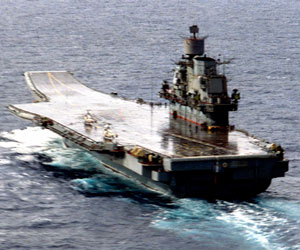
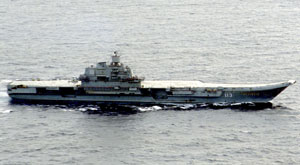
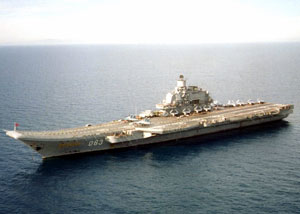
Currently Admiral Kuznetsov is the only Russian fixed wing carrier in service. She is conventionally powered and has a mixture of fixed wing aircraft and helicopters. The carrier’s main fixed-wing aircraft is the multirole Su-33. The air groups can perform air superiority, fleet defense, and air support missions. Also on board are twin seats Su-27, which are used for pilot training along with the Su-25UTG. The carrier also carries the Kamov Ka-27 and Ka-31 helicopters for anti-submarine warfare and troop transport.

Fixed wing aircraft taking off from the Admiral utilize a ski-jump on the front of the flight deck. Aircraft accelerate up the ski-jump using their afterburners. This results in the aircraft leaving the flight deck at a modestly higher angle and elevation than on an comparable American aircraft carrier with their flat deck and steam catapults. The ski-jump creates less G-force on the pilot because the acceleration is lower. The result is a takeoff speed of only 120-140 km/h requiring an aircraft engine that will not stall at low speeds.

The Russian Navy has indicated they will continue to be committed to aircraft carrier development based on the US Navy model. This is easy to say however it will require massive funds, technology and additional trained naval personnel currently not available. Also the Khrushchev mind set has not completely gone away with the cost of the USN model and anti-ship missiles making a carrier an easy target in a conflict. Another issue is the additional cost of the carrier fleet to protect the carrier. Some in Moscow feel this is not a good argument due to Russian ships having a weapons suite of SSM/SAM missiles on board for air threat protection. The expansion of a Russian carrier fleet is bleak at best. However the desire to provide political forward presence like the visit to Venezuela on 11/25/08 and Cuba in early 2009 is a top priority. The future of the Kuznetsov is problematic with parts becoming an issue and refits scheduled closer together. The Russian government feels she will be in service till 2030, being the only carrier supporting fixed wing aircraft. Another problem for the military will be to maintain her aged aircraft.

Her sister ship, Varyag was launched in 1988 but never completed. Some reports indicate is she is to be sold to the Peoples Republic of China another report says she will become a floating hotel. She is reported to be moored at the Nikolayev South shipyard in Ukraine. Navy officials indicated due to her material condition she will never go to sea.

History text ©2003-2009 www.MilitaryFactory.com • All Rights Reserved
No Reproduction Without Permission • Corrections / Comments to MilitaryFactory at Gmail dot com

Last Updated: 8/20/2009


  Specifications for the Admiral Kuznetsov (CV Project 1143-5/6)
arrow downDimensions:
Length: 999ft (304.50m)
Beam: 121.4ft (37.00m)
Draught: 34.4ft (10.49m)

arrow downPerformance:
Surface Speed: 30kts (35mph)
Range: 4,430miles (7,129km)

arrow downStructure:
Complement: 0
Suface Displacement: 67,000tons
arrow downPower:
Engine(s): 4 x shafts TV12-4 geared turbines; 8 x turbo pressurized boilers providing 200,000shp; 2 x 50,000hp turbines; 9 x 2,011hp turbo generators; 6 x 2,011hp diesel generators.
arrow downAir Arm:
18 x Su-27/33 air defense fighters
4 x Su-25 Frogfoot ground attack aircraft
15 x Kamov 27 helicopters
2 x Kamov 31 helicopters
arrow downArmament Suite:
12 x SS-N-19 Shipwreck anti-ship missiles in flush mountings.
24 x SA-N-9 Gauntlet SAM (VLS launchers)
8 x CADS-N-1 Kashtan CIWS SAM launchers
6 x 30mm/65 AK-630-AA gun mountings (6-barrel)
2 x 30mm Gatling AA cannons
1 x 6mm Gatling AA
2 x RPK-5 ASW/Anti-Torpedo rocket launcher
10 x 10 chaff dispensers
4 x 2 chaff dispensers

  Pictures of the Admiral Kuznetsov (CV Project 1143-5/6)
     
Picture of Admiral Kuznetsov (CV Project 1143-5/6)
Picture of the Admiral Kuznetsov (CV Project 1143-5/6)
Image of the Admiral Kuznetsov (CV Project 1143-5/6)
     
arrow upView All 5 Images

More Pictures CompareX2 Conversions Dictionary Acronyms

  Special Navy Ship Collections

Collections:
United States Navy Carriers
Modern Warships

World War 2:
Destroyers of World War 2
Navy Ships of World War 2
USN Warships of World War 2
Submarines of World War 2

Vietnam War:
Warhips of the Vietnam War

Miscellaneous:
Battle of Trafalgar
How Submarines Work
United States Navy Classification


  Recent Navy Ship Section Additions
Thumbnail picture of the USS New York LPD-21 amphibious support landing dock
USS New York (LPD-21)
Thumbnail picture of the Bell PACV/ACV hovercraft
Bell PACV/ACV
Thumbnail picture of the USS United States frigate of 1797
USS United States

  Contacting MilitaryFactory.com
We can only get better if you tell us how. You can contact MilitaryFactory.com at MilitaryFactory at gmail dot com (replace "at" with "@" and "dot with ".") with any questions, comments or corrections. We also accept related military imagery that you approve for us to use on our website. Keep in mind, however, that due to volume, we may not directly respond to your inquiry. Please add us to your list of non-blocked recipients!

Aircraft Carriers

  Navy Ship Profile:


Picture of the Admiral Kuznetsov (CV Project 1143-5/6).
Photo Courtesy of the United States Department of Defense

flag of Russia
1991
Designation: Admiral Kuznetsov (CV Project 1143-5/6)
Classification Type: Conventionally-Powered Aircraft Carrier
Ship Class: Admiral Kuznetsov

Country of Origin: Russia
Number in Class: 2

Operators: Russia


  Ships in Class
Admiral Kuznetsov; Varyag (never completed)

  Collections
  • Dreadnoughts - Bigger Ships, Bigger Guns
  • Pocket Battleships
  • Destroyers - Power of One
  • Tall Ships
  • Carriers of the United States Navy
  • Cruisers
  • Battleships of World War 2


Free GI Bill Guide

Top MF Stuff: Military Pay Scale Chart | Military Ranks | World War 2 Weapons | Sniper Rifles | Conversion Calculators


©2009 www.MilitaryFactory.com • Content ©2003-2009 MilitaryFactory.com • All Rights Reserved • Disclaimer Privacy Policy Site Map Origins
Most photographic images appearing on this site are courtesy of the United States Department of Defense and are approved for public use.
Other images acquired through the public domain. Digital art work courtesy of Dan Alex.
Business Consulting by Kyle Williams

Material presented throughout this website is for historical and entertainment value and should not to be construed as usable for
hardware restoration, maintenance or general operation. Please consult manufacturers for such information.

Site Contact: militaryfactory at gmail dot com (replace "at" with "@" and "dot" with ".") eXTReMe Tracker