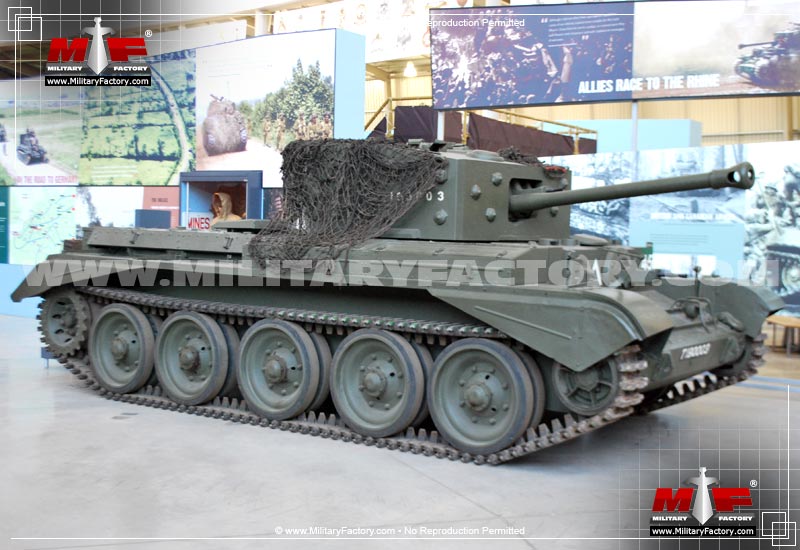
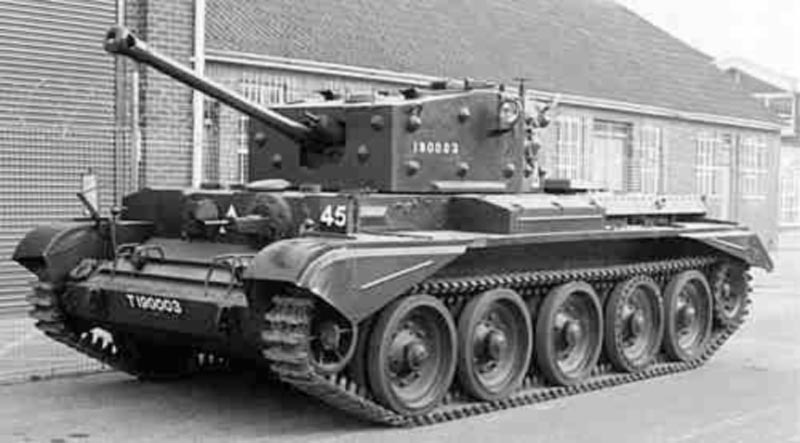
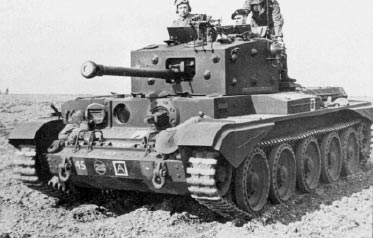
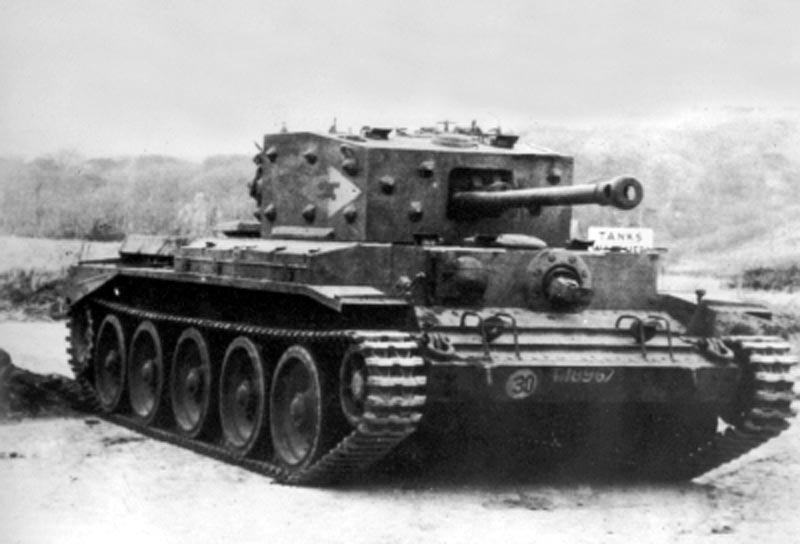
"The Cromwell was a major upgrade to previous British Cruiser Tank designs, finally giving British tank crews something on par to what the Germans were fielding in 1943."
The Cromwell (officially known as Tank, Cruiser, Mk VIII, Cromwell (A27M)) was one of two design proposals submitted to fulfill the British Army specification A27. The specification centered on a direct replacement for the army's Crusader series of tanks. While the other submitted design - becoming the Centaur (A27L) - was built around the inadequate Liberty engine, the Cromwell design (A27M) was built with the Rolls-Royce Meteor, this engine being a direct development of the same Rolls-Royce Merlin engine found in the spectacular Spitfire aircraft. While the Centaur's limitations kept it from fulfilling its true potential, the Cromwell was in many ways more of a success despite its eventual replacement by the American Sherman tanks arriving in the British inventory.
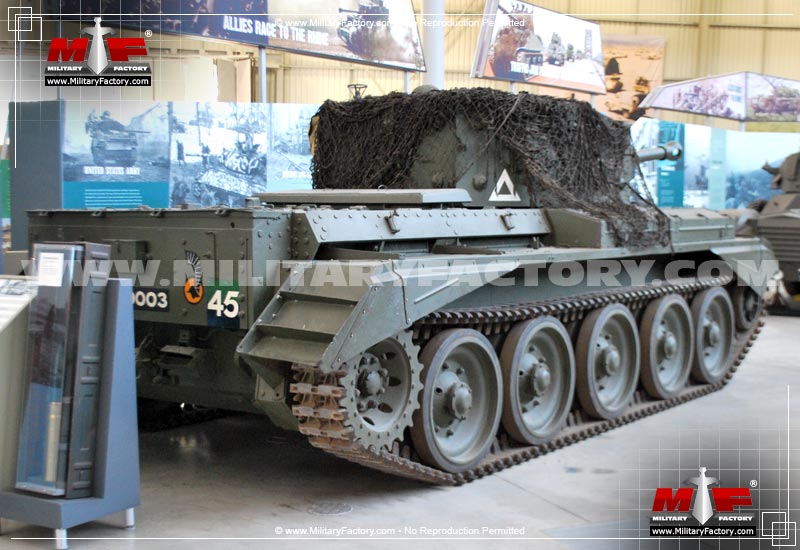
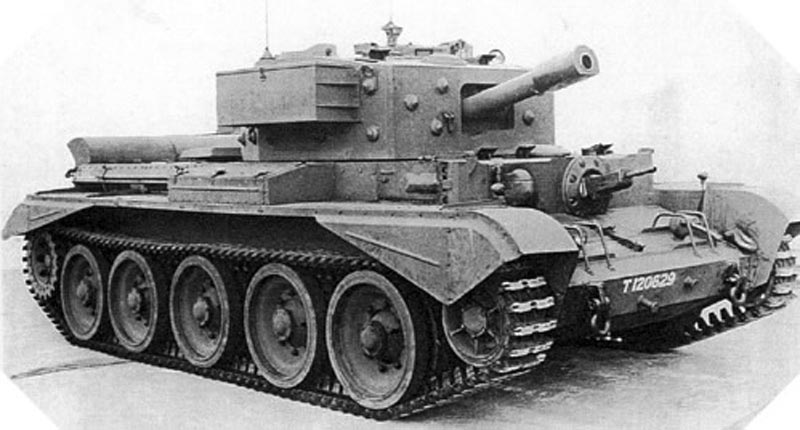
The Cromwell featured five road wheels to a side with no side skirts and some frontal protection. Design was such that it offered a lower profile when compared to the Sherman and armor protection was at least as much as offered on the American tank though the Cromwell's configuration was made up of flat faces - not offering much in the way of blast deflection from enemy rounds. In contrast, the Sherman featured sloping armor, adding to at least some additional degree of survivability when facing off with the potent German guns. The Cromwell's main gun was held in a boxy turret at the center of the hull, this component also with flat armor plates. The main gun (initially a 6-pdr but later upgraded to a 75mm) was complimented by two 7.92mm anti-infantry machine guns (most models), one mounted in the turret and the other in the bow of the hull.
The Cromwell appeared in three initial major marks (first tanks completed in January of 1943) known simply as Cromwell I, Cromwell II and Cromwell III - all featuring the 6-pdr (47mm) main gun. The Cromwell I had two BESA 7.92mm machine guns while the Cromwell II featured only one such machine gun but wider tracks for improved traction. The Cromwell IV then appeared as a "heavier" version and with the standard 75mm main gun - these were issued in October of 1943. The Cromwell VIII followed but these were fitted with the larger caliber 94mm main gun with the intention of using these systems in the close-support role in conjunction with infantry offenses.
The Cromwell saw first action in the Invasion of Normandy with the 7th Armored Division and played a successful role in the event and the inland attacks to follow. Crew response was positive for the Cromwell and the system was noted as being reliable with good maneuverability. The main gun action proved equally well-liked by her crews for she was easy enough to bring to bear, load and fire. Performance proved exceptional as well no doubt thanks to the Meteor powerplant and Christie suspension.
Compared to earlier British tank designs, the Cromwell was something of a dream. The system finally allowed British tank crews a viable weapon capable of engaging German armor thanks to its improved main armament and better armor protection - two elements not readily apparent in any of the previous cruiser tanks fielded. The Cromwell definitely made a name for itself in multiple capacities before the end of the war as the chassis was the basis for further specialized variants.
Despite the inherent usefulness in the Cromwell system, the daily additions of the American M4 Sherman tanks (from the middle of 1944 onwards) to the British Army inventories was slowly overtaking the Cromwell's reach. For the sake of logistics, the Sherman was to become the main medium tank of the British army for the duration of the war and, as such, the Cromwell was fitted into more auxiliary and reserve roles as time wore on. The Cromwell went on to become a noted trainer of British tank crews as a result and her chassis was reused in other more useful battlefield roles.
Success in the Cromwell design led to the development of the Comet, probably Britain's most successful tank design of the Second World War. The Comet saw use in the Korean War. Though designed by the Birmingham Railway Carriage and Wagon Company, production was handled by the Nuffield Organisation. Rover Car Company handled production of the Rolls-Royce Meteor engines.
Power & Performance Those special qualities that separate one land system design from another. Performance specifications presented assume optimal operating conditions for the Cruiser Tank Mk VIII Cruiser Tank / Medium Tank.
1 x Rolls Royce V-12 Meteor petrol engine developing 570 horsepower driving conventional track-and-wheel arrangement. Installed Power
38 mph 61 kph Road Speed
173 miles 278 km Range
Structure The physical qualities of the Cruiser Tank Mk VIII Cruiser Tank / Medium Tank.
5 (MANNED) Crew
21.1 ft 6.42 meters O/A Length
10.0 ft 3.05 meters O/A Width
8.2 ft 2.5 meters O/A Height
61,602 lb 27,942 kg | 30.8 tons Weight
Armament & Ammunition Available supported armament, ammunition, and special-mission equipment featured in the design of the Cruiser Tank Mk VIII Cromwell (A27M) Cruiser Tank / Medium Tank.
1 x 75mm L/36.5 main gun in front turret face.
1 x 7.92mm BESA machine gun in co-axial mounting in front turret face.
1 x 7.92mm BESA machine gun in bow mounting
AMMUNITION: 64 x 75mm projectiles.
4,950 x 7.92mm ammunition.
Variants Notable series variants as part of the Cruiser Tank Mk VIII Cromwell (A27M) family line.
Cruiser Tank Mk VIII "Cromwell" - Base Series Designation.
A27M - Base Model Designation.
Cromwell I - Based on Centaur I; fitted with Rolls-Royce Meteor engines; 357 examples produced.
Cromwell II - Wider tracks; only 1 x Besa 7.92mm machine gun; never produced.
Cromwell III - Centaur I models with Rolls-Royce Meteor engines.; 200 examples produced.
Cromwell IV - Centaur III models upgraded to Meteor engines; 1,935 examples produced.
Cromwell IVw - Fitted with Rolls-Royce Meteor engines; all-welded hulls.
Cromwell Vw - 75mm main guns; welded hulls.
Cromwell VI - Fitted with 95mm main gun; 341 examples produced.
Cromwell VII - Upgraded Cromwell IV and V models; wider tracks; improved armor protection; 1,500 examples produced.
Cromwell VIIw - Cromwell Vw models upgraded to Cromwell VII standards.
Cromwell VIII - Based on Cromwell VI with Cromwell VII upgrades.
Cromwell A33 - Heavy Armored Assault Tank; never produced.
Cromwell OP - Mobile Artillery Observation Post; sans main gun; extra communications equipment in way of radios.
Cromwell ARV - Armored Recovery Vehicle
Operators Global customers who have evaluated and/or operated the Cruiser Tank Mk VIII Cromwell (A27M). Nations are displayed by flag, each linked to their respective national land systems listing.
Total Production: 4,333 Units Contractor(s): Nuffield Organisation - UK
[ Soviet Union (Lend-Lease); United Kingdom ]
1 / 6
Image copyright www.MilitaryFactory.com; No Reproduction Permitted.
2 / 6
Image copyright www.MilitaryFactory.com; No Reproduction Permitted.
The "Military Factory" name and MilitaryFactory.com logo are registered ® U.S. trademarks protected by all applicable domestic and international intellectual property laws. All written content, illustrations, and photography are unique to this website (unless where indicated) and not for reuse/reproduction in any form. Material presented throughout this website is for historical and entertainment value only and should not to be construed as usable for hardware restoration, maintenance, or general operation. We do not sell any of the items showcased on this site. Please direct all other inquiries to militaryfactory AT gmail.com. No A.I. was used in the generation of this content.