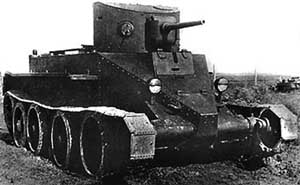
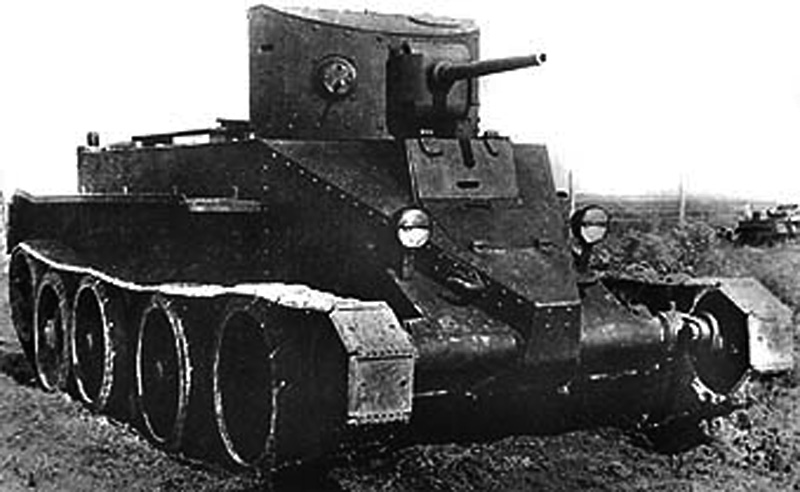
"The BT-2 Fast Tank officially began the BT-series of Soviet light tanks featured in World War 2."
Power & Performance Those special qualities that separate one land system design from another. Performance specifications presented assume optimal operating conditions for the BT-2 (Bystrochodnij Tankov) Fast Light Tank.
1 x Model M-5-400 (Liberty) 12-cylinder liquid-cooled gasoline engine developing 400 horsepower driving conventional track-and-wheel arrangement OR all-roadwheel arrangement. Installed Power
124 miles 200 km Range
Structure The physical qualities of the BT-2 (Bystrochodnij Tankov) Fast Light Tank.
3 (MANNED) Crew
18.0 ft 5.5 meters O/A Length
7.2 ft 2.2 meters O/A Width
7.2 ft 2.2 meters O/A Height
22,046 lb 10,000 kg | 11.0 tons Weight
Armament & Ammunition Available supported armament, ammunition, and special-mission equipment featured in the design of the BT-2 (Bystrochodnij Tankov) Fast Light Tank.
STANDARD:
1 x 37mm B-3 main gun
1 x 7.62mm DT coaxial machine gun
ALTERNATIVE:
2 x 7.62mm DT machine guns in turret
AMMUNITION: 92 x 37mm projectiles
2,500 to 2,700 x 7.62mm ammunition
Variants Notable series variants as part of the BT-2 (Bystrochodnij Tankov) family line.
BT-1 - Original Christie Prototype; sans turret.
BT-2 - Initial Soviet-inspired BT Fast Tank design; 1 x 37mm cannon with 1 x 7.62mm DT coaxial machine gun.
BT-3 - BT-2 design produced to metric measurements as opposed to Imperial.
BT-4 - Three welded-hull prototypes with revised suspensions.
BT-5 - 45mm armed combat tank.
BT-7 - Definitive BT tank.
Like many of the military powers prior to World War 2, the Red Army adopted a series of light, fast tanks intended to overwhelm enemy positions through speed and numbers. The Soviets began development of such a system in the early 1930s when, in 1931 out of the Kharkov heavy industry facility, engineer M.N. Toskin went to work on a new light tank in the mold of a design originating with American engineer John Walter Christie. The initial prototype was nothing more than the Christie design completed without a turret and designated simply as "BT-1". The design was further evolved with more Soviet influence by A.O. Firsov to become the "BT-2" and formally adopted by the Red Army on May 23rd, 1931. Serial production for the BT-2 was scheduled the following year and manufacture of hulls and turrets were to be handled by separate facilities.
Design of the BT-2 incorporated a distinct wheel-and-track system in which the track sections could be removed, allowing the vehicle to run on its road wheels (the removal process taking approximately 30 minutes to complete). The hull was a highly faceted design with angles intended to deflect basic small arms fire and artillery spray. Construction of the hull included use of heavy riveting and thickness of up to 13mm. The general internal arrangement of the vehicle was highly conventional with the driver at the front center of the hull, the fighting compartment at the middle (along with the turret emplacement) and the powertrain at the rear. The turret was located along the hull roof as a cylindrical installation with unfettered access to engage at all angles about the vehicle. The installation was also noticeable fitted well-ahead of amidships, a design element to be carried over into the war-winning T-34 Medium Tank to follow. The original design called for a two-man crew in which the commander would double as his own gunner and loader of the primary weapon. However, this was given up in favor of incorporating a third crewmember to manage the loading of the main gun, leaving the commander available to direct his crew and manage the main gun proper. The wheel-and-track arrangement constituted four large road wheels with the drive sprocket at the front of the design and the track idler at the rear. When in "wheeled" mode, the front set of wheels were steerable. These were locked when the track links were set in place, turning then accomplished by managing each entire track side as normal. Though trialed with onboard radio sets as early as 1933, official production BT-2 tanks did not incorporate communications equipment due to their poor showing in tests.
Power was served through an American-originated Liberty 45V 12-cylinder, liquid-cooled gasoline-fueled engine of 400 horsepower. In Soviet nomenclature, this became the "Model M-5-400". Maximum road speed peaked at approximately 62 miles per hour with an operational range of 75 miles on tracks and up to 120 miles on road wheels (the tracks having been removed). As a Christie design, the BT-2 was suspended atop a Christie suspension system - common to several Soviet tanks of the period.
While primary armament of the BT-2 fast tanks primarily centered around a 37mm B-3 cannon / 7.62mm DT coaxial machine gun combination, early production versions saw only 115 of the 180 first-batch tanks completed in this fashion, the remainder fielding only machine guns in the turret. The turret was traversed and elevated through manual means. The 37mm cannon was cleared to fire both an armor-piercing (AP) and high-explosive (HE) round. AP rounds were utilized against armored targets (such as enemy tanks) while HE rounds were utilized against soft targets and infantry. The AP projectile held a penetrative ability against 13mm of armor thickness at range which was adequate for the period and a popular caliber featured in other combat tanks of the world. Total ammunition counts included 92 x 37mm projectiles along with 2,700 x 7.62mm ammunition - of course this could vary based on wartime availability and mission requirements.
The initial 180 BT-2 vehicles were then followed by some 440 BT-2 Light Tanks, these showcasing 2 x 7.62mm DT machine guns in their turrets. Up to 2,500 x 7.62mm rounds of ammunition were afforded to the crew.
Despite the newness of the BT-2 design, it could be improved and work on its successor was already underway in 1931 and into 1932, producing the follow-up "BT-3" mark. The BT-3 was nothing more than the BT-2 produced through metric measurements as opposed to Imperial and, therefore, officially recognized as the "BT-2" as well. The BT-2 itself was furthered into the BT-2-IS which served as a test platform. Other dedicated test platforms included the SBT Bridgelayer and the HBT-2 chemical warfare platform. The BT series of light tanks was truly improved with the arrival of the quantitative 45mm cannon-armed BT-5 Fast Tank of 1933 (the BT-4 appeared in only three prototypes with welded hull armor and revised suspension systems). The definitive BT tank arrived in the BT-7 of 1935 with its welded hull, Mikulin M-17T engine and a shrouded muffler system.
The BT-2 was available in number by the time of the German invasion of the Soviet Union in June of 1941. 594 BT-2 Fast Tanks were on hand despite their official retirement announced the year prior. Their available numbers and the level of desperation on the part of the Soviets ensured that the outmoded little tank was pressed into service. Many fell to German anti-tank guns while providing a valiant -if foolhardy - unprepared defense. When possible, damaged vehicles were repaired and pushed back into service to help stave off complete elimination. Others were dug into deep trenches with only their gun turrets exposed and utilized in a defensive role. Needless to say, the lightly-armed and armored BT-2 tanks (and her BT successors) did not fare particularly well in the hasty Soviet responses that followed the German assault.
A total of 620 BT-2 series light tanks were eventually produced. The series undoubtedly lay the groundwork for the T-34 Medium Tank to follow, the T-34 being the BT's direct successor in the Red Army inventory.
Operators Global customers who have evaluated and/or operated the BT-2 (Bystrochodnij Tankov). Nations are displayed by flag, each linked to their respective national land systems listing.
Total Production: 620 Units Contractor(s): State Factories - Soviet Union
[ Soviet Union ]
1 / 1
Image from the Public Domain.
Going Further... The BT-2 (Bystrochodnij Tankov) Fast Light Tank appears in the following collections:
The "Military Factory" name and MilitaryFactory.com logo are registered ® U.S. trademarks protected by all applicable domestic and international intellectual property laws. All written content, illustrations, and photography are unique to this website (unless where indicated) and not for reuse/reproduction in any form. Material presented throughout this website is for historical and entertainment value only and should not to be construed as usable for hardware restoration, maintenance, or general operation. We do not sell any of the items showcased on this site. Please direct all other inquiries to militaryfactory AT gmail.com. No A.I. was used in the generation of this content.