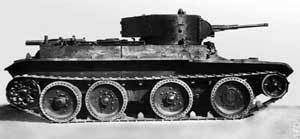
"The BT-5 Fast Tank preceded the much-improved BT-7 series into Soviet Army service and both led directly to the excellent T-34 Medium Tank of WW2."
Power & Performance Those special qualities that separate one land system design from another. Performance specifications presented assume optimal operating conditions for the BT-5 (Bystrochodnij Tankov) Light Fast Tank.
1 x Model M-5 gasoline engine developing 400 horsepower driving conventional track-and-wheel arrangement OR all-roadwheel arrangement. Installed Power
45 mph 72 kph Road Speed
124 miles 200 km Range
Structure The physical qualities of the BT-5 (Bystrochodnij Tankov) Light Fast Tank.
3 (MANNED) Crew
18.3 ft 5.58 meters O/A Length
7.3 ft 2.23 meters O/A Width
7.4 ft 2.25 meters O/A Height
25,353 lb 11,500 kg | 12.7 tons Weight
Armament & Ammunition Available supported armament, ammunition, and special-mission equipment featured in the design of the BT-5 (Bystrochodnij Tankov) Light Fast Tank.
1 x 45mm Model 32 main gun
1 x 7.62mm DT machine gun
AMMUNITION: 115 x 45mm projectiles
2,400 x 7.62mm ammunition
Variants Notable series variants as part of the BT-5 (Bystrochodnij Tankov) family line.
BT-5 (Model 1933) - Base Series Designation; initial production model designation; introduced in 1933.
BT-5PKh - Proposed amphibious design; prototype forms only.
BT-5A - Self-Propelled Gun Variant; limited production; fitting 76.2mm main gun.
BT-5 (flameprojector) - Flamethrower tank; prototype forms only.
PT-1A - Amphibious Tank; limited production.
The BT series of Soviet "Fast Tanks" was born out of a John Walter Christie design in the early 1930s featuring an American suspension system and engine. The initial Soviet influences produced the 37mm-armed BT-2 out of the original Christie BT-1 with the BT-3 following based on metric measurements as opposed to Imperial. The BT-4 proved just three prototype examples with welded hulls and revised suspension systems. In 1933, the series received a more definitive existence with the unveiling of the BT-5 sporting a 45mm main gun and coaxial 7.62mm DT machine gun.
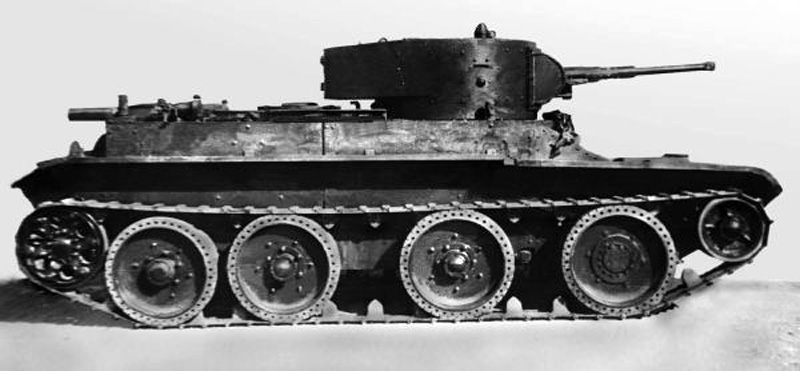
Even while the BT-2 was being worked on, the BT-5 was already being formed as early as 1932 and was intended as a modernization of the preceding type. The BT-5 retained the original's operating crew of three personnel made up of the driver in the front-center hull and the commander/gunner and ammunition handler in the turret. The internal layout was conventional with the driver in front, the fighting compartment at center and the powertrain at the rear. The turret was set well-forward of amidships which was a featured carried over into the upcoming war-winning T-34 Medium Tank. The running gear remained the same, dominated by four large pressed steel road wheels (now reinforced and no longer cast steel) to a hull side and a track link system encompassing the arrangement. Like the BT-2 before it, the BT-5 could see its tracks removed through a 30-minute manual process to which the vehicle could then run along its wheels, being steered by the front-most pair. This allowed for improved operational ranges across ideal, even surfaces (the tracks proved beneficial on uneven terrain).
Compared to the BT-2, the BT-5 was heavier (11.5 tons to 10.2 tons) while, dimensionally, its size was comparable. Armor protection remained 13mm at the thickest facing with 6mm along lighter, more vulnerable areas. The BT-5 was also powered by the American Liberty-based M-5 gasoline-fueled engine of 400 horsepower allowing for speeds of up to 45 miles per hour with a road range out to 200km. The design was decidedly slower than the BT-2 (45mph to 62mph) and limited in operational range (200km to 300km) on roads. External fuel stores could be fitted for increased ranges.
The major upgrade to the BT series came in the form of the larger-caliber 45mm Model 32 series main gun over that of the original's 37mm offering, this in a redesigned turret. 115 x 45mm projectiles were carried aboard. Defense was through a coaxial 7.62mm DT machine gun. Instead of the 13mm penetration value of the 37mm gun, BT-5 crews enjoyed penetration of up to 37mm of armor thickness at ranges reaching 1,000 meters. Ammunition options for the main gun included an armor-piercing (AP) and high-explosive (HE) type allowing the crew to engage both armored and unarmored targets with some level of success. The command vehicle version of the BT-5 retained its combat capabilities though the required additional communications equipment limited projectile stowage to 75 rounds.
Production of BT-5 tanks began in March of 1933 out of the Kharkov plant. For every five combat versions produced, a single iteration came with a radio set as the "BT-2RT". As many as 263 radio-fitted BT-5s were produced. 1933 also saw testing of a new V-2 diesel-fueled engine and these made their way into production tanks in 1939. Various other developmental platforms were also retained. The base BT-5 combat tank was further evolved into several distinct models including the the BT-5A artillery support tank mounting a 76.2mm howitzer and seeing limited production. Similarly, only a few of the PT-1A amphibious tanks were produced. The BT-5PKh amphibious platform and BT-5 flamethrower tank both resided in limited prototype forms.
Production of all BT-5s was eventually given up for good after some 1,884 examples had come off of the lines due to the arrival of the definitive, all-welded hull BT-7 Fast Tank model - in development from 1933 to 1934. The BT-7 incorporated a new M-17T engine of 500 horsepower, increased fuel stores, increased ammunition stowage space, increased maximum road speeds (53mph) and greater displacement (14-15 tons). The mark was eventually produced across three major variants to include the BT-7, the 76.2mm-armed BT-7A and the BT-7M. All fielded the same 7.62mm DT tank machine guns.
BT-5 tanks saw their official baptism of fire during the Spanish Civil War alongside Republican forces. The type saw additional combat actions in the Battle of Khalkhin Gol of the Soviet-Japanese border wars. It was then utilized with limited success in the Winter War against Finland from 1939 to 1940. In early engagements, BT-5 Fast Tanks proved successful largely due to their unquestioned speed and hard-hitting 45mm main gun which could penetrate available enemy tanks at range with little effort. By the time of the German invasion of the Soviet Union in Operation Barbarossa during June of 1941, the BT-5 had seen its best fighting days - its armor too weak and its main gun too small. Regardless, it was available in suitable numbers and pressed into service as both offensive and defensive set pieces. When on the defensive, BT-5 tanks could be dug in up to their turrets and left to await the oncoming enemy. Many were either destroyed or abandoned in the ensuing drive of the Germans which left few to combat by 1942. Regardless, the Red Army had mobilized and factories were outputting more potent combat tank systems such as the T-34 Medium Tank - the direct successor to the BT series. Captured BT-5 tanks was pressed back into service against their former masters along both the Finnish and Eastern fronts.
Operators Global customers who have evaluated and/or operated the BT-5 (Bystrochodnij Tankov). Nations are displayed by flag, each linked to their respective national land systems listing.
Total Production: 1,884 Units Contractor(s): State Factories - Soviet Union
[ China; Finland; Mongolia; Nazi Germany; Soviet Union; Spain ]
1 / 1
Right side profile view of the Soviet BT-5 Fast Tank
Going Further... The BT-5 (Bystrochodnij Tankov) Light Fast Tank appears in the following collections:
The "Military Factory" name and MilitaryFactory.com logo are registered ® U.S. trademarks protected by all applicable domestic and international intellectual property laws. All written content, illustrations, and photography are unique to this website (unless where indicated) and not for reuse/reproduction in any form. Material presented throughout this website is for historical and entertainment value only and should not to be construed as usable for hardware restoration, maintenance, or general operation. We do not sell any of the items showcased on this site. Please direct all other inquiries to militaryfactory AT gmail.com. No A.I. was used in the generation of this content.