Military Factory
Military Pay Chart
Global Firepower
Military Industrial Complex
Second World War
Home
Military Pay Scale
Military Ranks
Small Arms
Aircraft
Land Systems
Navy
Education
Military Factory Facebook Logo
flag of Nazi Germany

Panzerkampfwagen Neubaufahrzeug (PzKpfW NbFz V / VI) Heavy Tank Prototype (1934)

Authored By Staff Writer | Last Updated: 1/31/2013

The prewar German Neubaufahrzeug was a short-lived heavy tank program netting just five vehicles.

Find a School Near You
Follow Military Factory on Facebook:
Trending on Military Factory:
Recent Articles:
By the mid-1930s, Germany - under the power of Adolph Hitler - had undertaken broad reaching reforms that included modernizing the German military. As the combat tank was firmly entrenched in modern warfare, it grew into light, medium and heavy classes of which Germany developed all three to an extent. One such project became Neubaufahrzeug intending to design, develop and produce a heavy-class tank of a large scale for the German Army. Design work spanned from 1933 to 1934 and limited production began in 1934, completing in 1936. However, by this time, German armor concepts and battlefield doctrine held little use for heavy-class tank systems and the program produced just five working examples. At least three saw little combat, limited during the German invasion of Norway and none of the pilot vehicles would survive the war - scrapped on order - as museum pieces. Germany would, however, find success with later-war heavy tank designs such as the famous "Tiger I" and "Tiger II" series and forged ahead on many incomplete heavy tank programs before the end of the war - many proving too little too late to the German war effort.

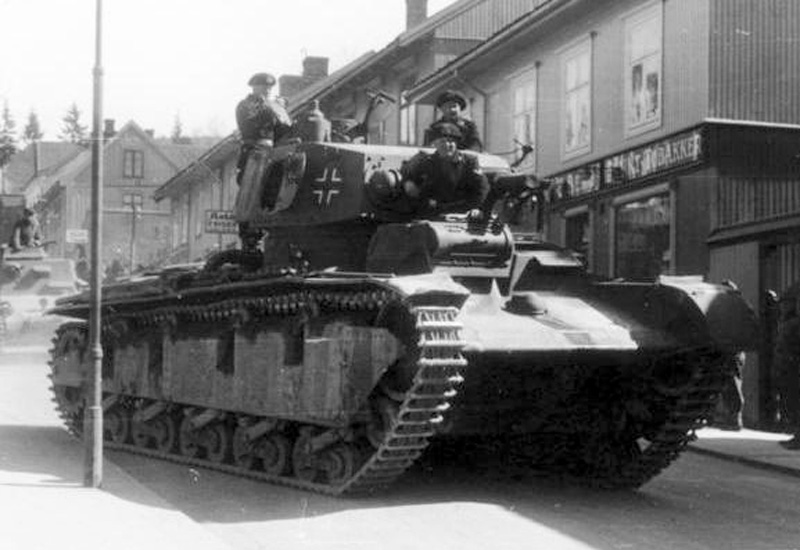
The Neubaufahrzeug initiative as born under the guise of a heavy tractor project to shield unwanted world attention away from a rearming Germany. Rheinmetall and Krupp, heavy industry specialists in the realm of steel and weaponry, each took to evolving respective proposals. Both concerns developed tracked armored systems with a multiple turret approach that proved popular in the 1920s and 1930s elsewhere. The basic design incorporated a fully-traversing main turret flanked in front and behind by smaller turrets. The primary turret fielded a highly-capable 75mm KwK L/24 series main gun and this was complemented by a 37mm KwK L/45 anti-tank gun fitting. Each of the smaller turrets were taken from original Panzer I light tank designs and retained their typically modest machine guns. In this way, the main turret crew could engage potential armor threats and the machine gun crews could defend the vehicle from possible infantry attacks. At one point, it was suggested that a 105mm field howitzer could also be fitted to the main turret in place of the dual-cannon arrangement. The main turret utilized some angled faces for basic ballistics protection but, when fitted atop the design, promoted a very tall profile on the battlefield.

The basic chassis utilized a multi-wheel approach with small road wheels suspended form bogies. The upper portions of the wheel system were covered over in side armor. The track linkage system ran about the side of the hull in the traditional way, covered only across its top section to protect the vehicle and any exposed crew from spurting mud being brought up by the tracks.

The glacis plate was well-sloped but, in many ways, betrayed by the forward Panzer I turret that seemed very out of place in the design. The track systems straddled the hull in a conventional manner and the engine was fitted to the rear of the tank. The propulsion system of choice was split between a BMW Va series engine of 290 horsepower or a Maybach HL 108 TR series engine of 300 horsepower. Operational ranges were in the vicinity of 75 miles with a top road speed of 16 miles per hour on ideal surfaces.

Due to the multiple turret approach, the vehicle was crewed by no fewer than six personnel. This involved the driver, commander, gunner, loader and machine gunners. Not only was the Neubaufahrzeug a complicatedly engineered beast, it also required specialized training for such a large crew contained in such a small space. Undoubtedly, such multi-turret designs soon showcased poor communications between the crew and a heavy load for the vehicle commander in the heat of battle.

To differentiate the Rheinmetall and Krupp Neubaufahrzeug designs, the German Army assigned different designations in line with accepted German nomenclature of the period. Therefore, the Rheinmetall Neubaufahrzeug was known as the "PzKpfW NbFz V" and the Krupp Neubaufahrzeug was recognized as the "PzKpfW NbFz VI". PzKpfW was the abbreviation of "Panzerkampfwagen" which, basically, translated to "Armored Fighting Vehicle" in German.

When the German Army officially went to war in the fall of 1939, the Panzer forces proved the spearhead the ground assault. While cavalry and motorcycle forces were still in play, it was the armored vehicle that came to embody the thrust of war concerning the campaigns of World War 2. The German Army made good on its use of light Panzer I and Panzer II tank systems and these were then supplemented and, ultimately, replaced by medium class tanks in the Panzer III and Panzer IV. The Panzer I and II hulls were then reconstituted for other battlefield roles in true German fashion. This left the Neubaufahrzeug largely out of place in both the early and late-war years fighting. For some time, they existed mainly as showcase tools for the German propaganda machine. During the German invasion campaign of Norway, several Neubaufahrzeugs were, in fact, delivered and at least three of the pilot vehicles arrived and saw limited combat. One was lost in a Norwegian swamp, ultimately detonated where she lay by German army engineers. Beyond that, there remains little evidence to suggest that the Neubaufahrzeug were ever serious players in the global conflict reaching deep into Europe.

As it stood, the Neubaufahrzeug proved nothing more than a forgotten German heavy tank program. Little remains (if anything) of these creations today, perfectly complementing their mostly forgotten legacy in military history.
Text ©2003-2013 www.MilitaryFactory.com • All Rights Reserved • No Reproduction Permitted
MilitaryFactory.com does NOT sell equipment/weaponry. Material presented throughout this website is for historical and entertainment value and should not to be construed as usable for hardware restoration, maintenance or general operation. Please consult manufacturers for such information. Our disclaimer. Email corrections / Comments to MilitaryFactory at Gmail dot com.
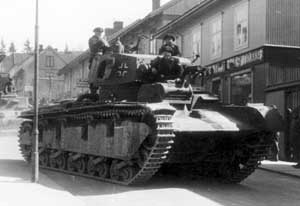
Picture of Panzerkampfwagen Neubaufahrzeug (PzKpfW NbFz V / VI)
View All Images (1)

Specifications for the
Panzerkampfwagen Neubaufahrzeug (PzKpfW NbFz V / VI)
Heavy Tank Prototype


Country of Origin: Nazi Germany
Manufacturer: Rheinmetall - Nazi Germany
Initial Year of Service: 1934
Production: 5


Focus Model: Panzerkampfwagen Neubaufahrzeug (PzKpfW NbFz V / VI)
Crew: 6


Overall Length: 21.65ft (6.60m)
Width: 7.19ft (2.19m)
Height: 9.78ft (2.98m)
Weight: 25.8 US Short Tons (23,414kg; 51,619lbs)


Powerplant: 1 x Maybach HL 108TR developing 300 horsepower OR 1 x BMW Va engine developing 290 horsepower.


Maximum Speed: 16mph (25 km/h)
Maximum Range: 75 miles (120 km)


NBC Protection: None
Nightvision: None


Armament:
1 x 75m KwK L/24 main gun and 1 x 37mm KwK L/45 gun in main turret
1 x 7.92mm MG 13/34 machine gun in frontal turret
1 x 7.92mm MG 13/34 machine gun in rear turret


Ammunition:
Not Available.


Variants:
Neubaufahrzeug - Base Series Designation; five prototypes completed by Krupp and Rheinmetall.


Operators: Nazi Germany

ALL LAND SYSTEMS CATEGORIES

By Decade:


1910 to 1919
1920 to 1929
1930 to 1939
1940 to 1949
1950 to 1959
1960 to 1969
1970 to 1979
1980 to 1989
1990 to 1999
2000 to 2009
2010 to 2019
VIEW ALL
Compare Tanks


By Type:


4x4 Military Vehicles
6x6 Military Vehicles
8x8 Military Vehicles
Artillery Gun Systems
Anti-Aircraft (AA) Guns
Anti-Aircraft (AA) Vehicles
Anti-Tank (AT) Guns
Anti-Tank (AT) Vehicles
Armored Cars
Armored Personnel Carriers (APC)
Battlefield Robots
Halftrack Vehicles
Heavy Tanks
Infantry Fighting Vehicles (IFV)
Light Tanks
Main Battle Tanks (MBT)
Modern Combat Tanks
Medium Tanks
Military Motorcycles
Multiple Launch Rocket Systems (MLRS)
Reconnaissance Vehicles
Special Purpose Vehicles
Self-Propelled Guns (SPG)
Tank Destroyers
General Purpose / Utility Vehicles


By Nation:


Afghanistan
Britain
China
France
Germany
Iran
Iraq
Israel / Israeli Army
Italy
Libyan Army
North Korea / North Korean Army
Pakistan
Russia
South Korea
Soviet Union
Syrian Army
United States
VIEW ALL

World War 2:


Artillery
Infantry Fighting Vehicles
Tank Destroyers (All)
Tanks (All)
Australian Tanks
British Tanks
Canadian Tanks
Cruiser Tanks (UK)
Czechoslovakian Tanks
French Tanks
German Tanks
German Tank Destroyers
German FlaK Guns
German Reconnaissance Vehicles
Hungarian Tanks
Italian Tanks
Japanese Tanks
Romanian Tanks
Soviet Tanks
Swedish Tanks
US Tanks
VIEW ALL


World War 1:


France WW1 Tanks
Germany WW1 Tanks
Britain WW1 Tanks
US WW1 Tanks
WW1 Artillery
WW1 Tanks (all)
VIEW ALL


Spanish Civil War:

VIEW ALL


Korean War:

Tanks
VIEW ALL


Vietnam War:

VIEW ALL


Cold War:

Cold War Tanks
Cold War American Tanks
Falklands War
Post-WW2 British Tanks
VIEW ALL


Gulf War (1991):

VIEW ALL


Miscellaneous:

Armored Vehicle Chassis Types

Site Disclaimer | Privacy Policy | Site Map | MF Origins


©2013 www.MilitaryFactory.com • Content ©2003-2013 MilitaryFactory.com • All Rights Reserved • Site Contact Email: militaryfactory at gmail dot com. The "Military Factory" name and MilitaryFactory.com logo are registered ® trademarks and protected by all applicable domestic and international intellectual property laws.


Top MF Stuff: 2013 Military Pay Scale | Military Ranks | WW2 Weapons | Sniper Rifles | Kts to Mph | WW1 Aircraft | Automatic Rifles | Aircraft Cockpits | Vietnam War Weapons | Main Battle Tanks | Submachine Guns | Shotguns | French Military Victories


Most photographic images appearing on this site are courtesy of the United States Department of Defense and are approved for public use. Other images acquired through the public domain. Digital art work courtesy of Dan Alex. Business Consulting by Kyle Williams. Material presented throughout this website is for historical and entertainment value and should not to be construed as usable for hardware restoration, maintenance or general operation. Please consult manufacturers for such information.


eXTReMe Tracker