In 1934, Sir John Carden of the Vickers-Armstrong concern began work on a fast, mobile tank requested by the British War Office. Doctrine of the day specified two distinct tank forms to encompass British Army actions - fast, light and capably-armed "cruiser" tanks and slower, well-protected and well-armed "infantry tanks". Cruiser tanks would use their speed and mobility to advance beyond enemy defenses and engage in disruptive actions behind the lines whereas infantry tanks would move ahead in support of infantry-minded actions, tackling enemy defenses and tanks head-on. For this initiative, the first cruiser tank to emerge proved to be the "Tank, Cruiser Mk I (A9)" of 1938. It was not an outright success and only 125 of the type were produced into 1941, the same year they were retired from service.
At the same time, Carden began work on a heavier design with slightly better armor protection intended for the infantry support role in cruiser tank form. The A9 and A10 had much in common including thin, long-running tracks set about a wheeled and suspended chassis. A short hull superstructure housed a 360-degree traversing turret at center. Where the A9 featured a pair of machine gun positions to either side of the hull superstructure, the A10 did away with these rather novel installations. Primary armament remained a QF 2-pounder (40mm) cannon fitted to the turret. Defense was through a coaxial 7.7mm Vickers machine gun and a hull-mounted 7.9mm BESA machine gun (front-right). The A9 armor thickness of up to 14mm was bettered in the A10's 30mm maximum. However, both designs were governed by the AEC Type A179 6-cylinder gasoline-fueled engine of 150 horsepower which only served to limit the heavier A10 design. Maximum speed was, therefore, 16 miles per hour on ideal surfaces with an operational road range of 100 miles. Comparatively, the A9 featured a top road speed of 25 miles per hour with a road range of 150 miles. The A10 was crewed by five personnel in what amounted to cramped working conditions. The crew included the driver seated in the front-left of the hull, the bow gunner seated at front-right and the commander, loader and gunner in the turret/central hull.
A pilot (prototype) vehicle emerged in 1936 as the "A10E1" to designate its experimental status. Despite its reduced performance specifications when compared to the preceding A9, the additional armor and capable armament was enough to warrant the type for formal adoption into the British Army. The vehicle was formally christened as the "Tank, Cruiser, Heavy Mk I" before this marker gave way to "Tank, Cruiser, A10 Mk I". The designation was once again formalized to become "Tank, Cruiser, Mk II" with serial manufacture ordered in July of 1938 amidst the growing clouds of war over Europe.
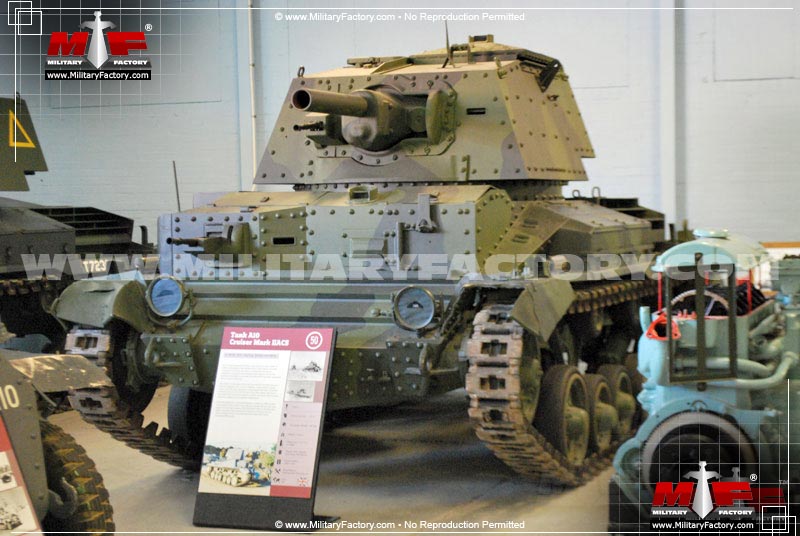
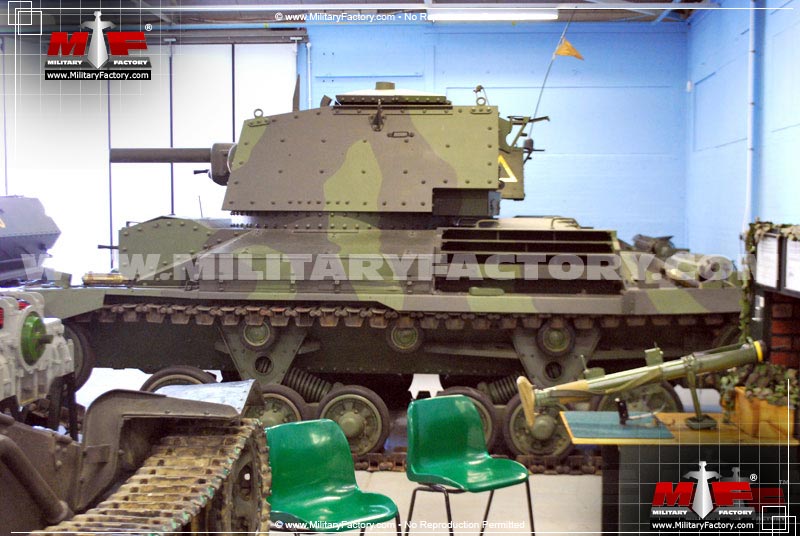
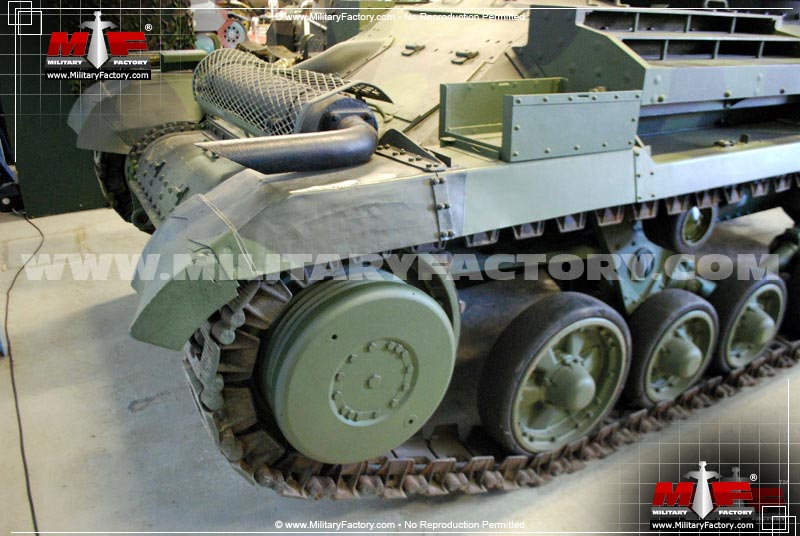
The A10 was of conventional design weighing in at 15.7 tons (short). She fielded a running length of 18 feet, 4 inches with a width of 8 feet, 4 inches. Her height to the turret top was 8 feet, 8 inches which made her a relatively small target at distance. The multiple crew was charged with operating in very tight confines though communication was relatively open with no compartment bulkheads featured. The engine was fitted to the rear of the hull which allowed for an expanded forward-set crew area. The drive sprocket was at the rear with the track idler at front and three track return rollers used to guide the upper track regions in place. The running gear included six rubber-tired road wheels with the two-most out ones being of a noticeably larger diameter than the four inside pairings. Riveted hull construction was highly apparent and presented a danger to the crew inside in the event of a direct hit (rivets and shell splinters could ricochet all about the inside). A pair of circular headlamps was installed at each front hull corner for low-level/night time driving. Not an imposing specimen, the A10 nonetheless filled a required need of the time.
First production quality vehicles entered service in late-1939/early-1940, the sole operator only ever being the British Army (the type was never exported). 175 units were ultimately ordered and this production was spread across Birmingham Railway Carriage and Wagon Company (45), Metropolitan-Cammell (45) and Vickers (10). A follow-up order with Birmingham Railway Carriage netted the final 75 units which proved rather distinct in their additional armor protection - though this did little to prove the type effective in modern combat of the day.
The A10 managed only a short service life in World War 2 when it was pressed into action during the defense of France through the British Expeditionary Force (BEF). Despite their being built around speed, these cruiser tanks had trouble navigating the variable French countryside under the stresses of combat that consisted of obstacles, uneven terrain and mud. They did prove reliable under certain circumstances, however, particularly when in use at the defense of Tobruk in the dry African desert during 1941. It was to be noted that many examples actually fell to their own mechanical shortcomings, primarily in the track links which were prone to breaking free of the running gear, than actual enemy fire during their short time abroad. With A10s still in supply, the type was also shipped for combat in Greece and gave a good account of themselves there on the whole. However, their use after 1941 fell off precipitously through basic wartime/mechanical attrition and more modern, capable models coming online in the British inventory.
Despite its limited production numbers, the A10 saw three major variants produced beginning with the original 31 examples under the base Mk II designation. The Mk IIA was similar with the exception of a protected radio station and the coaxial Vickers machine gun replaced by a BESA type for improved logistics (the same ammunition could now be used across both machine gun installations). The Mk IIA CS saw its 40mm main gun given up in favor of a 94mm field howitzer for use as a close support system (hence its "CS" designation). The Mk IIA CS model was primarily intended to supply on-call smoke screens for advancing (or retreating) friendly units. The A10 chassis went on to influence another more well-known British Army tank, the Valentine Infantry Tank of 1940 which saw production figures reach over 8,200 examples.
One example of the Cruiser Mk IIA CS resides at the Bovington Tank Museum in the UK.
Power & Performance Those special qualities that separate one land system design from another. Performance specifications presented assume optimal operating conditions for the Cruiser, Tank, Mk II (A10 Mark IA) Cruiser Tank.
1 x AEC Type A179 6-cylinder gasoline engine developing 150 horsepower. Installed Power
16 mph 26 kph Road Speed
100 miles 161 km Range
Structure The physical qualities of the Cruiser, Tank, Mk II (A10 Mark IA) Cruiser Tank.
5 (MANNED) Crew
18.1 ft 5.51 meters O/A Length
8.3 ft 2.54 meters O/A Width
8.5 ft 2.59 meters O/A Height
30,799 lb 13,970 kg | 15.4 tons Weight
Armament & Ammunition Available supported armament, ammunition, and special-mission equipment featured in the design of the Cruiser Tank Mk II (A10) Cruiser Tank.
1 x 40mm (QF 2-pdr) main gun.
1 x 7.92mm Vickers OR BESA coaxial machine gun.
1 x 7.92mm Vickers OR BESA hull-mounted machine gun.
AMMUNITION: 100 x 40mm projectiles.
4,050 x 7.92mm ammunition.
Variants Notable series variants as part of the Cruiser Tank Mk II (A10) family line.
Cruiser, Tank, Mark II (A10) - Formal Designation
Cruiser, Tank, Mark II (A10 Mk I) - Initial Production Model; Vickers machine guns.
Cruiser, Tank, Mark II (A10 Mk IA) - Second Production Model; BESA machine guns; armored radio compartment.
Cruiser, Tank, Mark II (A10 Mk IA CS) - Third Production Model / "Close-Support" Tank; fitted 94mm howtizer main gun.
Operators Global customers who have evaluated and/or operated the Cruiser Tank Mk II (A10). Nations are displayed by flag, each linked to their respective national land systems listing.
Total Production: 175 Units Contractor(s): Vickers (among others) - UK
[ United Kingdom ]
1 / 3
Image copyright www.MilitaryFactory.com; No Reproduction Permitted
2 / 3
Image copyright www.MilitaryFactory.com; No Reproduction Permitted
3 / 3
Image copyright www.MilitaryFactory.com; No Reproduction Permitted
The "Military Factory" name and MilitaryFactory.com logo are registered ® U.S. trademarks protected by all applicable domestic and international intellectual property laws. All written content, illustrations, and photography are unique to this website (unless where indicated) and not for reuse/reproduction in any form. Material presented throughout this website is for historical and entertainment value only and should not to be construed as usable for hardware restoration, maintenance, or general operation. We do not sell any of the items showcased on this site. Please direct all other inquiries to militaryfactory AT gmail.com. No A.I. was used in the generation of this content.