The Fiat M11/39 Medium Tank was another in the long line of tanks born from the influential British Vickers 6-Ton of 1928 (by way of the Italian L3 Tankette). Key to the design was its use of a leaf-spring bogie system reengineered from the original British imagining and the Italian design was more akin to the American M3 Grant/Lee Medium Tank series with its hull-mounted armament. The M11/39 was initially conceived of as a medium-class, tracked infantry support system intended to work in close proximity to infantry forces - protecting such elements from enemy infantry and armored vehicles alike. Like other Italian tanks developed prior to World War 2, the "M11/39" designation was a direct reflection of certain characteristics of the tank itself - "M" marking its categorization as a "medium-class" tank, "11" marking its weight in tons and "39" marking its year of formal adoption into the Italian Army (1939). Design work on the M11/39 began in 1937 by Ansaldo-Fossati to which production began in January of 1939, finishing in June of that year and producing 96 compete examples. Four prototypes were used in the development process and these were never fielded in action.
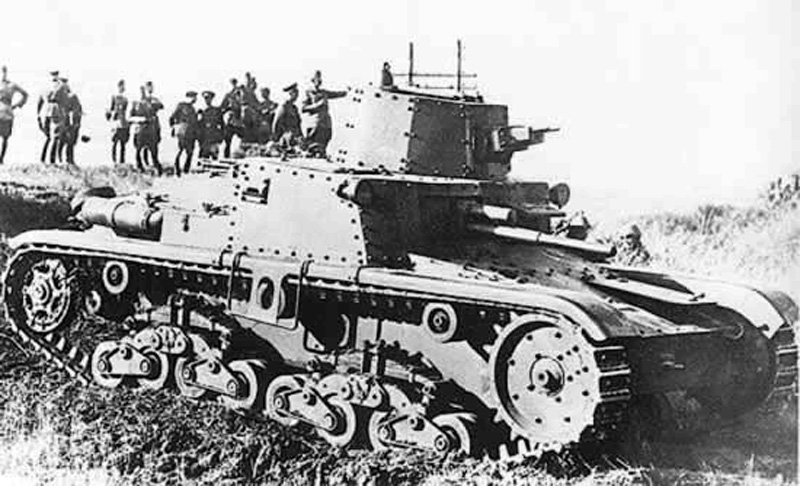
Outwardly, the M11/39 was of a conventional tracked armored vehicle design. The engine was concentrated within a compartment at the rear of the hull. The chassis was supported by two suspended, four-wheeled bogie systems with the drive sprocket at the front of the hull and the track idler at the rear. There were three track return rollers managing the upper regions of the track linkage system. The hull incorporated a fixed superstructure to provide internal room for the 37mm main gun armament, crew and ammunition supply. One of the critical failings of the M11/39 series was its implementation of the 37mm Vickers-Terni L/40 main gun which was fixed in place - forcing the crew to turn their entire tank to face a given target (as in the American M3 series). Traverse of the main gun was limited to 15-degrees left or right. This also promoted a rather tallish hull superstructure in the process (as in the American M3 series), making for a tempting target to anti-tank crews. There was a 360-degree traversing turret on the hull roof though this was only used to manage 2 x 8mm Breda 38 series machine guns for anti-infantry defense and fitted one crew. Additionally, the turret was powered by hand which made reaction times to incoming targets somewhat slow and cumbersome. The M11/39 was crewed by three personnel made up of the commander, gunner and driver. The driver was positioned in the front left hull with the gunner to the right. The gunner also doubled as his own loader while the commander doubled as the radio operator (if so equipped). While provisions for radio were made in the basic design, M11/39s were known to be delivered without, severely hampering tank-to-tank communications now reliant on hand signals and "runners". The fact that the gunner had to reload his own weapon was another tactical detriment to the M11/39 design and all this was further compounded by the fact that armor protection was only 30mm at its thickest facing - designed to counter shots up to 20mm in caliber - British tank guns had graduated to 40mm in caliber by this time. The M11/39 carried 84 x 37mm projectiles as well as 2,808 rounds of 8mm ammunition. Power for the series was supplied via a single Fiat SPA 8T V8 diesel-fueled engine developing 105 horsepower. This allowed for a top road speed of 20 miles per hour with an operational range nearing 125 miles.
Italy entered World War 2 on the side of the Axis powers in June of 1940. The M11/39 series was already in stock and promptly shipped to the battlefront that was North Africa (an improved version - the M13/40 - was already in the works by this time). About 72 M11/39 series vehicles were delivered for the North African campaign while a further 24 were sent to the east portion of the continent - providing a much needed "punch" for Italian armor offensives. At the beginning, the M11/39 proved a serviceable combat tank though, when ultimately pitted against thicker-armored foes, it fared quite poorly - particularly in its own armor protection and main armament. Additionally, the M11/39 - like other complex machinery of the interwar years - proved mechanically unreliable, particularly when pressed by the rigors of combat in environments for which it was never designed for. As such, the M11/39s tactical reach was rather limited in the broad scheme of war and the later British cruiser tank developments - primarily the Matilda and Valentine - proved more than a match for the Italian design. Once British tacticians realized their superiority over the M11/39, definitive steps were enacted to expose the Italian weakness in several campaigns. The M11/39 was simply in a fight that it was never truthfully designed for and its war record would go on to prove this. Some examples were known to be captured by the Allies - specifically the Australian Army - who reused these vehicles against their original owners for a time. These were appropriately painted with the white kangaroo insignia to mark their new owners. M11/39 tanks served operationally up until about 1944 - its production limited by the arrival of the more-capable M13/40 series.
An attempt to improve upon the M11/39 became the aforementioned "M13/40" - its designation marking it as a medium-class tank weighing in at 13 tons and adopted by the Italian Army in 1940. This model fielded a 47mm main gun in a 360-degree traversing turret with 104 x 47mm reloads as well as up to 4 x 8mm machine guns. 779 of this type were ultimately produced and used by several parties including Germany, Australia and the United Kingdom. The M13/40 became Italy's most-produced tank of World War 2 - leaving the M11/39 to the pages of history for other, less reputable reasons.
Power & Performance Those special qualities that separate one land system design from another. Performance specifications presented assume optimal operating conditions for the Carro Armato M11/39 Medium Tank.
1 x Fiat SPA 8T 8-cylinder diesel engine developing 105 horsepower. Installed Power
21 mph 33 kph Road Speed
124 miles 200 km Range
Structure The physical qualities of the Carro Armato M11/39 Medium Tank.
3 (MANNED) Crew
15.5 ft 4.73 meters O/A Length
7.2 ft 2.18 meters O/A Width
7.5 ft 2.3 meters O/A Height
24,637 lb 11,175 kg | 12.3 tons Weight
Armament & Ammunition Available supported armament, ammunition, and special-mission equipment featured in the design of the Carro Armato M11/39 Medium Tank.
1 x 37mm Vickers-Terni L/40 main gun in hull superstructure.
2 x 8mm Breda Model 38 machine guns in turret
AMMUNITION: 84 x 37mm projectiles
2,808 x 8mm ammunition
Variants Notable series variants as part of the Carro Armato M11/39 family line.
Carro Armato M11/39 - Base Series Designation
Operators Global customers who have evaluated and/or operated the Carro Armato M11/39. Nations are displayed by flag, each linked to their respective national land systems listing.
Total Production: 100 Units Contractor(s): FIAT / Ansaldo - Italy
[ Australia; Kingdom of Italy ]
1 / 1
Front right side view of the Carro Armato M11/39 Medium Tank
Going Further... The Carro Armato M11/39 Medium Tank appears in the following collections:
The "Military Factory" name and MilitaryFactory.com logo are registered ® U.S. trademarks protected by all applicable domestic and international intellectual property laws. All written content, illustrations, and photography are unique to this website (unless where indicated) and not for reuse/reproduction in any form. Material presented throughout this website is for historical and entertainment value only and should not to be construed as usable for hardware restoration, maintenance, or general operation. We do not sell any of the items showcased on this site. Please direct all other inquiries to militaryfactory AT gmail.com. No A.I. was used in the generation of this content.