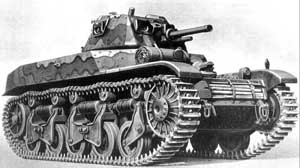
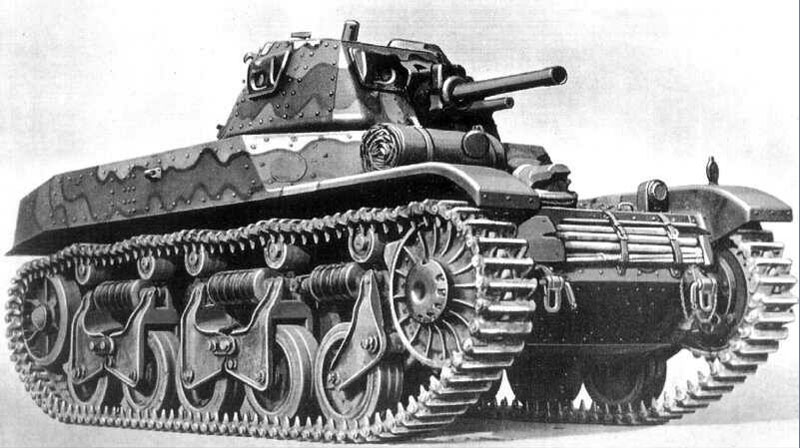
"The Renault AMC-35 Cavalry Tank served in limited numbers within the armies of Belgium, France and Nazi Germany."
Power & Performance Those special qualities that separate one land system design from another. Performance specifications presented assume optimal operating conditions for the AMC-35 Medium Cavalry Tank.
1 x Renault water-cooled 4-cylinder gasoline-fueled engine developing 180 horsepower. Installed Power
25 mph 40 kph Road Speed
100 miles 161 km Range
Structure The physical qualities of the AMC-35 Medium Cavalry Tank.
3 (MANNED) Crew
15.0 ft 4.57 meters O/A Length
7.3 ft 2.23 meters O/A Width
7.6 ft 2.33 meters O/A Height
31,967 lb 14,500 kg | 16.0 tons Weight
Armament & Ammunition Available supported armament, ammunition, and special-mission equipment featured in the design of the Renault ACG-1 / AMC-35 Medium Cavalry Tank.
1 x 47mm SA35 L/32 OR 47mm FRC main gun.
1 x 7.5mm Reibel OR 7.65mm Hotchkiss coaxial machine gun.
AMMUNITION: 120 x 47mm projectiles.
5,250 x 7.5mm ammunition.
Variants Notable series variants as part of the Renault ACG-1 / AMC-35 family line.
AMC-35 - Base Series Designation
ACG-1 - Altewrnative Designation
ACG-2 - Proposed Tank Destroyer Variant fitting 75mm main gun; single prototype example completed.
AMC-35 (smoke) - Smoke Laying Variant; single prototype example completed.
PzKpfw AMC 738(f) - German Army Designation of captured AMC-35 tanks.
PzKpfw AMC 738(b) - German Army Designation of captured AMC-35 tanks used for training.
The AMC-35 (or "Automitrailleuse de Combat Renault modele 1935") served the French and Belgian armies in the early stages of World War 2. It was classified as a Medium Cavalry tank designed to supplement cavalry actions in the field. While it displayed some good qualities, the tank ultimately suffered from mechanical issues, lack of armor protection, a stable of trained and qualified tanker crews and French armored doctrine of the time. The AMC-35 fought in the invasions of Belgium and France but were eventually knocked out of commission, abandoned by her crews or captured to serve with the German Army. Less than 60 were ever produced.
In the early 1930s, French authorities had decided upon a modernization program aimed at "mechanizing" its cavalry forces to cope with the changing global situation witnessed across Europe. It was therefore requested that an "Automitrailleuse de Combat" be produced to specific French Army requirements which could manage the variable European terrain while showcasing potent firepower and good performance qualities. At this point in armored warfare history, cavalry still served a large part of any land campaign offensive while infantry elements formed their own unique sections. As such, armies developed both cavalry- and infantry-minded combat tank systems: "cavalry" tanks were designed as fast, mobile systems with excellent cross-country mobility while "infantry" tanks were designed around heavier armor protection and increased firepower for they were only required to keep pace with slower moving infantry.
As such, the French concern of Renault delivered a light, decidedly compact, two/three man design powered by a single V8 120 horsepower engine. Armor protection was 20mm at its thickest while weight was just over ten tons. Renault engineers initially proposed an all-welded version (the "Renault VO") but Louis Renault himself championed for a riveted version to help keep costs minimal. This became the "Renault YR". Riveted designs were cheaper to produce but did not offer the armor protection that welded armor provided. Additionally, a direct hit to a riveted tank could send loose rivets flying about the interior of a tank - a real threat to the crew inside. The French government ordered twelve of the type under the new designation of "AMC-34" in 1934 with initial deliveries commencing in October of 1935.
Back in June of 1934, however, the specifications of the original requirement were changed to a vehicle which prioritized armor protection and firepower while being able to attain speeds of roughly 30 miles per hour. Renault returned with the "Renault ACG", essentially a lengthened version of its original AMC-34 design. The hull was elongated to install a Renault V6 series engine of 180 horsepower (incidentally the same powerplant featured in the French Char B1 Heavy Tank). In December of 1936, Renault's military arm came under government control which gave birth to "AMX" group. Initial findings on the part of French authorities found the new tank to be lacking in certain key areas, principally in its field reliability, but they had no choice but to order the type for service - the German Army had begun its spread into western Europe with the occupation of the Rhineland at the Belgium and French borders - a clear violation of the Locarno Treaty. Some fifty tanks were eventually placed on order with the first examples of the new "AMC-35" being delivered in November of 1938.
Externally, the AMC-35 followed the largely accepted and conventional tank design practices of the time. The design consisted of a suspended hull with a short hull superstructure capped by a traversing turret containing the main armament. Interestingly, the AMC-35 represented one of only a handful of indigenous French tank designs to feature a multi-person turret emplacement - most were centered around a single operator who was required to not only command the vehicle but also aim, fire and reload the guns in the heat of combat. The track arrangements consisted of five road wheels to a hull side four of the wheels set as pairs, the front-most wheel being separated from the arrangement. The suspension system consisted of horizontal rubber-sprung "scissor" bogies. The drive sprockets were at the front of the hull with the track idlers at the rear. The engine was also fitted to the rear to allow for the crew, ammunition storage and transmission system in the front. The driver managed a position in the front left of the hull superstructure with the commander and gunner stationed in the turret - there was no dedicated loader for the weapons, a common position found on other medium-class tanks of World War 2. The glacis plate was multi-sectioned but nearly horizontal at the base of hull superstructure. The crew could use various external areas of the vehicle for additional storage of track sections, extra road wheels, tow cables or "pioneer tools" as needed. The turret sported multiple sloped facings for basic ballistics protection. With its Renault water-cooled 4-cylinder gasoline -fueled engine, the AMC-35 managed a top road speed of 26 miles per hour - well below the initial 30 mile per hour requirement - and a road range of approximately 100 miles.
Primary armament centered around a 47mm main gun (French SA35 L/32 or Belgian FRC series depending on production model) fitted centrally in the traversing turret. To its left was a coaxial 7.5mm machine gun (of the Reibel or Hotchkiss brand) tied to the elevations of the main gun. The turret was also completed with a roof-mounted access hatch and several vision ports. The driver was given a rectangular vision port with an armored fold-down visor. The machine gun could defend the vehicle from enemy infantry grenade attacks often exercised against tanker crews.
Production of the AMC 35 by Renault/AMX spanned from November of 1938 to January of 1940 with an estimated 57 vehicles being built in all. In the initial production run, only ten to twelve AMC-35 tanks were completed and these were shipped to Belgian to cover a failed AMC-34 Light Tank procurement order (the order was canceled due to poor performance exhibited by the received evaluation vehicle with the Belgians paying a hefty fine in return). It was not until the events of 1939 that production of the AMC-35 ramped up for the German Army was on the move in several brazen offensives - including the eventual invasion of Poland in conjunction with the Red Army in October, an action that turned out to be the historical "official" start of World War 2. The French held 47 AMC-35 examples in inventory at the beginning of 1940 and, in May of that year, the attention of Hitler and his seemingly unstoppable military turned to Belgium and France with an invasion commencing on the 10th.
The Belgian AMC-35 tanks were sent into action against the German Werhmacht, at least eight such tanks forming into a Belgian Army cavalry squadron. In the first day of fighting, half of these were lost to skillful use of German anti-tank guns (37mm) while a further pair were lost to mechanical issues and left by their crews. The final two in service managed to survive the fighting only to be eventually handed over to the German victors on May 28th, 1940 - Belgium's surrender.
This left stunned French warplanners without the expected defensive buffer along their north. French authorities were also slow to react to the quickly unfolding events and even lacked trained crews in which to field with their newly-minted AMC-35 Cavalry Tanks. Eventually, numbers swelled to usable totals but her assigned crews did not hold their tanks in high regard - the systems still proved unreliable in-the-field and were considered limited in respect to their actual combat qualities. Once German forces pushed through Sedan, the AMC-35 was finally sent to war to fight under its national banner. However, all this proved too late for the French capital city of Paris was taken by the Germans on June 14th - an armistice being signed on June 22nd. France proper was officially out of the war, its government now relocated and the Germans taking in a stunning victory over their neighboring rivals who had humiliated them in the world war prior.
Despite the loss of France, the AMC-35 soldiered on in a limited role afterwards for the Germans required services of a security nature to help keep the peace across newly conquered territories. As such, existing AMC-35s were reconstituted by the German Army under the designation of "PzKpfW AMC 738(f)". To help train its troops in the use of the foreign machine, a separate designation - "PzKpfW AMC 738(b)" - was used to mark training vehicles. Beyond that, the legacy of the AMC-35 was a rather unspectacular and forgettable affair by historical standards.
In some of the available texts - particularly those of French origin - the AMC-35 may be referred to as the "Renault ACG-1". This is due to the development of a single "one-off" proposed dedicated 75mm-armed tank destroyer known as the "Renault ACG-2". This design was not accepted into serial production.
Operators Global customers who have evaluated and/or operated the Renault ACG-1 / AMC-35. Nations are displayed by flag, each linked to their respective national land systems listing.
Total Production: 57 Units Contractor(s): Renault / AMX - France
[ Belgium; France; Nazi Germany ]
1 / 1
Front right side view of the AMC-35 Cavalry Tank
Going Further... The Renault ACG-1 / AMC-35 Medium Cavalry Tank appears in the following collections:
The "Military Factory" name and MilitaryFactory.com logo are registered ® U.S. trademarks protected by all applicable domestic and international intellectual property laws. All written content, illustrations, and photography are unique to this website (unless where indicated) and not for reuse/reproduction in any form. Material presented throughout this website is for historical and entertainment value only and should not to be construed as usable for hardware restoration, maintenance, or general operation. We do not sell any of the items showcased on this site. Please direct all other inquiries to militaryfactory AT gmail.com. No A.I. was used in the generation of this content.