The Germans, Soviets, British and Americans were not the only ones seriously considering the development of "super heavy tanks" during the course of World War 2 - the Imperial Japanese Army proposed the "O-I" initiative to, itself, create an indigenous super heavy tank all their own. An initial plan called for a 120-ton tank to be armed with a 105mm main gun in a main turret with smaller turrets mounting smaller-caliber weaponry. All told, the vehicle would require 11 personnel to manage its various functions. Another O-I plan - the 100-ton "Type 100 Ultra Heavy Tank O-I" - foresaw the construction of a mammoth vehicle showcasing as many as four turrets with large and small caliber armaments added to the mix. While this design fell to naught, the 120-ton endeavor did see life to a certain extent before the end of the war.
The design direction involving the use of multiple turrets here is an interesting one. The multi-turret tank concept gained steam in the decades following the close of World War 1 and it was the British and Soviets that primarily took to indigenous attempts at such a combat vehicle. However, actions in World War 2 quickly shown the limitations of the multi-turret concept and the single turret was then largely accepted as the norm, a norm continuing today with the Main Battle Tank. Nevertheless, the Japanese must have still seen some value in the multi-turret tank concept for their O-I tanks and continued in their design.
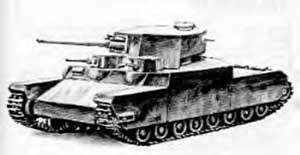
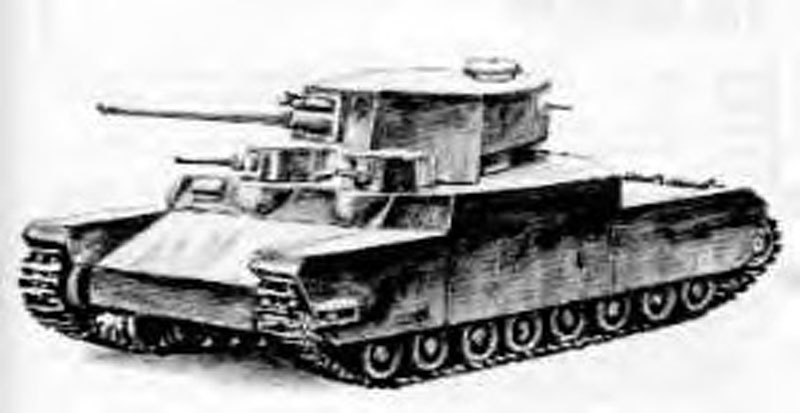
Outwardly, the 120-ton design attempt - otherwise known under the designation of "Type 120 O-I Super Heavy Tank" - exhibited a most conventional appearance and followed the much accepted straight-line-and-boxy-form design of previous Japanese armor attempts. The vehicle was suspended atop eight road wheels to a track side, the tracks running the entire length of the hull and protected along its upper regions by armor skirting that was bolted onto the side of the upper hull. The glacis plate was near-horizontal in its setting with the driver's compartment at front center. There was a short hull superstructure for the crew within and a main gun turret was fitted atop the hull roof. A pair of smaller turrets would have been added ahead of the main turret in order to house additional armament. The main turret featured at least two access hatches along the roof with another at the rear facing. Additional fuel stores could be carried in drums along the rear of the hull as a vehicle this large was sure to drink through the available internal stores rather quickly. The powerplant would have been set to the rear of the hull with access panels allowing for ease of maintenance of the large twin gasoline installations.
Primary armament was intended to be 1 x 105mm main gun which would have made for an excellent mobile artillery system against Allied armor in 1945. This gun was more than likely to be based on an existing field artillery system - thought to be the five-ton Type 92 - for it would have been a proven commodity and require some modification to fit into a turret - thus curtailing development times concerning an all-new 105mm gun development. The gun was fitted into a fully-traversing turret with an overlapping rear section. The main armament would have been backed by secondary weapons in the form of 1 x 37mm anti-tank cannon fitted to a smaller traversing turret at the front hull, just ahead and under the main gun turret. Anti-infantry defense would have stemmed from the use of up to 3 x 7.7mm Type 97 series machine guns, one fitted to another front-mounted turret and the others elsewhere. Ammunition counts included 60 projectiles for the 105mm gun, 100 projectiles for the 37 cannon and as much as 7,470 rounds of 7.7mm ammunition.
Dimensionally, the Type 120 was to have exhibited a running length equal to 10 meters with a width of 4.2 meters and a height of 4 meters. Indeed she would have made for a large and slow target on the battlefields of World War 2 - particularly to low flying attack aircraft overhead. Base armor values indicated a thickness of up to 200mm. Overall weight was in the vicinity of 120 tons - hence the designation. Her plodding nature would have assumed that the tank be fielded with infantry protection and medium and light tank support to avoid being overrun by enemy personnel.
Power was to be supplied by a pair of V12 series gasoline-fueled engines rated at 500 horsepower each. The engines would be conventionally installed in a rear compartment of the armored hull. As the Type 100 was nothing more than a proposed conceptual tank, performance specifications were never truly made available leaving to an estimated top speed of 25 kilometers per hour.
While the Type 120 was thought to have been built, its "completeness" has always been suspect - perhaps maybe an unfinished hull existed at some point. It is believed that the single existing example was shipped under the direction of a project engineer to Manchuria after 1944 though its whereabouts today remain lost to history. Additionally, no known photographs of the vehicle exist. The Type 100 is believed to never have been constructed at all before the collapse of the Japanese Empire in 1945.
Power & Performance Those special qualities that separate one land system design from another. Performance specifications presented assume optimal operating conditions for the Type 120 O-I Super-Heavy Tank Project.
2 x V12 gasoline engines developing 550 horsepower at 1,500rpm. Installed Power
16 mph 25 kph Road Speed
Structure The physical qualities of the Type 120 O-I Super-Heavy Tank Project.
11 (MANNED) Crew
32.8 ft 10 meters O/A Length
13.8 ft 4.2 meters O/A Width
13.1 ft 4 meters O/A Height
240,000 lb 108,862 kg | 120.0 tons Weight
Armament & Ammunition Available supported armament, ammunition, and special-mission equipment featured in the design of the Type 120 O-I Super-Heavy Tank Project.
Type 120:
1 x 105mm main gun in main turret
1 x 37mm Type 1 cannon in forward turret
1 x 7.7mm Type 97 machine gun in forward turret
2 x 7.7mm Type 97 machine guns
Type 100:
1 x 105mm main gun in main turret
1 x 37mm Type 1 cannon in forward turret
1 x 37mm Type 1 cannon in rear turret
1 x 7.7mm Type 97 machine in forward turret
2 x 7.7mm Type 97 machine guns
AMMUNITION: 60 x 105mm projectiles
100 x 37mm projectiles
7,470 x 7.7mm ammunition
Variants Notable series variants as part of the Type 120 O-I family line.
Type 120 O-I Super Heavy Tank - Base Series Designation; 2 x gasoline engines; 120-ton operating weight; three turrets; single example may have been completed.
Type 100 O-I Ultra-Heavy Tank - Proposed 100-ton development of the Type 100 with four turrets.
Operators Global customers who have evaluated and/or operated the Type 120 O-I. Nations are displayed by flag, each linked to their respective national land systems listing.
Total Production: 1 Units Contractor(s): State Factories - Imperial Japan
[ Imperial Japan ]
1 / 1
Artist impression of the Type 120 O-I Super Heavy Tank
Going Further... The Type 120 O-I Super-Heavy Tank Project appears in the following collections:
The "Military Factory" name and MilitaryFactory.com logo are registered ® U.S. trademarks protected by all applicable domestic and international intellectual property laws. All written content, illustrations, and photography are unique to this website (unless where indicated) and not for reuse/reproduction in any form. Material presented throughout this website is for historical and entertainment value only and should not to be construed as usable for hardware restoration, maintenance, or general operation. We do not sell any of the items showcased on this site. Please direct all other inquiries to militaryfactory AT gmail.com. No A.I. was used in the generation of this content.