The BTR-4 eight-wheeled armored personnel carrier began as a in-house endeavor through the Kharkiv Morozov Machine Building Design Bureau concern - otherwise known by the initials KMDB - based out of the Ukraine. The firm was founded in 1927 and continues today as a state-run, military-oriented entity largely being responsible for production of various heavy vehicles including both armored personnel carriers and main battle tank classes. During the Cold War, Ukraine fell under the Soviet sphere of influence and the firm was called upon to produce Soviet tanks including the fabled T-34 Medium Tank of World War 2 fame as well as the excellent T-54 series. Additionally, production of the T-64, T-80 and T-84 marks were also undertaken over the decades.
The BTR-4 itself, therefore, is obviously inspired by the Soviet/Russian series of BTR eight-wheeled armored carriers and continues the relatively recent tradition of in-house, indigenous Ukrainian military equipment and weaponry meant to keep the nation as independent as possible. The BTR-4 was first displayed in June of 2006 and entered production in 2008 with limited deliveries to the Ukrainian Army beginning in 2009. At its core, the BTR-4 is intended as a modular battlefield system able to mount various weaponry "modules" and undertake multiple mission roles as needed with little or no modification to the basic chassis. This makes for a versatile, multi-faceted battlefield implement that can be procured in some number at reasonable cost.
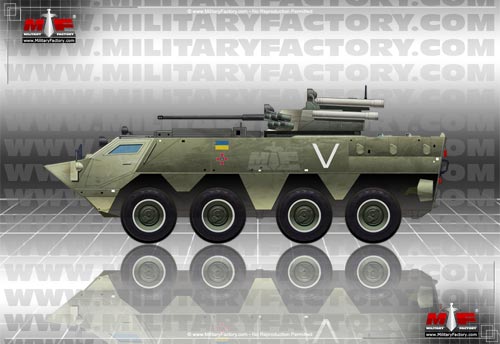
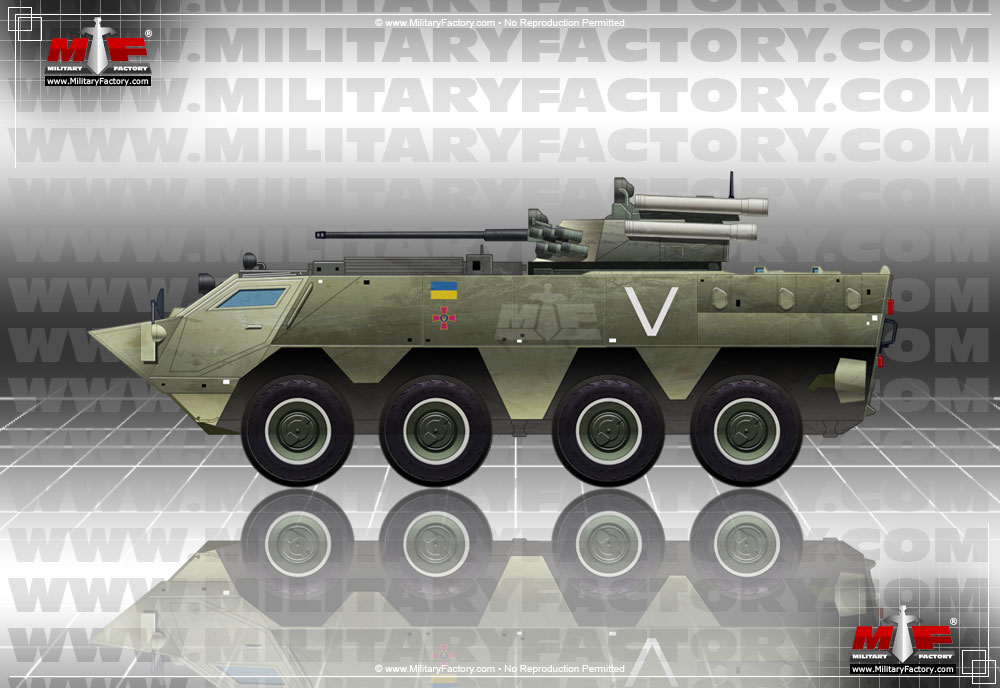
Externally, the BTR-4 mimics much of the appearance of Cold War Soviet BTR vehicle designs. The vehicle is characterized by its arrangement of eight large road wheels, four to a hull side. Ground clearance of the BTR-4 is excellent and each suspended wheel is paired along individual axles with the front pair being steerable by an automobile-style steering wheel. The forward portion of the hull sports a near-flat glacis plate with a sloped windscreen and thick vision blocks for the driver. The lower forward hull is also extensively sloped downwards to help navigate cross-country terrain and provide for basic ballistics protection. The sides of the vehicle are angled inwards toward the vehicle's centerline. The roof is flat and mounts the optional weapons packages, troop entry/exit hatches and various communications and field equipment as needed. The base hull is amphibious, allowing the BTR-4 the ability to traverse deep water sources with some ease and is powered in such fashion by way of two integrated waterjets located at the rear of the vehicle hull. A standard fire suppression system and NBC (Nuclear, Biological, Chemical) suite protect the crew from various battlefield hazards. Additional armor blocks can be added for point defense against enemy missiles and projectiles. Navigation is assisted by a TIUS-NM satellite navigation system, an inertial navigation support system and the SN-3003 series Bazalt portable satellite navigation support system. Night-vision is included as is a target illuminator.
Perhaps one of the most notable differences in the Ukrainian approach to their BTR over that of the Soviet version is the relocation of the powerplant to the middle of the hull, allowing a passenger area to be added to the rear of the vehicle. The BTR-4 essentially breaks down into three key internal areas - the front driving compartment, the central engine compartment and the rear fighting compartment. Soviet versions maintained their engines at the rear forcing occupants to enter/exit the vehicle along the sides which, under enemy fire, presented its inherent problems. The Ukrainian approach is more inline with contemporary APC, AFV and IFV offerings the world over - the vehicle's own hull serving to shield passengers when entering/exiting from the rear of the vehicle. Power for the BTR-4 is derived from a single KMDB 3TD two-stroke, diesel-fueled engine developing 500 horsepower (600 horsepower version also known to be available) and drives all eight wheels for "true" 8x8 action. For discerning customers, a DEUTZ EBPO III series four-stroke, diesel-fueled engine of 498 to 598 horsepower output can replace the original KMDB fitting.
The BTR-4 series features a modular armaments package that can be edited to suit customer or mission needs (and directly can dictate the variant type in the process). The standard fitting is a turreted 30mm autocannon with a 1 x 7.62mm coaxial machine gun. Additionally, the armament display is backed by up to 4 x anti-tank guided missile launchers - in particular, support for the 9P135M "Konkurs" or "Baryer" ATGMs is noted. In place of two of these launchers can be a 1 x 30mm automatic grenade launcher for enemy infantry suppression through use of High-Explosive (HE) lopped grenades. The basic BTR-4 is crewed by three personnel - the driver, vehicle commander and dedicated gunner (the latter two in the powered turret) - as well as seating for up to eight personnel in the passenger compartment.
In its dedicated BAU 23x2 air defense form, the BTR-4 system is primarily armed with 2 x 23x115mm automatic cannons for close-in defense work against low flying aircraft. This armament is backed by a 1 x 7.62mm coaxial machine gun and seats three crew along with eight passengers. A command vehicle - designated as the BTR-4KSh - sports extra communications equipment and is armed with just a single 12.7mm TKB-01-1 heavy machine gun for self-defense work. The crew consists of seven personnel including the driver and vehicle commander as well as applicable mission specialists. One of the more interesting forms of the BTR-4 is the MOP-4K Fire Support Vehicle which sports a turreted 120mm main gun to counter threats from enemy tank systems. The vehicle is further defensed by a 12.7mm heavy machine gun in a trainable ring mounting on the turret roof. In this variant, the BTR-4 is essentially converted into a mobile tank destroyer with limited armor protection. The crew is consists of four personnel - the driver, vehicle commander, gunner and an ammunition handler. Other variants in the BTR-4 family line include the BREM-4K battlefield repair and recovery vehicle, the BSEM-4K medical vehicle with room for litters and equipment and the BRM-4K dedicated reconnaissance platform with additional communications equipment.
To date, the armies of Ukraine and Iraq are the sole operators of the BTR-4. Iraq has only recently placed a procurement order of approximately 420 vehicles to help beef up their decimated mechanized forces following the 2003 American invasion of Iraq. The order began delivery in late 2013 but quality issues with the vehicles led to the order being cancelled after just 88 BTR-4s were delivered.
In 2012, the government of Kazakhstan placed an order for 100 vehicles. The Indonesian military has placed an order for fifty-five to serve in its Army and Marine Corps ranks.
September 2022 - The BTR-4 has been actively featured with Ukrainian ground forces in the ongoing war with Russia.
Power & Performance Those special qualities that separate one land system design from another. Performance specifications presented assume optimal operating conditions for the BTR-4 8-Wheeled Armored Personnel Carrier (APC).
1 x 3TD diesel-fueled engine developing 500 horsepower driving conventional eight-wheeled arrangement. Installed Power
68 mph 110 kph Road Speed
429 miles 690 km Range
Structure The physical qualities of the BTR-4 8-Wheeled Armored Personnel Carrier (APC).
3 (MANNED) Crew
25.1 ft 7.65 meters O/A Length
9.8 ft 3 meters O/A Width
9.2 ft 2.8 meters O/A Height
44,092 lb 20,000 kg | 22.0 tons Weight
Armament & Ammunition Available supported armament, ammunition, and special-mission equipment featured in the design of the BTR-4 8-Wheeled Armored Personnel Carrier (APC).
STANDARD:
1 x 30mm Automatic Cannon in turret.
1 x 7.62mm co-axial anti-infantry machine gun in turret.
2 OR 4 x 9P135M "Konkurs" OR "Baryer" Anti-Tank Guided-Missile (ATGM) launchers.
1 x 30mm Automatic Grenade Launcher (AGL - replacing one ATGM launcher).
12 x Smoke Grenade Dischargers (twin banks of six launchers to each side of turret).
AIR-DEFENSE:
2 x 23mm Automatic Cannons in turret.
1 x 7.62mm co-axial anti-infantry machine gun in turret.
12 x Smoke Grenade Dischargers (twin banks of six launchers to each side of turret).
COMMAND VEHICLE:
1 x 12.7mm TKB-01-1 Anti-Aircraft Heavy Machine Gun (AAHMG).
12 x Smoke Grenade Dischargers (twin banks of six launchers to each side of turret).
FIRE SUPPORT:
1 x 120mm turreted Main Gun.
1 x 12.7mm AAHMG.
12 x Smoke Grenade Dischargers (twin banks of six launchers to each side of turret).
Also any personal weapons carried by passengers (gun ports provided).
AMMUNITION: Dependent upon variant and armament fit.
Variants Notable series variants as part of the BTR-4 family line.
BTR-4 - Base Series Deisgnation; standard armament of 1 x 30mm autocannon, 1 x 7.62mm coaxial machine gun and 2 to 4 x Konkurs/Baryer anti-tank guided missile launchers; crew of 3 with 8 passengers.
BTR-4 (Up-Armored) - Additional Armor Protection; passenger seating of 7; same armament as base BTR-4.
BTR-4 (GROM)
BTR-4 (SHKVAL) - 1 x 30mm cannon; 1 x 30mm automatic grenade launcher; 1 x 7.62mm coaxial machine gun; 2 to 4 x Konkurs or Baryer ATGMs.
BTR-4 (BAU 23x2) - 2 x 23mm cannons; 1 x 7.62mm machine gun.
BTR-4K/BTR-4KSh - Command Vehicle; fitted with additional communications and sensor equipment; crew of 7.
MOP-4K - Fire Support Vehicle; fitted with 1 x 120mm main gun and 1 x 12.7mm anti-aircraft heavy machine gun; crew of 4.
BRM-4K (Recon) - Reconnaissance Vehicle; additional communications equipment; crew of 6.
BREM-4K (R&R) - Repair and Recovery Vehicle; crew of 4; fitted with powered crane, winch and cable; welding equipment; towing equipment.
BSEM-4K (MEDEVAC) - Medical Vehicle; crew of 3; room for medical litters, equipment and staff.
Operators Global customers who have evaluated and/or operated the BTR-4. Nations are displayed by flag, each linked to their respective national land systems listing.
Total Production: 430 Units Contractor(s): Kharkiv Morozov Machine Building Design Bureau - Ukraine
[ Indonesia; Iraq; Kazakhstan; Ukraine ]
1 / 1
Image copyright www.MilitaryFactory.com; No Reproduction Permitted.
Going Further... The BTR-4 8-Wheeled Armored Personnel Carrier (APC) appears in the following collections:
The "Military Factory" name and MilitaryFactory.com logo are registered ® U.S. trademarks protected by all applicable domestic and international intellectual property laws. All written content, illustrations, and photography are unique to this website (unless where indicated) and not for reuse/reproduction in any form. Material presented throughout this website is for historical and entertainment value only and should not to be construed as usable for hardware restoration, maintenance, or general operation. We do not sell any of the items showcased on this site. Please direct all other inquiries to militaryfactory AT gmail.com. No A.I. was used in the generation of this content.