"The Bionix AFV is a family of armored vehicles that currently serves the growing Singaporean military. "
Power & Performance Those special qualities that separate one land system design from another. Performance specifications presented assume optimal operating conditions for the Bionix AFV Armored Fighting Vehicle.
1 x Detroit Diesel Corporation 92TA turbocharged 6-cylinder diesel engine developing 550 horsepower. Installed Power
43 mph 70 kph Road Speed
249 miles 400 km Range
Structure The physical qualities of the Bionix AFV Armored Fighting Vehicle.
3 (MANNED) Crew
19.4 ft 5.9 meters O/A Length
8.9 ft 2.7 meters O/A Width
8.5 ft 2.6 meters O/A Height
49,999 lb 22,679 kg | 25.0 tons Weight
Armament & Ammunition Available supported armament, ammunition, and special-mission equipment featured in the design of the Bionix AFV Armored Fighting Vehicle.
Bionix 25:
1 x 25mm Bushmaster M242 autocannon
1 x 7.62mm coaxial general purpose machine gun
1 x 7.62mm general purpose anti-aircraft machine gun on turret roof.
1 x 7.62mm general purpose machine gun on rear hull roof (optional).
6 x Smoke Grenade Dischargers
Bionix 40/50:
1 x 40mm Automatic Grenade Launcher WITH 1 x 12.7mm heavy machine gun (Twin Weapon Station).
1 x 7.62mm general purpose coaxial machine gun
1 x 7.62mm general purpose anti-aircraft machine gun.
1 x 7.62mm general purpose machine gun on rear hull roof (optional).
6 x Smoke Grenade Dischargers
Bionix II:
1 x 30mm Bushmaster cannon
1 x 7.62mm coaxial general purpose machine gun
1 x 7.62mm general purpose anti-aircraft machine gun.
1 x 7.62mm general purpose machine gun on rear hull roof (optional).
6 x Smoke Grenade Dischargers
AMMUNITION: 650 x 25mm projectiles (estimated)
550 x 30mm projectiles (estimated)
400 x 40mm grenades (estimated)
2,000 x 7.62mm ammunition (estimated)
600 x 12.7mm ammunition (estimated)
6 x Smoke Grenades
Variants Notable series variants as part of the Bionix AFV family line.
Bionix 25 - Base Production Model; fitted with 25mm Bushmaster main gun; 2 x 7.62mm machine guns; 300 examples produced.
Bionix 40/50 - 40mm grenade launcher / 12.7mm heavy machine gun dual weapon station fitted to cupola; 2 x 7.62mm machine guns; 300 examples produced.
Bionix II - Upgraded Series Variant; new cannon system; improved armor protection; digital battlefield management; improved sighting systems; air conditioning.
Bionix ARV - Armored Recovery Vehicle
Bionix AVLB - Bridge Layer
Bionix Trailblazer - Counter-Mine Vehicle
The Bionix family was designed and developed to replace the ubiquitous, yet aging, series of American M113 armored personnel carriers. The M113 was serving in quantity yet she was still a 1950s-era design whose time had essentially come and gone. In the 1980s, an internal initiative was forged by the Singapore Ministry of Defense to find an eventual replacement to supplement a more modern and mobile Singapore land force. Several foreign prospects were entertained but authorities eventually settled on an in-house solution to meet the very specific demands by the Singapore Army. Design work on the new armored fighting vehicle began in 1988 under the ST Kinetics brand label with the intention that the basic chassis would form the basis of other battlefield-specific mounts to follow. After several evaluation vehicles had been completed and tested, production of first Bionix systems began in 1996 with formal entry into the Singapore Army commencing in 1997 and operational levels being reach in 1999. Production continues today under the ST Engineering brand label. Despite it being labeled an indigenous Singapore design, the Bionix series makes use of many Western components included main armament and engine.
The base production Bionix is categorized as an "Infantry Fighting Vehicle" (IFV) which has become a modern army standard vehicle the world over and is used in bringing infantry personnel to the front while also being able to supply their fire support after insertion of troops. As such, IFVs are generally well-armed and well-armored to a greater extent than common Armored Personnel Carriers (APCs) but to a lesser extent than Main Battle Tanks (MBTs). The use of the same chassis across other battlefield "role player" types makes for an economical solution as well as a logistically-friendly end product. The Singaporean Army has therefore enjoyed the procurement of several hundred of these vehicles and has also accepted specific mission-minded types in turn. While not overly spectacular in any one way, the Bionix is a major indigenous step for the future of armed forces in Singapore and across Southeast Asia - a region of the world that, at one point in recent history, relied heavily on procurement of such military vehicles from the world powers such as the United States, Soviet Union, France, Germany and Great Britain.
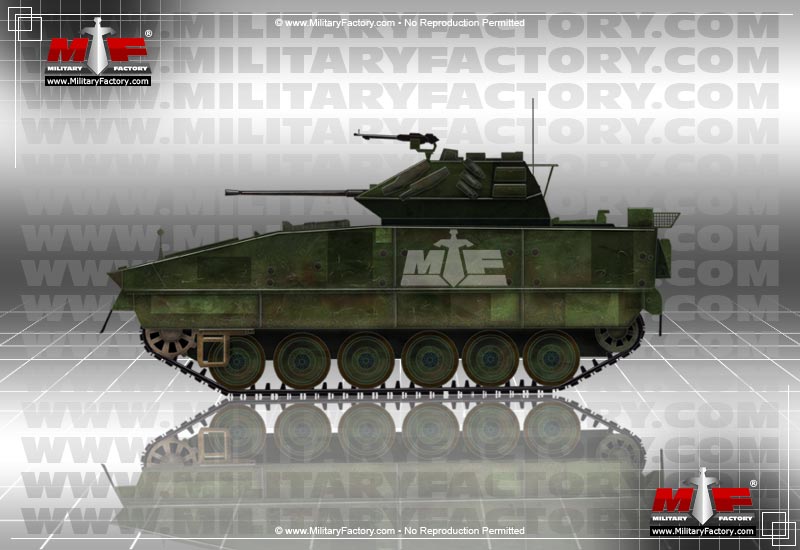
Design of the Bionix is highly conventional when compared to contemporary armored fighting vehicles. The system sports a tracked wheel arrangement with six rubber, double-tired road wheels to a track side with the drive sprocket in front and the track idler at the rear. Three track return rollers are noted. Suspension is hydro-pneumatic in nature and affords excellent off road capabilities. The glacis plate is well sloped to the point of it being nearly vertical and helps in ballistics protection while promoting a lower profile. The driver maintains a left front position in the forward hull with the powerpack to his right. The hull sides are vertical in design with the hull roof being flat. The turret (if equipped) is fitted at the middle of the vehicle's hull roof and contains the heavy armament. The turret itself is "ballistics friendly" in that it features many sloped angles, particularly along its frontal facings. The fighting compartment - or passenger cabin - is set to the rear of the vehicle. The Bionix design is not inherently amphibious and must be modified for such use.
The Bionix series is powered by an American Detroit Diesel 6V 92TA diesel engine outputting 475 horsepower though installation of a turbocharger increases output to 550 horsepower. The powerpack allows for a top speed nearing 43 miles per hour with an operational range of 250 miles - capable of keeping up with other mechanized forces along a mobile front. The base Bionix weighs in at 25 tons and features a running length of over 19 feet. Her height is listed at 8 feet, 6 inches with a span of 8 feet, 10 inches. Her standard combat crew consists of three personnel made up of the driver, gunner and vehicle commander and her fighting compartment can seat seven combat-ready infantry. Entry and exit for the passengers is via a rear-mounted, rectangular powered ramp. Defensive measures include six smoke grenade dischargers along the turret sides (in banks of three if equipped) as well as composite Modular Expandable Armor System (MEXAS) protection.
The Bionix carrier first appeared in three pilot vehicles known as the "XV1", "XV2" and "XV3" each appearing in early 1990, late 1990 and early 1991 respectively. Such vehicles served to prove certain mechanical, technological and armament arrangements as viable in a new overall design. These pilot vehicles then allowed finalization to occur in a preproduction form suitable for evaluation by the Singapore defense forces. In all, there would be nine evaluation vehicles produced.
The "Bionix 25" became the initial production model and the first of its kind to be produced indigenously anywhere in Southeast Asia. These examples were delivered with a traversing turret armed with a 25mm Bushmaster M242 series autocannon (produced by ATK Gun Systems) and further backed by a pair of 7.62mm machine guns - one coaxially and another in a flexible mount on the turret roof. A third 7.62mm machine gun system can be mounted over the rear entry/exit ramp to cover infantry. Deliveries of some 300 vehicles commenced in September 1997. The "Bionix 40/50" was similar in form, scope and function to the Bionix 25 before it. The differentiating feature of this type was its addition of new indigenously-developed weapon station cupola which could fit a 40mm automatic grenade launcher or a 12.7mm heavy machine gun for improved offensive and suppression capabilities. The Bionix 40/50 can also reportedly seat 11 passengers.
The "Bionix II" appeared next as upgraded form of the original armored fighting vehicle in 2006. This included improved overall armor protection for the crew and key onboard systems (including attention paid to mine resistance), upgraded communications and digital sharing suites, improved sighting equipment and gunnery services, a 30mm Bushmaster II series cannon of higher capability and a laser rangefinder. These changes served to make the Bionix AFV an even more capable and potent platform.
The Bionix chassis then went on to see battlefield-specific roles developed including an engineering vehicle, a bridgelayer and a dedicated "counter-mine" vehicle. The engineering mount was known as the Bionix ARV (ARV = Armored Recovery Vehicle) while the bridgelayer was the Bionix AVLB (AVLB = Armored Vehicle Launcher Bridge). The former was easily identified by its integrated winch and crane system to help clear the battlefield of debris and destroyed vehicles. The latter fielded a steel bridge 72 feet in length, suitable for setting over trenches and streams to allow mechanized formations to pass. This form was just as easily identifiable by the folded bridge system sitting atop the basic Bionix frame. The counter-mine vehicle version was aptly titled the "Trailblazer" and featured a flail to help detonate mines ahead of the proceeding mechanized forces. This vehicle was vastly different to any other Bionix family product for its high, stout appearance designed specifically to survive mine blasts.
The "Infantry Carrier Vehicle" (IVC) was a proposed Bionix-based tracked system intended to be a light armored vehicle that could be air-transportable. It was completed with a remote weapon station fitting a 40mm automatic grenade launcher as well as machine guns to allow for the firing of all weapons from within the turret. However, the type was not selected for serial production as the established American Stryker armored wheeled vehicle was introduced instead.
A Main Battle Tank form was entertained at some point, this fitting either a potent 105mm or 120mm main gun system. Tests with these guns saw it installed across several turret options but the overall design has since fallen to naught with the Indonesian government electing instead to procure used German Leopard 2A4 tanks for the interim. As of this writing, the main battle tank prospect of the Bionix has not advanced.
Operators Global customers who have evaluated and/or operated the Bionix AFV. Nations are displayed by flag, each linked to their respective national land systems listing.
Total Production: 700 Units Contractor(s): ST Kinetics - Singapore
[ Singapore ]
1 / 1
Image copyright www.MilitaryFactory.com; No Reproduction Permitted.
Going Further... The Bionix AFV Armored Fighting Vehicle appears in the following collections:
The "Military Factory" name and MilitaryFactory.com logo are registered ® U.S. trademarks protected by all applicable domestic and international intellectual property laws. All written content, illustrations, and photography are unique to this website (unless where indicated) and not for reuse/reproduction in any form. Material presented throughout this website is for historical and entertainment value only and should not to be construed as usable for hardware restoration, maintenance, or general operation. We do not sell any of the items showcased on this site. Please direct all other inquiries to militaryfactory AT gmail.com. No A.I. was used in the generation of this content.