With full scale war across Europe in full swing, the battle tank was the forefront of any offensive armored spearhead. As the war raged on, developments in armor for such systems advanced as a bewildering pace. The Germans learned much with their initial Panzer I and Panzer II light tanks and the proceeding Panzer III and Panzer IV series proved capable up to a point. However, armor advancements would not stop there for heavy tanks such as the Panther and Tiger series were in the works. British authorities were not blind to the evolution of the tank and realized that their QF 6-pdranti-tank guns would soon - if not rather quickly - be outmoded on the modern battlefield, a fate shared by the preceding QF 2-pdr series as well.
As such, by 1941 work had already begun on a larger caliber anti-tank gun system to supply British Army artillery forces in dire need of a more capable tank-stopping weapon. The next logical evolution of the anti-tank gun fell within the 76.2mm caliber and, for the British, the weapon type would be issued with a new 17lb projectile suitable for defeating any known enemy armor of the time. With the requirements now set, design proceeded quickly and ultimately gave birth to the larger and heavier "Ordnance, Q.F., 17-pounder" anti-tank gun family.
The Ordnance QF 17-pdr anti-tank gun was a vast upgrade from the preceding QF 2-pdr and QF 6-pdr gun designs (each system was so-named based on the weight of their respective projectiles). The QF-17 relied primarily on a new Armor-Piercing, Discarding Sabot (APDS) round that improved basic penetrative abilities of British ammunition and this round type was first introduced with the arrival of the QF 6-pdr.
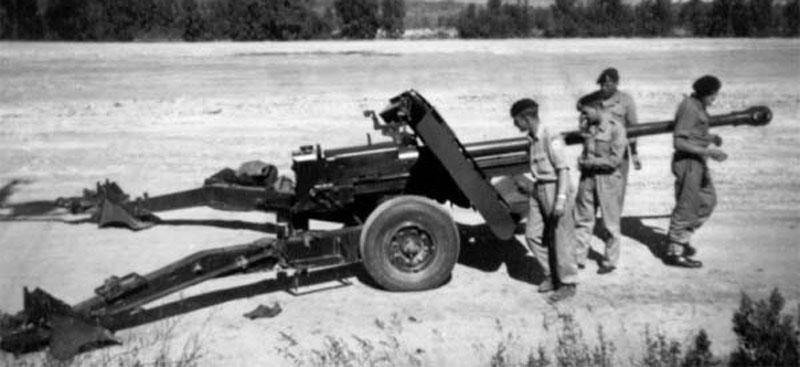
With its larger design and dimensions, the QF 17-pdr naturally utilized a heavier projectile. The QF 17-pdr design was characterized by its conventional arrangement consisting of a long barrel, gun mount and carriage. The long, double-baffled gun barrel sat on an adjustable mount that featured a large breech block for loading at the rear. The gunnery crew was partially protected by a flat, thick angled armored shield. A pair of rubber-tired steel wheels straddled either side of the gun mount and a split trail carriage served as both the towing arms and recoil legs. A dedicated recoil system was fitted to a cylinder system underneath the barrel base. The barrel was formally classified as the "L/60" and measured in at 180 inches in length. Elevation was limited to -6 and +16.5 degrees with a 60-degree traverse. Muzzle velocity varied across the different ammunition types but ranged between 3,000 and 4,000 feet per second. As a whole, the QF 17-pdr weighed in at 4,619lbs and required a crew of at least seven personnel.
The weapon was cleared to fire a standard Armor-Piercing (AP) round, an Armor-Piercing, Discarding Sabot (APDS) round and a base High-Explosive (HE) round. Armor-piercing projectiles were naturally used to tackle armored targets such as tanks while High-Explosive projectiles were used against soft-skinned vehicles and troop concentrations. Maximum range was approximately 10,000 yards. The 76.2mm weapon could penetrate up to 130mm of armor thickness at 1,000 meters and her elevation capabilities (coupled with HE shells) allowed her to be used as a makeshift field howitzer for dislodging enemies. A well-trained and combat experienced gunnery crew could let loose with up to 10 rounds per minute.
British industry took on production of the QF 17-pdr and, while pre-production versions of the guns themselves were already available in August of 1942, the special carriages they were to rely on were not. As such, this forced the mating of the QF 17-pdr gun barrel with the existing carriages of the Ordnance QF 25-pdr artillery field guns for the interim until full production standards could be attained. This allowed the new gun to be fielded quickly to desperate British Army forces fighting the German Army across North Africa where the stout Tiger heavy tank series was to make its combat debut in numbers. At least 100 guns were airlifted to British Army forces stationed in North Africa where they were quickly set into action after being installed on QF 25-pdr mounts. These "mutt" variants took on the designation of "QF 17/25-pdr". With the conversions complete, the British were able to bring the new guns to bear against the equally new German Tiger tanks with success.
Once the proper QF 17-pdr carriages had become available, the guns finally appeared in their intended and completed production forms. However, these new carriage mounts proved rather heavy and required much in the way of manpower to reposition and a mover-type vehicle to transport over long stretches of terrain, precluding their use as an infantry-level weapon. Conversely, these same weapons sported a lower profile ideal for ambush and their penetrative powers spoke volumes. With the North African Campaign completed and Germany moved off of the continent, the finalized QF-17 production models were made available just in time for combat actions in the Italian Campaign of 1943 along the road to Rome and, finally, Berlin proper.
In 1945, the QF 17-pdr formally moved into position as the primary anti-tank gun of the British Army, serving primarily with her Royal Artillery batteries. The weapon proved so valuable to the Allied cause that she was furnished to Commonwealth forces in need of such a weapon. For the British Army themselves, the QF 17-pdr would go down in their military history as the last foray into dedicated anti-tank gun development, bring an end to a rather successful, though sometimes overlooked, contribution to the field of artillery. British Forces utilized the QF 17-pdr into the 1950s before discontinuing operational use and more combat actions greeted the type in the upcoming Korean War. The weapon survived a longer tenure in other armies however.
The QF 17-pdr gun was further fitted to the mobile chassis of the British Valentine Cruiser Tank to produce the "Archer" self-propelled gun vehicle. This vehicle was unique in that the gun was actually fixed to fire rearwards, allowing the vehicle to lie in wait for enemy tanks, complete the ambush and relocate to favorable ground without the need to rotate the entire vehicle for the retreat. The QF 17-pdr gun was also a fixture on the all-important M10 "Wolverine"/"Achilles" tank destroyers, the upgunned Sherman VC Firefly medium tanks, the Challenger and Comet Cruiser Tanks and the upcoming Centurion Mk 1 main battle tank series.
Power & Performance Those special qualities that separate one land system design from another. Performance specifications presented assume optimal operating conditions for the Ordnance QF 17-pounder 76mm Towed Anti-Tank (AT) Gun.
None. This is a towed artillery piece. Installed Power
Structure The physical qualities of the Ordnance QF 17-pounder 76mm Towed Anti-Tank (AT) Gun.
6 (MANNED) Crew
14.6 ft 4.44 meters O/A Length
6,444 lb 2,923 kg | 3.2 tons Weight
Armament & Ammunition Available supported armament, ammunition, and special-mission equipment featured in the design of the Ordnance QF 17-pounder 76mm Towed Anti-Tank (AT) Gun.
1 x 76.2mm (3-inch) gun barrel
AMMUNITION: Dependent upon ammunition carrier.
Variants Notable series variants as part of the Ordnance QF 17-pounder family line.
Ordnance QF 17-pdr - Base Series Designation
Ordnance QF 17-pdr Mk 1 - Initial Production Model.
Ordnance QF 17-pdr Mk 2 - Tank Gun Version; fitted to Archer SPG and Challenger Cruiser Tank.
Ordnance QF 17-pdr Mk 3 - Royal Navy Gun; automatic loading system.
Ordnance QF 17-pdr Mk 4 - Tank Gun Variant; revised breech system.
Ordnance QF 17-pdr Mk 5 - Tank Gun Variant; based on the Mk 4 with revised mount; fitted to Wolverine and Achilles SPGs.
Ordnance QF 17-pdr Mk 6 - Tank Gun Variant; based on Mk 4; revised, shortened breech assembly.
Ordnance QF 17-pdr Mk 7 - Tank Gun Variant; based on Mk 4; revised breech.
Ordnance QF 17/25-pdr - 17-pdr gun barrels on QF 25-pdr carriages.
Straussler Conversion - Developmental Variant; self-propelled motorized four-wheeled carriage.
77mm HV - Tank Gun Variant; utilizing 17-pdr projectile from 3-inch 20 cwt AA gun; fitted to Comet Cruiser Tank.
Operators Global customers who have evaluated and/or operated the Ordnance QF 17-pounder. Nations are displayed by flag, each linked to their respective national land systems listing.
Total Production: 15,000 Units Contractor(s): State Factories - UK
[ Australia; Canada; United Kingdom ]
1 / 1
Right side view of the Ordnance QF 17-pdr anti-tank gun
Going Further... The Ordnance QF 17-pounder 76mm Towed Anti-Tank (AT) Gun appears in the following collections:
The "Military Factory" name and MilitaryFactory.com logo are registered ® U.S. trademarks protected by all applicable domestic and international intellectual property laws. All written content, illustrations, and photography are unique to this website (unless where indicated) and not for reuse/reproduction in any form. Material presented throughout this website is for historical and entertainment value only and should not to be construed as usable for hardware restoration, maintenance, or general operation. We do not sell any of the items showcased on this site. Please direct all other inquiries to militaryfactory AT gmail.com. No A.I. was used in the generation of this content.