"Production of the Vickers Ordnance QF 2-pounder anti-tank gun spanned from 1936 to 1944."
Power & Performance Those special qualities that separate one land system design from another. Performance specifications presented assume optimal operating conditions for the Ordnance QF 2-pounder Anti-Tank (AT) Gun.
None. This is a towed artillery piece. Installed Power
Structure The physical qualities of the Ordnance QF 2-pounder Anti-Tank (AT) Gun.
5 (MANNED) Crew
6.8 ft 2.08 meters O/A Length
1,834 lb 832 kg | 0.0 tons Weight
Armament & Ammunition Available supported armament, ammunition, and special-mission equipment featured in the design of the Ordnance QF 2-pounder Anti-Tank (AT) Gun.
1 x 40mm (1.575-inch) gun barrel
AMMUNITION: Dependent upon ammunition carrier.
Variants Notable series variants as part of the Ordnance QF 2-pounder family line.
Ordnance QF 2-pdr - Base Series Designation
Ordnance QF 2-pdr Mk IX - Main Production Model; autofrettage barrel construction.
Ordnance QF 2-pdr Mk IX-A - Simplified Mass Production Variant.
Ordnance QF 2-pdr Mk X - Forged Barrel Construction.
Ordnance QF 2-pdr Mk X-A - Revised Mk X Model
Ordnance QF 2-pdr Mk X-B - Vehicle Mounted Variant.
4.0cm PaK 192(e) - German Army designation of captured British systems.
4.0cm PaK 154(b) - german Army designation of captured Belgian systems.
The rather promising Ordnance QF 2-pounder anti-tank gun suffered historically from entering operational service at a time when tank armor had improved to such a point that she was essentially rendered obsolete. Regardless, the weapon system was placed into action with the desperate British Army to help shore up its limitations of both trained men and capable firepower until the situation was improved. As such, the QF 2-pounder went on to receive a rather misplaced reputation as a poor anti-tank gun when, in fact, she was a quite capable system for a short time in history, measured just as accurate and powerful as her contemporaries.
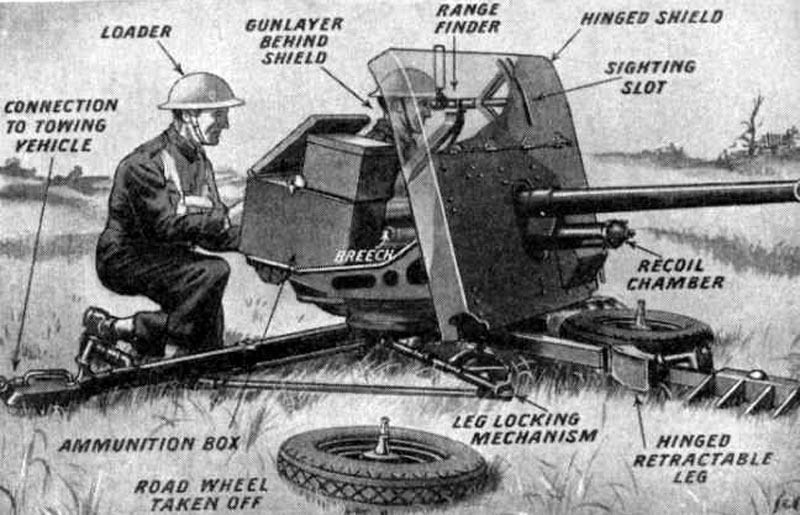
Beginning in 1934, British authorities submitted a requirement for an anti-tank gun of 40mm (2-pounder) caliber. Vickers-Armstrong proceeded with development but the British Army was slow to move, instead seeing the new gun being sold to interested foreign parties. The weapon featured a gun barrel mounted onto a base which was further affixed to a two axle wheeled system. Wheels were rubber with steel rims and a split carriage assembly was connected at the rear for transport by mover vehicle. The carriage opened fully to become a tripod for a firm seat onto hard ground and the travel wheels were raised to either side of the gun. The weapon was, after all, envisioned as a static defensive gun emplacement and did not follow the mobile-minded designs encountered throughout the rest of Europe. A seat was installed behind an armored shield for the gunnery crew and a sighting device was set at eye level for the seated operator. The upper portion of the shield was hinged and could be folded forward and down for an improved view (at the expense of exposure to enemy fire). To the lower right of the shield there lay a magazine storage locker with four rows of ready-to-fire 40mm projectiles to be handled by a loader. The British Army did not receive delivery of their first gun system until 1938 as war in Europe seemed all but inevitable at this point. After some refinement of the initial design, the British Army formally accepted the weapon as the "Ordnance, Q.F., 2-pdr" in 1939 and the gun component was issued on the "Carriage, 2-pdr, Mk III" carriage assembly. Despite its promising nature, the end-product proved a heavy weapon than anything comparable to it across Europe. QF 2-pdr guns were staffed with specially-trained members of the Royal Artillery.
The QF 2-pdr measured in at 6 feet, 9 inches long and weighed 1,848lbs. The system fired an armor-piercing, 2.4lb 40mm projectile out to an effective range of 600 yards at a muzzle velocity of 2,626 feet per second. Penetration of 53mm (2 inches) of armor was possible out to 500 yards. The tripod carriage assembly offered a complete 360-degree traverse (unlike other towed anti-tank artillery pieces in this class that rest on their two-arm split carriage stems) and the crew managed an elevation range between -13 and +15 degrees. The standard operating crew was between three and five personnel.
As war rapidly spread about Europe, the QF 2-pdr was set into action along multiple fronts with the British Expeditionary Force. However, despite its defensive-minded design, the QF-2 soon shown its inherent limitations. The fast-moving Blitzkrieg offense of the German Army often meant that such defensive positions were overrun along the flanks, forcing gunnery crews to abandon their guns where they sat. Additionally, the heavy-minded nature of the QF 2-pdr system meant that it was near impossible to relocate the weapon without the assistance of vehicles. To add insult to injury, the selected 40mm caliber gun proved little match against the stout armor of German tanks where penetration at uncomfortably short ranges proved necessary. German tank crews almost always held the advantage on QF 2-pdr crews for their tank main guns and machine guns could often attack before the QF 2-pdr was within its own effective range. The QF 2-pdr was never issued with High-Explosive (HE_ ammunition, limiting its reach against "soft" targets such as enemy troop concentrations and enemy AT gun emplacements. Such qualities quickly shown the QF 2-pdr to be obsolete despite just having entered service. British production of the gun outputted the QF 2-pdr in quantity but many of the available systems were left to the Germans after the dire evacuation of Allied forces from the port town of Dunkirk, France.
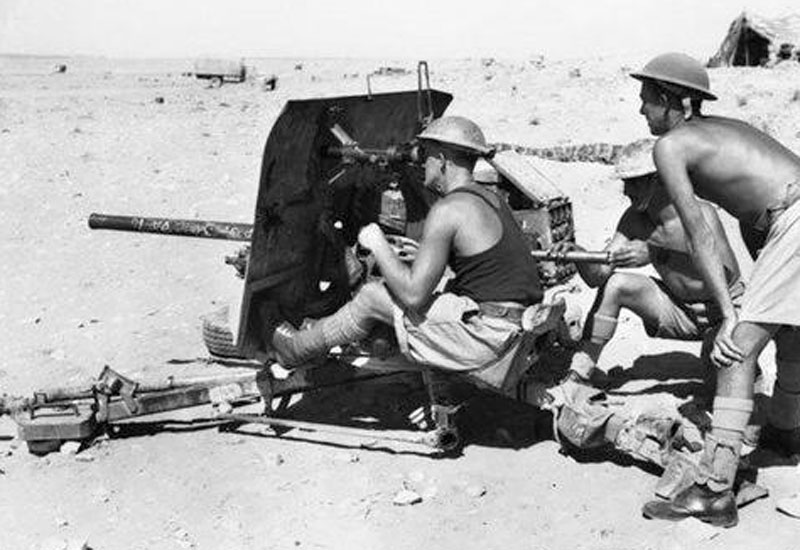
Regardless of the poor initial showing, anti-tank manufacturing infrastructure within Britain was still lacking at this point in the war, forcing the QF 2-pdr to soldier on both on the assembly lines and in the field. As such, production of the weapon continued and the type was put into combat with British crews in the North African campaign. Again, the results were poor as improved German armor and tactics outplayed the QF 2-pdr on many levels. Despite attempts to help improve the field performance of the weapon, the system was simply not up to the task. The situation proved so dire for the British Army that the Ordnance QF 25-pdr artillery field gun was being used as a makeshift anti-tank weapon for the interim. The QF 2-pdr would be pulled out of frontline service in Africa and Europe as soon as 1942 though, in the Pacific Theater, where enemy armor was generally thinner on the Japanese tanks, the QF 2-pdr was still in play as her 40mm projectile could pierce this thinner skin with some success. These Commonwealth units fielded the QF 2-pdr up until the end of the war in 1945 and some were mounted on tracked chassis for mobile support.
Beyond the United Kingdom, Australia, Belgium, Ireland and Spain all fielded the QF 2-pdr to an extent. Captured systems in Europe by the Germans were reconstituted back into service with their new owners. The Germans redesignated their British guns as the 4.0cm PaK 192 (e). Captured Belgian samples were known as 4.0cm PaK 154(b).
The QF 2-pdr existed in a few notable variants, known more formally as "marks" in the British inventory system. The Mk IX proved the main production model and these were completed with an "autofrettage" barrel construction. The Mk IX-A was brought online as a simplified form to improve mass-production efforts in British factories. The Mk X was completed with a forged barrel assembly. The Mk X-A was nothing more than a revised Mk X production model with dimension tolerances reduced while the Mk X-B was used on vehicles as a mobile gunnery platform.
The carriage appeared in two distinct production forms, the first designated as the Mk I and developed by Vickers and the second designated as the Mk II and developed by Royal Arsenal.
Operators Global customers who have evaluated and/or operated the Ordnance QF 2-pounder. Nations are displayed by flag, each linked to their respective national land systems listing.
Total Production: 12,000 Units Contractor(s): Vickers - UK
[ Australia; Belgium; Ireland; Nazi Germany; Spain; United Kingdom ]
1 / 2
Rear left side view of the Ordnance QF 2-pdr anti-tank gun in Tobruk. North African with an Australian gunnery crew
2 / 2
Illustration breaking down the major components of the Ordnance QF 2-pounder anti-tank gun
The "Military Factory" name and MilitaryFactory.com logo are registered ® U.S. trademarks protected by all applicable domestic and international intellectual property laws. All written content, illustrations, and photography are unique to this website (unless where indicated) and not for reuse/reproduction in any form. Material presented throughout this website is for historical and entertainment value only and should not to be construed as usable for hardware restoration, maintenance, or general operation. We do not sell any of the items showcased on this site. Please direct all other inquiries to militaryfactory AT gmail.com. No A.I. was used in the generation of this content.