The Type 5 "Chi-Ri" was a further evolution of the preceding Type 4 "Chi-To" development - both becoming unrealized medium tank projects for the Empire of Japan by the end of World War 2. The original 33-ton Type 4 was in development beginning 1942 into 1944 and only saw two pilot vehicles completed before September 1945. The system proved the most promising of all the Japanese tanks available, a fleet stocked with mostly light-class vehicles falling to the mercy of American M4 Sherman Medium Tanks and anti-tank weapons as small as 37mm. The Type 4 incorporated a hexagonal turret housing a 75mm main gun and was defense by 2 x 7.7mm Type 97 Light Machine Guns (LMGs). The powerpack included a Mitsubishi 412 horsepower engine providing speeds of 28 miles per hour with an operational range out to 160 miles.
The following Type 5 emerged as a 37-ton vehicle fitting armor as thick as 75mm along its critical facings. Main armament of initial vehicles was to be a 75mm Type 5 series gun until replaced by a more potent 88mm offering in the Type 99 line. Secondary armament included a 37mm Type 1 cannon mounted to the bow as well as 2 x 7.7mm Type 97 LMGs. Unlike the Type 4, the Type 5 would be powered by a Kawasaki water-cooled Type 98 series gasoline-fueled engine based on a German BMW 800-horsepower aero engine design and outputting at 550 horsepower. Projected road speeds were 28 miles per hour with an operational range of 174 miles. The Type 5 Medium Tank was being designed as a direct counter to the ubiquitous M4 Sherman series utilized by all American allies during the Pacific War.
Design work on the Type 5 commenced in 1943 and spanned into 1944 to which a prototype entered construction in 1945. The vehicle was only partially completed in May when Germany fell to the Allies, ending the European Front and leaving the Pacific Front as the remaining source of contention. The Japanese mainland was under constant Allied bombing raids and its infrastructure severely disrupted. Resources were lacking as valuable territories were being conceded by the retreating Japanese Army forces who lacked viable naval and air support due to Allied victories in several major campaigns. As such, the future of the Type 5 proved grim and the single prototype example was all that would eventually emerge from the program.
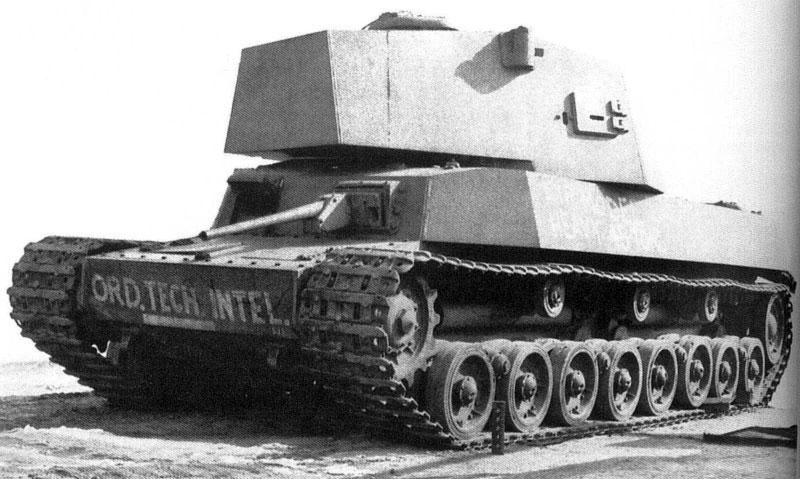
Outwardly, the Type 5 mimicked the preceding Type 4 design to an extent including its faceted hull superstructure and hexagonal turret. The chassis was lengthened from its predecessor to complete the needed internal volume for crew, ammunition, storage, engine and fuel as well as create a larger base in which to support the turret and armament fitting. This also necessitated the use of an extra pair of road wheels to a track side. The track system revolved around a front-mounted drive sprocket and a rear-mounted track idler with three return rollers present. No side skirt armor was fitted. The driver sat at the front right of the hull with a gunner managing the hull-mounted 37mm cannon to his left. The engine was fitted to a rear compartment in a conventional fashion. The vehicle would have been crewed by five total personnel including a gunner, loader and commander all housed in the turret. Armor was welded steel to provide the necessary protection against the Sherman's 75mm main gun. By any measure, the Type 5 was highly conventional in its design approach and its combat effectiveness could only be estimated by historians. One noticeable drawback to the Type 5's arrangement was its rather tall profile - making for a tempting target along the horizon. The vehicle stood at 10 feet with an equal width and ran 27 feet, 9 inches in length. Even the "tall" Sherman measured shorter at 9 feet.
With the fall of the Japanese Empire in August of 1945 and the subsequent occupation by Allied forces from September onwards, the incomplete Type 5 prototype was captured by the Americans. Its existence beyond that point remains unknown while several theories exist (either scrapped by the Americans or lost to a typhoon en route to America via transport ship).
Power & Performance Those special qualities that separate one land system design from another. Performance specifications presented assume optimal operating conditions for the Type 5 Chi-Ri Medium Tank Project.
1 x Kawasaki Type 98 water-cooled gasoline engine developing 550 horsepower. Installed Power
28 mph 45 kph Road Speed
155 miles 250 km Range
Structure The physical qualities of the Type 5 Chi-Ri Medium Tank Project.
5 (MANNED) Crew
27.9 ft 8.5 meters O/A Length
10.2 ft 3.1 meters O/A Width
10.2 ft 3.1 meters O/A Height
81,571 lb 37,000 kg | 40.8 tons Weight
Armament & Ammunition Available supported armament, ammunition, and special-mission equipment featured in the design of the Type 5 Chi-Ri Medium Tank Project.
1 x 75mm Type 5 main gun (88mm Type 99 planned fo rlater production models).
1 x 37mm Type 1 cannon in hull bow fitting
1 x 7.7mm Type 97 Machine Gun
1 x 7.7mm Type 97 Machine Gun
AMMUNITION: Not Available.
Variants Notable series variants as part of the Type 5 Chi-Ri family line.
Type 5 "Chi-Ri" - Base Series Designation; single prototype partially completed at war's end.
Operators Global customers who have evaluated and/or operated the Type 5 Chi-Ri. Nations are displayed by flag, each linked to their respective national land systems listing.
Total Production: 1 Units Contractor(s): State Factories - Imperial Japan
[ Imperial Japan ]
1 / 1
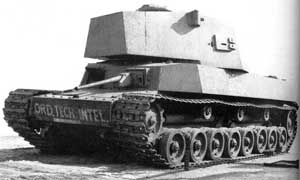
Front left side view of the single infinished prototype of the Type 5 Chi-Ri medium tank
Going Further... The Type 5 Chi-Ri Medium Tank Project appears in the following collections:
The "Military Factory" name and MilitaryFactory.com logo are registered ® U.S. trademarks protected by all applicable domestic and international intellectual property laws. All written content, illustrations, and photography are unique to this website (unless where indicated) and not for reuse/reproduction in any form. Material presented throughout this website is for historical and entertainment value only and should not to be construed as usable for hardware restoration, maintenance, or general operation. We do not sell any of the items showcased on this site. Please direct all other inquiries to militaryfactory AT gmail.com. No A.I. was used in the generation of this content.