Military Factory
Military Pay Chart
Global Firepower
Military Industrial Complex
Second World War
Home
Military Pay Scale
Military Ranks
Small Arms
Aircraft
Land Systems
Navy
Education
Military Factory Facebook Logo
flag of United Kingdom

Rolls-Royce (Armored Car) Armored Car (1915)

Authored By Staff Writer | Last Updated: 4/30/2013

Despite their World War 1 origins, Rolls-Royce Armored Cars served into World War 2 during the North African Campaign.

Find a School Near You
Follow Military Factory on Facebook:
Trending on Military Factory:
Recent Articles:
Prior to the acceptance of armored combat tanks in World War 1, armies developed doctrine to include use of the Armored Car. The armored car was just as its name suggested - an automobile armored through steel plates surfaces and armed with machine guns and personal weapons carried by the crew. The design offered a simplistic approach to the Armored Fighting Vehicle (AFV) concept which quickly grew into a field all its own by the end of the war in Europe. Due to the fact that early armored cars made use of existing automotive parts and designs, they proved largely unfit for large-scale, frontline combat and were exceedingly used in policing colonial interests or internal security after the arrival of the tank and into the interwar years following the global conflict. Armored cars were one of the few military products that Germany could build after the armistice of World War 1.

World War 1 began in the summer of 1914 with Britain committing as part of the Triple Entente to include the Russian Empire and France. Germany invaded neighboring Belgium, Luxembourg and France, attempting to capture the French capital of Paris in bold early strokes of what proved a rather fluid campaign to this point. However, the German advance was halted before reaching Paris proper and lines literally formed as both sides dug in for the brutal conflict ahead. With the arrival of these lines was lost the mobile nature of the war which, at one point, promised to be over by Christmas, and gave rise to networks of trenches beginning to dot the European countryside. From then on, the conflict would be largely fought through the bloody business of "Trench Warfare" with neither side wanting to give even a meter of ground.

With the stalemate along the Western Front, new devices were hurriedly developed and, in some cases, perfected in an effort to break the will of the enemy. The machine gun rose to deadly fame as did the aircraft through various guises including bomber and fighter. The tank was in its infancy and emerged as lozenge-shaped steel beasts for the British and several forgettable early designs for the French. Prior to these, however, the armored car played a vital role in supporting infantry actions when it could and most national powers fielded some form of it during the war.

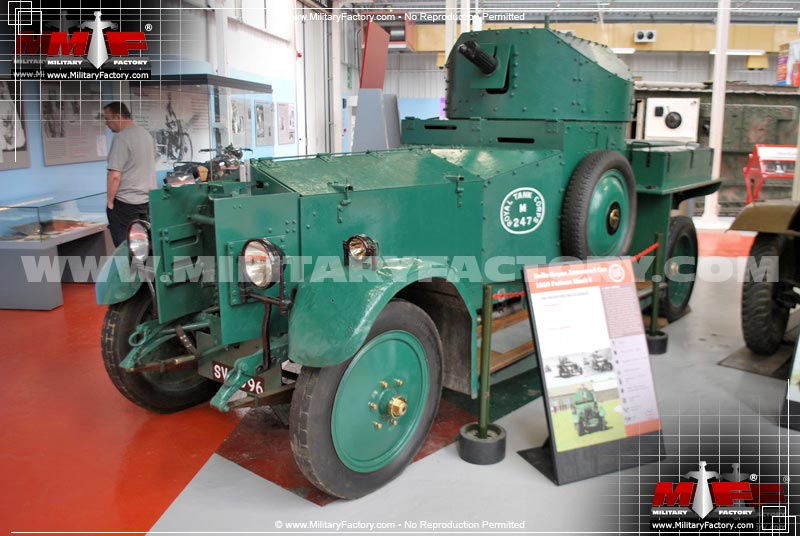
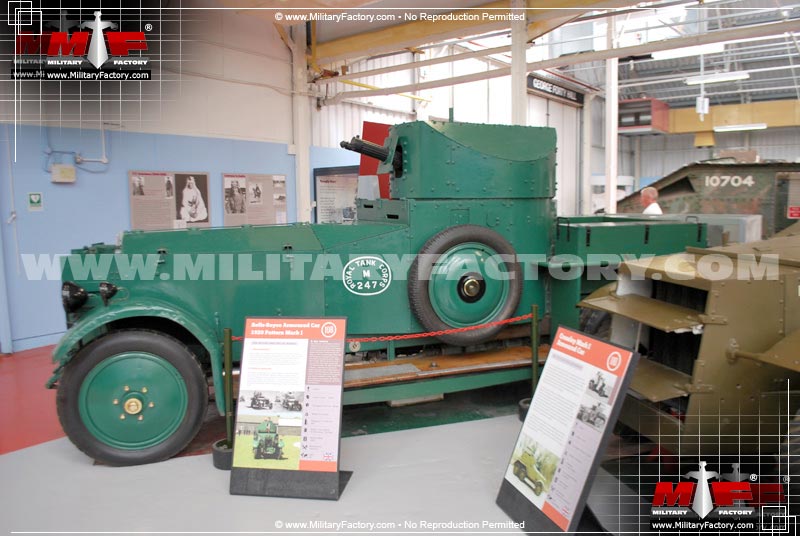
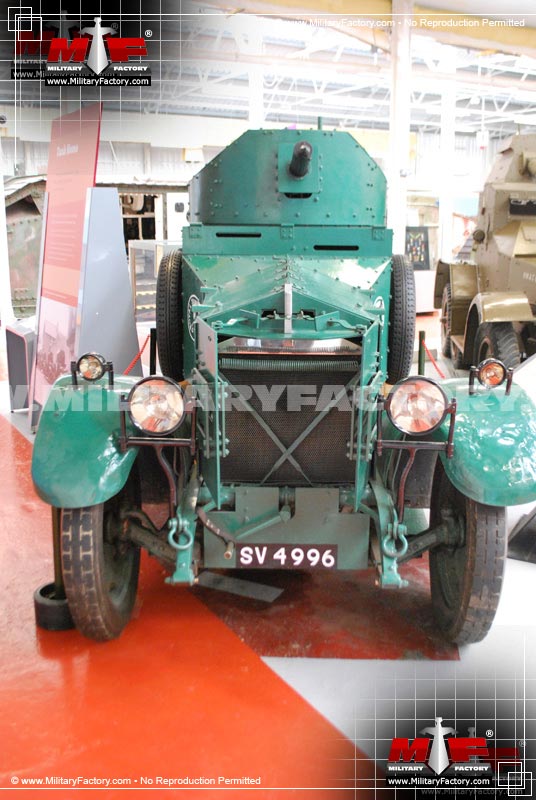
The British arranged their initial armored car squadron in September of 1914 and a total of six were eventually formed during the war. The Rolls-Royce "Silver Ghost" automobile chassis was selected to stock its inventory. The Silver Ghost series was first produced in 1906 and manufactured into 1926 with some 7,874 examples completed. Most of the civilian-minded accessories and comforts were appropriately stripped for military service and, to this existing understructure and four-wheeled arrangement, was added a boxy steel hull superstructure with traversing armored turret over the rear passenger section. The engine remained in a forward compartment with the driver in the center of the design. Aft of his placement was the turret and bulk of the vehicle's mass which made handling somewhat cumbersome. The wheels were spaced far apart at each corner of the frame, this carried over from the Silver Ghost car - though the rear set were double-tired to contend with the added weight of armor and armament. Armament was 1 x 7.7mm Vickers water-cooled machine gun, its jacketed barrel protruding some distance away from the turret's frontal armor. These changes then led to the "Rolls-Royce Armored Car" (RRAC) being born.

The RRAC weighed in at 5 Short Tons, and sported a running length of nearly 5 meters - certainly a long design by any measure and one that required a wide turning radius to boot. Width was 1.93 meters with a height of 2.54 meters. The standard operating crew was three personnel including the driver, a gunner and vehicle commander. All were modestly protected from small arms fire due to the armored superstructure. However, conditions within were spartan and generally unfriendly for periods of long service. Armor protection reached 12mm at critical spots about the superstructure. Power was served through 1 x 6-cylinder, water-cooled gasoline engine of 80 horsepower which provided the 4x2 wheeled chassis a top speed of 45 miles per hour and operational road range of 150 miles. Of course this was assuming an ideal road surface and optimal conditions. The chassis was supported through a leaf spring suspension system offering some cross-country travel. Entry and exit of the vehicle was through the turret roof or along the side of the vehicle via a hinged rectangular door. Spare road wheels could be affixed to the hull sides for replacement of flats.

Prototypes of the RRAC were unveiled in December of 1914. After a short period of evaluation, they were pressed into service during the early-to-mid portion of 1915 along the front but were quickly outpaced by developments in the war which had now grown into a series of stalled initiatives. As such, the design's limitations shown through for their cross-country capabilities proved lacking - underpowered due to excess weight brought about by the steel armoring and limitations in available armament options. Thusly, its arrival proved too late and many were better served as second-line units in support of advancing troops when concerning the battlefields of Western Europe. The combat tank eventually took the reins of armored warfare during the conflict and armored cars such as the RRAC were eventually sent overseas to the Middle East and across Africa where terrain and engagement environments proved more suitable to the design. RRACs and others like her gave a better account of themselves in fighting apart from Europe proper for even Lawrence of Arabia held the design in high esteem, owing much of his success against the Ottoman Turks to whatever RRACs he could get at his disposal. A total of 120 RRAC vehicles were produced by Rolls-Royce factories during World War 1, manufacture lasting until 1917 to which Rolls-Royce was pressed to produce more aircraft engines for the British aviation effort.

During the interwar years, the RRAC existed in limited numbers with British, Irish and Polish forces. In 1920, the British Army authorized a modernization program to bring the vehicle up to new required standards, producing the RRAC "1920 Pattern Mk I" with its reinforced radiator armor and all-new wheel installations. A further revision of the design that year added a commander's cupola to the roof and this produced the RRAC "1920 Pattern Mk IA" designation. In 1921, the RRAC "1921 Indian Pattern" was formed complete with the 1920 Pattern changes and an elongated armored hull with spherical turret mounting four machine guns. Another foreign modification of the original RRAC was occurring in British Egypt where existing superstructures were mated with Fordson truck chassis to produce the "Fordson Armored Car" - highly suitable for colonial policing duties in the region. By 1940, at least 34 of these vehicles were refitted with the Boys Anti-Tank Rifle coupled with a .303 Bren machine gun which broadened the tactical usefulness of the vehicle. In 1924, another revision added the commander's cupola to the turret roof and this produced the RRAC "1924 Pattern Mk I" designation.

Beyond their use in World War 1, RRACs were also featured in the Irish Civil War (1922-1923) where their policing qualities could be best put to use against unarmored guerilla-type forces in an urban environment. Pro-Treaty forces were supported by the British and eventually claimed the victory over the Anti-Treaty forces. Some 13 RRACs were handed over to the Irish government for the bloody clashes that ensued.

Despite their origination in a World War 1 initiative, the Rolls-Royce Armored Car was still present in the British inventory by the time of World War 2. At least 76 examples were still on hand though many based, again, in the Middle East where colonial security was of paramount importance to the Empire. As such, their fighting contribution was primarily centered in North Africa. World War 2 officially began in 1939 with the German invasion of Poland and quickly spread to include most of the discovered world. By 1941 however, the RRAC had seen its best fighting days behind her. The British eventually invested design and development into more modern armored cars and these proved much better suited to the war at hand. As such, the original Rolls-Royce design eventually faded to history, serving up to or around 1944 before they were given up for good. Irish-owned versions managed to outlive their usefulness into the mid-1950s.
Text ©2003-2013 www.MilitaryFactory.com • All Rights Reserved • No Reproduction Permitted
MilitaryFactory.com does NOT sell equipment/weaponry. Material presented throughout this website is for historical and entertainment value and should not to be construed as usable for hardware restoration, maintenance or general operation. Please consult manufacturers for such information. Our disclaimer. Email corrections / Comments to MilitaryFactory at Gmail dot com.
Picture of Rolls-Royce (Armored Car)
Pic of the Rolls-Royce (Armored Car)
Image of the Rolls-Royce (Armored Car)
View All Images (3)

Specifications for the
Rolls-Royce (Armored Car)
Armored Car


Country of Origin: United Kingdom
Manufacturer: Rolls-Royce - UK
Initial Year of Service: 1915
Production: 120


Focus Model: Rolls-Royce (Armored Car)
Crew: 3


Overall Length: 16.17ft (4.93m)
Width: 6.33ft (1.93m)
Height: 8.33ft (2.54m)
Weight: 5.2 US Short Tons (4,689kg; 10,337lbs)


Powerplant: 1 x 6-cylinder gasoline-fueled, water-cooled engine developing 80 horsepower.


Maximum Speed: 45mph (72 km/h)
Maximum Range: 149 miles (240 km)


NBC Protection: None
Nightvision: None


Armament:
1 x 7.7mm Vickers / Maxim water-cooled machine guns OR 1 x 0.55 caliber Boys Anti-Tank Rifle with 1 x 0.303 Bren Light Machine Gun.


Ammunition:
Not Available.


Variants:
Rolls-Royce 1914 Pattern Mk I - Initial Production Model.


Rolls-Royce 1920 Pattern Mk I - Modernized Variant; improved radiator armoring; new wheels.

Rolls-Royce 1920 Pattern Mk IA - Commander's cupola added.

Rolls-Royce 1921 Indian Pattern Mk I - British India RRACs with elongated hull armor; spherical turret emplacement for 4 x machine guns.

Rolls-Royce 1924 Pattern Mk I - Commander's cupola added to turret.

Fordson Armored Car - Rolls-Royce armored cars with Fordson truck chassis; various wartime armaments.


Operators: Ireland; Poland; United Kingdom

ALL LAND SYSTEMS CATEGORIES

By Decade:


1910 to 1919
1920 to 1929
1930 to 1939
1940 to 1949
1950 to 1959
1960 to 1969
1970 to 1979
1980 to 1989
1990 to 1999
2000 to 2009
2010 to 2019
VIEW ALL
Compare Tanks


By Type:


4x4 Military Vehicles
6x6 Military Vehicles
8x8 Military Vehicles
Artillery Gun Systems
Anti-Aircraft (AA) Guns
Anti-Aircraft (AA) Vehicles
Anti-Tank (AT) Guns
Anti-Tank (AT) Vehicles
Armored Cars
Armored Personnel Carriers (APC)
Battlefield Robots
Halftrack Vehicles
Heavy Tanks
Infantry Fighting Vehicles (IFV)
Light Tanks
Main Battle Tanks (MBT)
Modern Combat Tanks
Medium Tanks
Military Motorcycles
Multiple Launch Rocket Systems (MLRS)
Reconnaissance Vehicles
Special Purpose Vehicles
Self-Propelled Guns (SPG)
Tank Destroyers
General Purpose / Utility Vehicles


By Nation:


Afghanistan
Britain
China
France
Germany
Iran
Iraq
Israel / Israeli Army
Italy
Libyan Army
North Korea / North Korean Army
Pakistan
Russia
South Korea
Soviet Union
Syrian Army
United States
VIEW ALL

World War 2:


Artillery
Infantry Fighting Vehicles
Tank Destroyers (All)
Tanks (All)
Australian Tanks
British Tanks
Canadian Tanks
Cruiser Tanks (UK)
Czechoslovakian Tanks
French Tanks
German Tanks
German Tank Destroyers
German FlaK Guns
German Reconnaissance Vehicles
Hungarian Tanks
Italian Tanks
Japanese Tanks
Romanian Tanks
Soviet Tanks
Swedish Tanks
US Tanks
VIEW ALL


World War 1:


France WW1 Tanks
Germany WW1 Tanks
Britain WW1 Tanks
US WW1 Tanks
WW1 Artillery
WW1 Tanks (all)
VIEW ALL


Spanish Civil War:

VIEW ALL


Korean War:

Tanks
VIEW ALL


Vietnam War:

VIEW ALL


Cold War:

Cold War Tanks
Cold War American Tanks
Falklands War
Post-WW2 British Tanks
VIEW ALL


Gulf War (1991):

VIEW ALL


Miscellaneous:

Armored Vehicle Chassis Types

Site Disclaimer | Privacy Policy | Site Map | MF Origins


©2013 www.MilitaryFactory.com • Content ©2003-2013 MilitaryFactory.com • All Rights Reserved • Site Contact Email: militaryfactory at gmail dot com. The "Military Factory" name and MilitaryFactory.com logo are registered ® trademarks and protected by all applicable domestic and international intellectual property laws.


Top MF Stuff: 2013 Military Pay Scale | Military Ranks | WW2 Weapons | Sniper Rifles | Kts to Mph | WW1 Aircraft | Automatic Rifles | Aircraft Cockpits | Vietnam War Weapons | Main Battle Tanks | Submachine Guns | Shotguns | French Military Victories


Most photographic images appearing on this site are courtesy of the United States Department of Defense and are approved for public use. Other images acquired through the public domain. Digital art work courtesy of Dan Alex. Business Consulting by Kyle Williams. Material presented throughout this website is for historical and entertainment value and should not to be construed as usable for hardware restoration, maintenance or general operation. Please consult manufacturers for such information.


eXTReMe Tracker