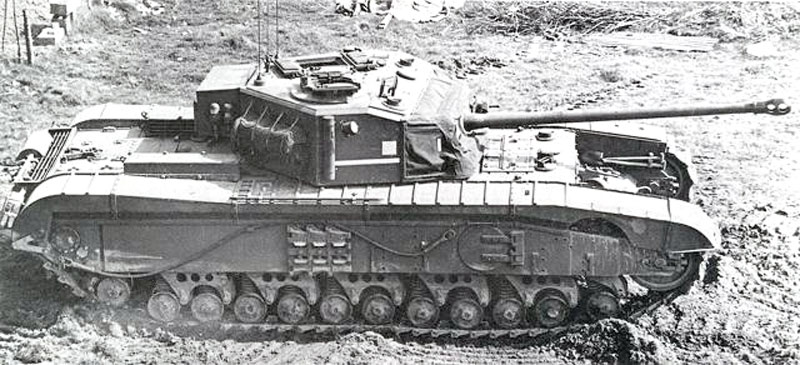
The Black Prince Infantry Tank was the ultimate evolution of the storied Churchill Infantry Tank of the British Army that saw considerable action during World War 2. The original Churchill entered service in 1941 and was produced until 1945 to the tune of 7,368 units, the last retired in 1952. The type saw service with British and Commonwealth forces in the North African campaign, across mainland Europe and along the East Front with Soviet forces via Lend-Lease - its reach making it one of the more important tanks of the war next to the American M4 Sherman and Soviet T-34 medium tanks. The "Black Prince" received its name from Edward of Woodstock (1330-1376), an English military commander better known to history as "Edward, The Black Prince".
Sensing a need to develop evermore powerful tracked gun platforms, it was suggested that the existing Churchill line be utilized as an interim solution until the availability of more modern, competing types to combat German forces. To this point, the British military had adopted a two-tank concept driven by "cruiser" and "infantry" tanks. Cruiser Tanks would be lighter armored and designed for the speed required of breaking through enemy defenses while engaging along the more vulnerable flanks and rear. Conversely, the counterpart Infantry Tank was developed with heavier armor in mind to support slower-moving infantry formations. The original Churchill fell into the latter category and its evolution - the "Black Prince" - followed the same concept. The British were already working on an entirely new tank concept, the "Universal Tank", that would combine the features of both tank types - this to become the famous Cold War-era Centurion Main Battle Tank seeing design in 1943 and entering service in 1945. Like the Centurion, the Black Prince began as a project with origins in 1943 and, accordingly, assigned the specification number of "A43". Its formal long-form name was "Tank, Infantry, Black Prince (A43)".
The main gun of choice became the QF 17 Pounder system, an excellent anti-tank field gun designed in 1941-1942 and debuting in 1943. The 3-ton weapon was centered around the 76.2x583mm R projectile (3 inches) and sported muzzle velocities between 2,900- and 3,950-feet per second depending on ammunition used. It could fire both a High-Explosive (HE) and Armor-Piercing (AP) round with equal lethality - the former against soft targets under cover and the latter against enemy armor and fortified structures. The QF 17 was considered the most lethal anti-tank gun of the Allies in all of World War 2. It was installed on the American M4 Sherman in British service and made into the "Sherman Firefly" variant, a proven tank-killing system.
Concerning the Churchill's original turret design, the QF 17 series gun was dimensionally larger than the preceding QF 2 Pounders initially fielded (later Churchill tanks managed a 75mm installation). As such, the base Churchill turret would have to be widened for the armament and a new diameter chosen for the turret ring. The added weight then spurred development of wider track links for better ground displacement and the sprung bogie suspension system would have to be modified in turn. For comparison, the original Churchill tank weighed in at nearly 40 tons while the revised Black Prince topped the scales at 50 tons.
Due to the weight gain, thought was given to utilizing a more powerful breed of engine - the Rolls-Royce Meteor series of 600 horsepower based on an original aircraft powerplant design. However, for ease of production, supply-and-demand and mechanical training, the original Bedford Type 120 series 12-cylinder powerplant of 350 horsepower was retained. This decision would end up severely limiting the Black Prince design from the outset for maximum road speed became a paltry 10.5 miles-per-hour across ideal surfaces (far lower when going cross-country) and operational range proved a respectable 100 miles.
Armor protection for the crew of five ranged up to 152mm (6 inches) in thickness. The crew consisted of the driver in the forward hull (right), a bow machine gunner (also in the hull, left), the tank commander, gunner and loader - these three residing in the turret. Onboard ammunition storage amounted to 89 x 76mm projectiles. The vehicle was defensed through 2 x 7.92mm BESA tank machine guns, one fitted to a flexible mounting in the hull bow and the other as a coaxial mounting alongside the main gun in the turret.
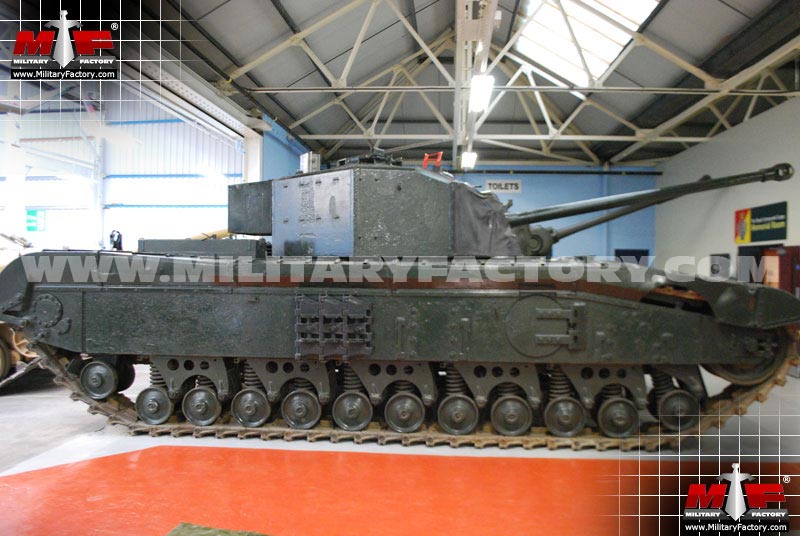
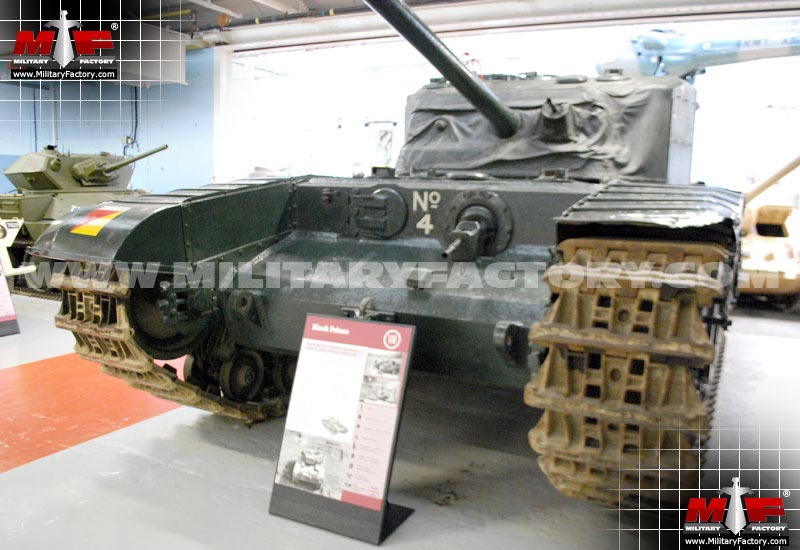
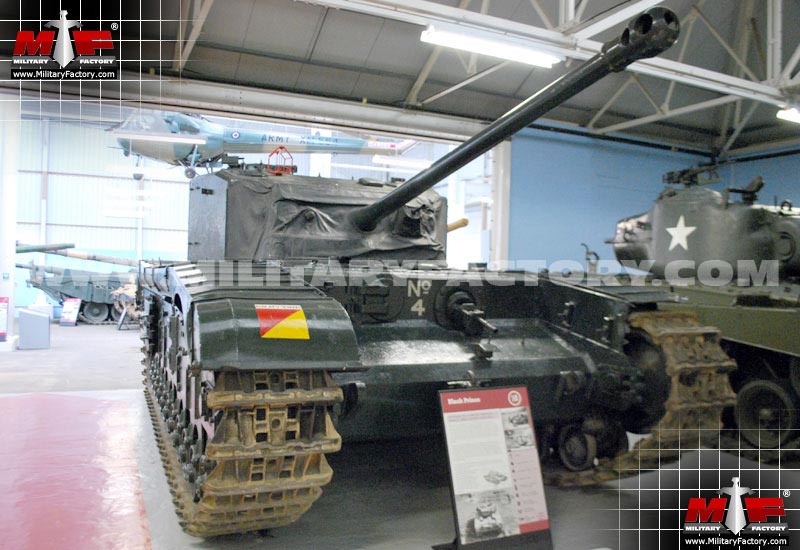
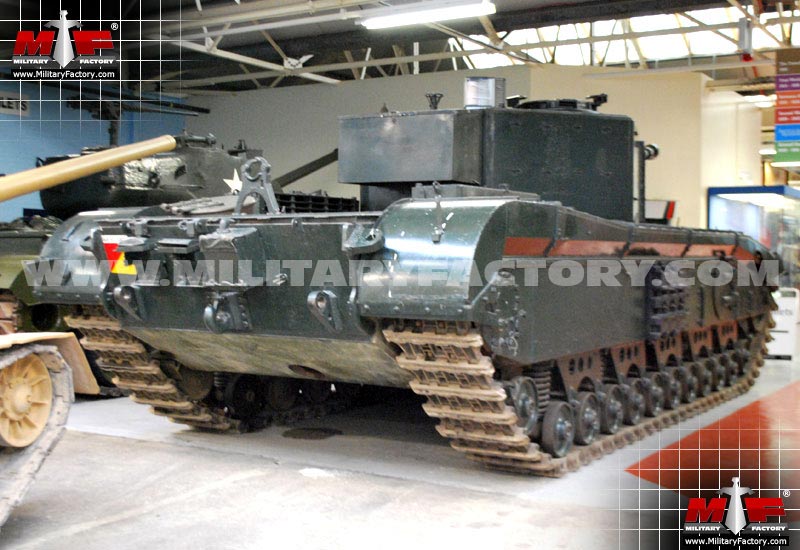
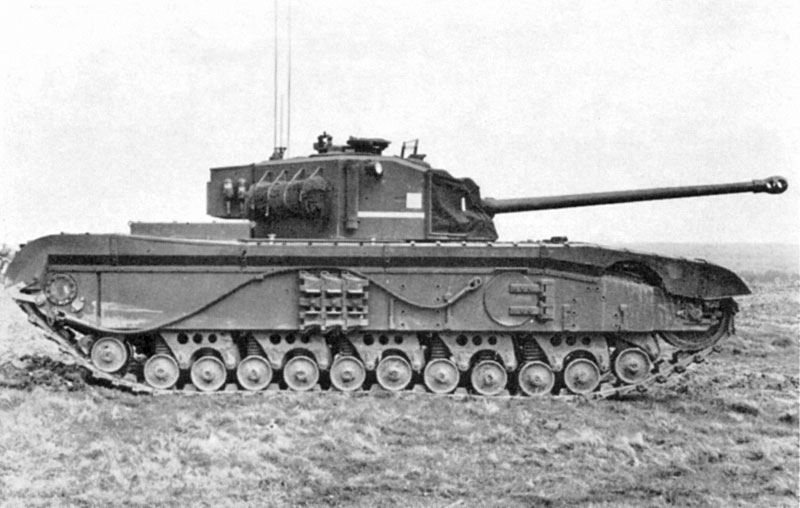
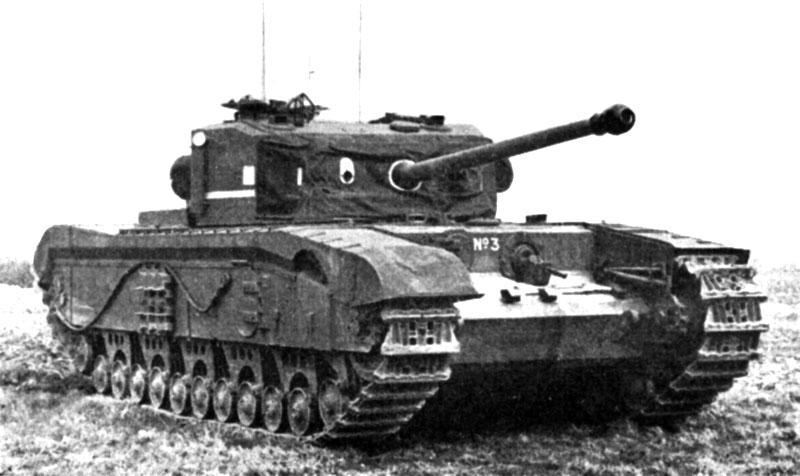
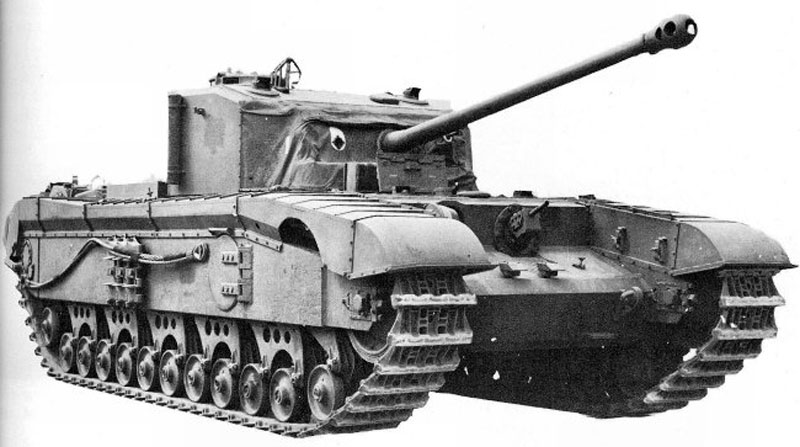
Externally, the Black Prince managed an appearance closely resembling the fabled Churchill series. Many vertical and horizontal lines were present, supplying the type with a rather utilitarian, boxy profile. The hull was straddled along both sides by the long-running track-and-wheel system consisting of multiple double-tired road wheels with the drive sprocket at the rear and the track idler at front. The sides were partially protected by armor skirts along the upper sections. The frontal section of the hull saw a well-sloped, though short-length, glacis plate leading up to a fully vertical plate that sat ahead of both driver and hull machine gunner. The hull roof was flat and relatively featureless. The turret sat atop the design, centrally placed for maximum balance. The frontal portions of the turret were gradually sloped towards the turret roofline while the sides were vertical. The main gun protruded from the frontal face and hung over the forward hull while being capped by a double-baffled muzzle brake. The engine resided in a compartment at the rear of the vehicle following a widely accepted traditional arrangement concerning combat tanks. There were two hatches along the turret roof (one reserved as the commander's cupola, slightly raised) as well as a pair of hatches over the front hull and circular hatches to either hull side.
Vauxhall Motors, manufacturers of the original Churchill and primarily recognized for their many contributions in the field of automobiles since 1897, was naturally charged with production of the Black Prince. Six pilot vehicles were introduced into 1945. This delay proved another factor that worked against the Black Prince finding any amount of battlefield success. By this time in the war, upgunned Shermans were proving adequate against the shrinking field of German tanks. In particular, British and Commonwealth forces had gained a mastery of their Sherman Fireflies which tended to level the battlefield against the more formidable of the Panzers - upgunned and uparmored Panzer IVs, the medium-class Panthers and the heavy-class Tigers and Tiger IIs (King Tiger). The 75mm-armed Cromwell Cruiser Tank had also been available to the British in quantity after debuting in 1944 and the 77mm-armed Comet Cruiser Tank arrived in December of that year to further bolster ranks. With the German initiatives faltering with each passing month heading into 1945, and the upcoming arrival of the Centurion Main Battle Tank, the Black Prince was doomed as a serial production combat tank. The war in Europe ended in May of 1945 and thusly ending the career of the Black Prince before it began. All told, there only existed the six prototypes and, of the six units completed, only one survived the ensuing war years to become a museum piece at Bovington in England - the birthplace of the tank.
Had the Black Prince been pressed into service, it would have been hampered by its heavy, underpowered design and its high profile turret. It lacked much in the way of sloped armor all about the hull and turret. Its road wheel configuration would have given it good ground crossing capabilities and the inherent penetration of its main gun would have been useful. The tank would most likely have been fielded with supporting armor for increased level of success and the type may very well have had a decent showing in the waning months of the war. However, it was increasingly apparent that the Churchill design has become a limited offering with the evolution of the war and its best fighting days were behind her - particularly with the arrival of the new class of combat tank, the "Main Battle Tank" embodied by the Centurion. The last British Army actions involving Churchill tanks was in the Korean War (1950-1953) when a Churchill "Crocodile" unit was dispatched to the fighting against the North and China. Many existing Churchills seeing service worldwide during the post-war years were replaced by the Centurion.
Power & Performance Those special qualities that separate one land system design from another. Performance specifications presented assume optimal operating conditions for the Infantry Tank Churchill (A43) Black Prince Infantry Tank.
2 x Bedford Flat 12-cylinder engine developing 350 horsepower. Installed Power
11 mph 18 kph Road Speed
99 miles 160 km Range
Structure The physical qualities of the Infantry Tank Churchill (A43) Black Prince Infantry Tank.
5 (MANNED) Crew
25.3 ft 7.7 meters O/A Length
11.2 ft 3.4 meters O/A Width
8.9 ft 2.7 meters O/A Height
97,980 lb 44,443 kg | 49.0 tons Weight
Armament & Ammunition Available supported armament, ammunition, and special-mission equipment featured in the design of the Infantry Tank Churchill (A43) Black Prince Infantry Tank.
1 x 75mm QF 17-pounder main gun
2 x 7.92mm BESA general purpose machine guns
AMMUNITION: 89 x 75mm projectiles (HE and AP mix)
1,200 x 7.92mm ammunition (estimated)
Variants Notable series variants as part of the Infantry Tank Churchill (A43) Black Prince family line.
Black Prince A43 - Base Series Designation and project number; six examples completed in 1945.
Tank, Infantry, Black Prince (A43) - Formal designation.
Operators Global customers who have evaluated and/or operated the Infantry Tank Churchill (A43) Black Prince. Nations are displayed by flag, each linked to their respective national land systems listing.
Total Production: 6 Units Contractor(s): Vauxhall Motors - UK
[ United Kingdom ]
1 / 8
Image copyright www.MilitaryFactory.com; No Reproduction Permitted
2 / 8
Image copyright www.MilitaryFactory.com; No Reproduction Permitted
3 / 8
Image copyright www.MilitaryFactory.com; No Reproduction Permitted
4 / 8
Image copyright www.MilitaryFactory.com; No Reproduction Permitted
The "Military Factory" name and MilitaryFactory.com logo are registered ® U.S. trademarks protected by all applicable domestic and international intellectual property laws. All written content, illustrations, and photography are unique to this website (unless where indicated) and not for reuse/reproduction in any form. Material presented throughout this website is for historical and entertainment value only and should not to be construed as usable for hardware restoration, maintenance, or general operation. We do not sell any of the items showcased on this site. Please direct all other inquiries to militaryfactory AT gmail.com. No A.I. was used in the generation of this content.