"The Denel G6 Rhino makes its mark as one of the most lethal wheeled self-propelled artillery platforms today."
Power & Performance Those special qualities that separate one land system design from another. Performance specifications presented assume optimal operating conditions for the Denel GV6 6x6 Wheeled Self-Propelled Artillery (SPA).
1 x Air-cooled diesel engine developing 525 horsepower. Installed Power
53 mph 85 kph Road Speed
435 miles 700 km Range
Structure The physical qualities of the Denel GV6 6x6 Wheeled Self-Propelled Artillery (SPA).
6 (MANNED) Crew
34.1 ft 10.4 meters O/A Length
11.5 ft 3.5 meters O/A Width
11.2 ft 3.4 meters O/A Height
103,617 lb 47,000 kg | 51.8 tons Weight
Armament & Ammunition Available supported armament, ammunition, and special-mission equipment featured in the design of the Denel GV6 Renoster (G6 Rhino) 6x6 Wheeled Self-Propelled Artillery (SPA).
1 x 155mm T6 L/52 howitzer main gun
1 x 12.7mm heavy machine gun
2 x 4 Smoke Grenade Dischargers
AMMUNITION: 47 x 155mm projectiles.
2,000 x 12.7mm ammunition.
8 x Smoke Grenade Dischargers.
Variants Notable series variants as part of the Denel GV6 Renoster (G6 Rhino) family line.
G6 "Rhino" - Base Production Series Designation
G6-52 "Extended Range" - Improved G6 currently under evaluation.
GV6 "Rhino" - Alternative designation within SANDF.
G6 M1A3 - UAE Export Variant Designation
G6 "Marksman" - British self-propelled anti-aircraft gun platform; Marksman turret assembly.
The G6 "Rhino" is an indigenous South African self-propelled artillery platform utilizing a six-wheeled chassis and armed with a 155mm main gun in a traversing turret. The G6 has since proven a highly accurate gunnery platform showcasing excellent mobility in limited actions to date though only seeing light production numbers and limited export orders since its inception. The G6 "Rhino" is also referred to as the "GV6 Rhino" in South African National Defense Force nomenclature.
Development of a new wheeled artillery system was initiated by the ever-growing South African military complex during the latter part of the 1970s, culminating in the first pilot vehicle of the G6 being made ready in 1981. The vehicle was a 6x6 all-terrain design centered around a modified version of the G5 towed field howitzer - this armament piece also being produced by Denel Land Systems since 1982. Despite it not being available in quantitative production numbers at the time, the vehicle was already being fielded in combat operations during the South African Border War of 1987/1988. Full-scale production of the G6 would begin in 1987 out of Denel facilities and it would not be until 1988 that the vehicle saw formal introduction into service with the SANDF. Once in service, the G6 would be called upon to provide infantry fire support as well as cover fire for advancing mechanized forces. Its highly mobile frame coupled with its turreted armament meant that the G6 could engage enemies both directly and indirectly as required.
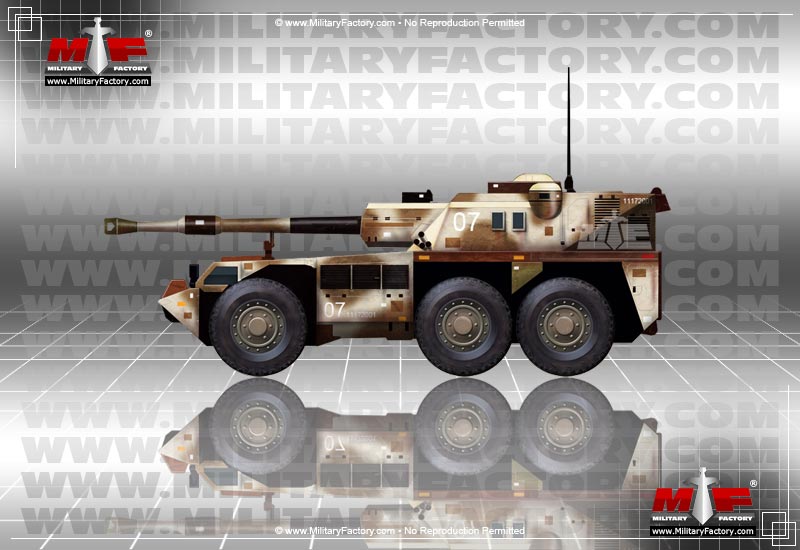
The G6 design is characterized by its low-silhouetted hull fitted atop a six-wheeled chassis - a very unique appearance when compared to similar self-propelled gun platforms in this class. There are three large, rubber-tired road wheels to a hull side with the rear-most pair set apart from the front-most pair. Only the front-most pairing is steerable though all wheels are driven by the powerpack. The front of the hull is low-set with a shallow and short glacis plate and protected headlights. The driver maintains a center-front position in the hull behind a three-sided windowed cockpit complete with fold-up armor panels. The hull roof is relatively flat with a large turret emplacement featuring sloped sides and housing the 155mm howitzer armament. There are vision and gun ports along the turret sides for basic point defense allowing the turret crew to engage enemy soldiers with personal weapons from within the relative safety of the vehicle. The barrel is capped by a single-baffled muzzle brake and a fume extractor is clearly identified along the forward portion of the barrel. The gun base sports the recoil housing and elevation mechanism. Overall panel construction of the G6 consists of welded steel providing basic armor protection to the crew and critical internal systems alike. As with most other armored vehicles, armor protection for the G6 is strongest along the front facing - capable of withstanding enemy rounds up to 20mm in caliber. The sides and rear of the vehicle are more vulnerable to the these weapon types but are generally sufficient against smaller caliber arms. As the G6 is not intended for frontline service, this limitation is somewhat negligible. The base production G6 weighs in at 46.5 tons and is crewed by six personnel including the driver, vehicle commander, gunner and loaders.
Primary armament for the G6 is the 155mm T6 L/52 main gun. Up to 47 projectiles of 155mm ammunition are carried aboard and these are issued with 50 charges and 64 primers/fuses. Elevation of the gun is limited to +75 and -5 degrees with 80-degrees of traversal in either horizontal direction. Ammunition types include standard High-Explosive Fragmentation (HE-FRAG) as well as and general incendiary, illumination and smoke types conforming to NATO artillery standards. There is an integrated semi-automatic loading system which allows for sustained rates of fire and quick setup and response times. Basic range utilizing standard ammunition is out to 19 miles though this can be extended out to nearly 24 miles with rocket-assistance as needed. A rate-of-fire is between six and eight rounds per minute with sustained levels of two rounds per minute being reported. The vehicle's wheeled nature means that it can fire a round and quickly relocate to a new position to repeat the process, giving the enemy little to fire at in return. When set up for general transport, the gun is affixed to the hull roof just behind the driver's position to stabilized the barrel. Recoil legs, fitted between the first and second tire pairs, are lowered for firing to help support the inherently violent recoil of the 155mm main gun.
The vehicle is defensed by a single 12.7mm heavy machine fitted to the turret roof and intended for low-flying, enemy aircraft such as helicopters and fixed-wing strike mounts. This weapon can also be utilized as a suppression system against enemy infantry and can penetrate the armor of light vehicles. Up to 2,000 rounds of 12.7mm ammunition are carried aboard. The G6 is also equipped with eight smoke grenade dischargers (in two banks of four along the turret sides) that allow the vehicle to move about under the cover of a smoke screen during tactical maneuvering. The crew is also protected from airborne threats by way of an integrated NBC (Nuclear, Biological, Chemical) system as well as an automated fire suppression system. South African battlefield experience has made its engineers something of experts when it comes to developing robust vehicles designed to withstand attacks from hidden landmines and, as such, the G6 chassis and underside hull of is designed in such a way as to help deflect blasts from these weapons.
The Rhino is powered by a single air-cooled diesel engine delivering 525 horsepower output. This supplies the vehicle with a top speed of 53 miles per hour in ideal conditions with an operational range equal to 430 miles on flat, paved roads and roughly 220 miles or less off road. Suspension is across all six wheels and the inherent six-wheeled mobility of the G6 allows it to traverse gradients of up to 60% and cross trenches of 1 meter heights with fording of water sources being limited to 1 meter as well. When the engine is not in operation, the vehicle is supplied power by way of an auxiliary arrangement.
The "G6" designation marks the original Rhino production variants already in service. The "G6-52 Extended Range" designation marks an upcoming improved form of the base G6 that brings the operational crew down to five personnel with a minimum crew of three possible for basic functions. Performance of both the gun and engine have also been further increased and "smart" projectiles figure into the G6 ammunition foray allowing for multiple rounds to hit at a single target area within seconds of one another. The G6-52 is currently under evaluation for possible serial production and inclusion into the SANDF inventory. The "G6 Marksman" designation is used to cover a British self-propelled artillery gun system development that utilizes the G6 chassis and fitting a "Marksman" turret.
Beyond the 43 G6 systems currently in service with South African National Defense Force, the weapon system has seen deliveries to both Oman and United Arab Emirates. Oman has received 24 examples to date with the UAE having added 78 examples of the type. The UAE version is designated as the "G6 M1A3".
Operators Global customers who have evaluated and/or operated the Denel GV6 Renoster (G6 Rhino). Nations are displayed by flag, each linked to their respective national land systems listing.
Total Production: 145 Units Contractor(s): Denel Land Systems Division - South Africa
[ Oman; South Africa; United Arab Emirates ]
1 / 1
Image copyright www.MilitaryFactory.com; No Reproduction Permitted.
Going Further... The Denel GV6 Renoster (G6 Rhino) 6x6 Wheeled Self-Propelled Artillery (SPA) appears in the following collections:
The "Military Factory" name and MilitaryFactory.com logo are registered ® U.S. trademarks protected by all applicable domestic and international intellectual property laws. All written content, illustrations, and photography are unique to this website (unless where indicated) and not for reuse/reproduction in any form. Material presented throughout this website is for historical and entertainment value only and should not to be construed as usable for hardware restoration, maintenance, or general operation. We do not sell any of the items showcased on this site. Please direct all other inquiries to militaryfactory AT gmail.com. No A.I. was used in the generation of this content.