For all intents and purposes, the Gun "Carrier Mark 1" became the world's first self-propelled artillery (SPA) system. This somewhat revolutionary concept was brought about by the British in July of 1916 with production ramping up from June to July of the following year. Mind you the armament aboard the Gun Carrier Mark 1 was not intended for firing from the vehicle, it introduced the concept of fielding artillery weapons on tracked carriers. All told, 50 examples of the vehicle type were delivered and utilized to an extent in the closing phases of World War 1, with the war itself eventually serving as the beginning of the age of the "tank" as we know it today. The self-propelled artillery piece became a staple of modern armies throughout World War 2 (in many ways perfected by the German Army and their approach to modifying modified obsolete tank systems to take on large-caliber field guns) and continued in its defined role in the Cold War and even into today.
The Gun Carrier Mk I was developed to operate alongside the Mark 1 series of British tanks, itself regarded as the world's first true combat tank. The combat tank concept was a forced development intended to break the stalemates that proved all too common with trench warfare and it soon became apparent that a similar armored tracked artillery carrier would be required to navigate the cratered landscapes of the war. It was foreseen that these gun carriers would follow along the advances created by the Mark 1 tanks with their artillery pieces in tow to help deliver key fire support at speed. Having reached its intended target area, the artillery system carried aboard the gun carriers would be assembled as normal and made ready to fire.
Taking the lessons being learned through operational use of the Mark 1 tanks, British engineers at the Metropolitan, Carriage, Wagon and Finance concern developed a pilot vehicle around the tank that would serve to transport a powerful field gun or howitzer system into combat. The end-result was a combination of parts and systems which promoted an ungainly appearance to say the least though the new "Gun Carrier Mark 1" was simply designed to haul artillery. The design was accepted and trialed before netting a production contract worth fifty vehicles. Production was handed over to Kitson & Company.
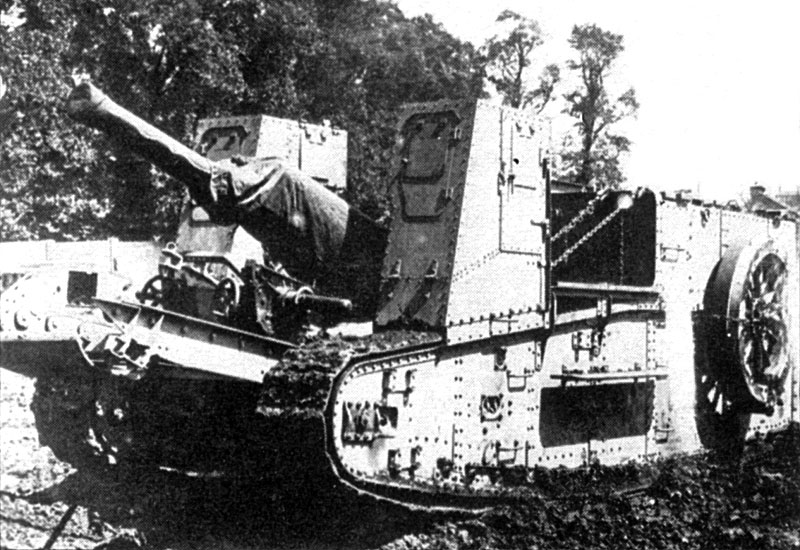
Design of the Gun Carrier Mark 1 followed along with conventional thinking when considering the "lozenge" shaped tanks appearing in World War 1. However, the Gun Carrier Mark 1 lacked the decidedly lozenge shape though it did maintain much of what made the Mark 1 tank a perceived success including riveted construction and long running tracks as well as a steering wheel "fish tail" system. The hull featured a boxy fixed superstructure which carried the engine, crew and primary armament - the latter in a front open-air compartment. A pair of wheels extending out at the rear of the vehicle acted as the tank's "rudder" when turning the vehicle about. A crew of four personnel were required for basic functions and consisted of a vehicle commander, an onboard mechanic to manage the engine and two personnel trained to handle the gears. Additionally, the gunnery crew traveled along to make their field gun ready to fire when called upon. The driver and was situated within a front-set armored cab alongside the armament mount. An armored cab straddled each side of the gun mount. The wheels for the artillery piece were separated from the gun during transport and mounted along the rear sides of the vehicle.
The Gun Carrier Mark 1 was completed with a single Daimler gasoline engine developing 105 horsepower, this fitted to a rectangular compartment at the rear of the vehicle. This allowed for a top speed of nearly 25 miles per hour in very ideal conditions. Considering the terrain types the carrier was to manage, this speed was optimistic at best. Overall weight for the vehicle was approximately 8,820lbs. She sported a running length of 16 feet, a width of 5 feet and a height between 7 feet and 9 feet overall.
Once in place, the gunnery crew would unload the armament, attach the wheels to the gun carriage and make the gun ready for fire. While this may have seemed a rather time consuming concept, it was advantageous when compared to the dozens of men required to transport a single artillery system, applicable supplies and ammunition stores across uneven terrain. The mechanized nature of the Gun Carrier Mark 1 certainly simplified the delivery of field artillery to an extent.
However, in the end, the Gun Carrier Mark 1s left little impact on the course of World War 1 where stalemates still ranged supreme and the tactics utilized by tanks today were still in their infancy. It is believed that none of these gun carrier systems ever fired a shot in combat despite there being the strength of some 48 vehicles - these divided into two companies of 24 vehicles each - delivered to the British Army. The two remaining vehicles out of the original 50-strong order were modified to serve as "Gun Carrier Crane" systems intended to support allied tanks in an engineer fashion. These versions showcased a heavy-duty crane at their front ends and saw their two armored cabs removed altogether. An improved version of the original Gun Carrier Mark 1 appeared as the Gun Carrier Mark 2 though this only evolved into a half-completed prototype and nothing more.
Power & Performance Those special qualities that separate one land system design from another. Performance specifications presented assume optimal operating conditions for the Gun Carrier Mark 1 (Mk 1) Self-Propelled Artillery (SPA).
1 x Daimler gasoline engine delivering 105 horsepower. Installed Power
25 mph 40 kph Road Speed
Structure The physical qualities of the Gun Carrier Mark 1 (Mk 1) Self-Propelled Artillery (SPA).
10 (MANNED) Crew
16.1 ft 4.9 meters O/A Length
5.1 ft 1.55 meters O/A Width
7.5 ft 2.3 meters O/A Height
8,818 lb 4,000 kg | 4.4 tons Weight
Armament & Ammunition Available supported armament, ammunition, and special-mission equipment featured in the design of the Gun Carrier Mark 1 (Mk 1) Self-Propelled Artillery (SPA).
1 x 60-pdr (127mm / 5-inch) main gun OR 1 x 6-inch field howitzer.
AMMUNITION: Not Available.
Variants Notable series variants as part of the Gun Carrier Mark 1 (Mk 1) family line.
Gun Carrier Mark 1- Base Series Designation; 48 examples produced.
Gun Carrier Mark 2- Proposed improved version; mock-up completed; gun mount relocated to rear of the chassis; single prototype partially completed; no mass production.
Gun Carrier Crane - Modified Gun Carrier Mark 1 models with heavy duty crane for battlefield engineering work; 2 examples produced.
Operators Global customers who have evaluated and/or operated the Gun Carrier Mark 1 (Mk 1). Nations are displayed by flag, each linked to their respective national land systems listing.
Total Production: 50 Units Contractor(s): Kitson & Company - UK
[ United Kingdom ]
1 / 1
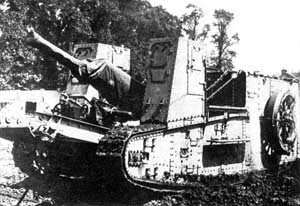
Front left side view of a Gun Carrier Mark 1; note field gun armament at front and artillery wheels along hull sides.
Going Further... The Gun Carrier Mark 1 (Mk 1) Self-Propelled Artillery (SPA) appears in the following collections:
The "Military Factory" name and MilitaryFactory.com logo are registered ® U.S. trademarks protected by all applicable domestic and international intellectual property laws. All written content, illustrations, and photography are unique to this website (unless where indicated) and not for reuse/reproduction in any form. Material presented throughout this website is for historical and entertainment value only and should not to be construed as usable for hardware restoration, maintenance, or general operation. We do not sell any of the items showcased on this site. Please direct all other inquiries to militaryfactory AT gmail.com. No A.I. was used in the generation of this content.