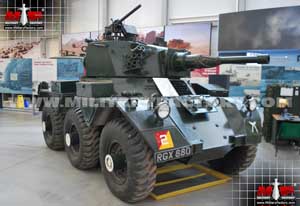
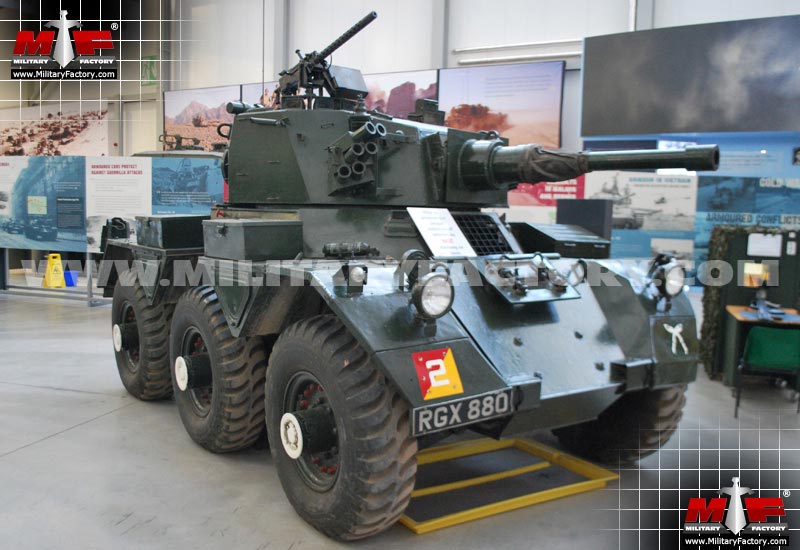
The Saladin Armored Car was a British multi-role vehicle appearing in the post-World War 2 years. It was brought online after a lengthy development period to replace the outgoing 4x4 AEC Armored Car that was used throughout the British campaigns of World War 2, first beginning in North Africa, and went on to serve for a time thereafter. The Saladin was named after the Kurdish Muslim warrior Saladin who led campaigns against European crusaders and was ultimately ruler over what is today modern-day Egypt, Syria and Yemen as well as the regions consisting of Mesopotamia and Hejas. Despite development of the Saladin beginning in the post-war years, the type did not formally enter British service until 1958.
The Saladin was part of the Alvis family of FV600 series vehicles (all named with designations beginning with the letter "S"). Another vehicle in the line, the 6x6 FV603 Saracen, was also born from the FV600 family and used extensively in policing territories in Northern Ireland. Similarly, the Saladin was developed with a 6x6 wheelbase that made use of a 6x6 wheeled suspension system and borrowed some of the drivetrain lessons as learned in the development of the Saracen. While the Saracen itself was billed as an Armored Personnel Carrier (APC) at heart, the Saladin was categorized as a dedicated armored car system.
Externally, the Saladin was conventional in nature. The engine was fitted to a rear compartment with the driver maintaining his position at the front hull. The glacis plate was well sloped to provide for some ballistics protection from enemy projectiles. The sides of the vehicle were characterized by its six large road wheels (three wheels to a hull side). Ground clearance was excellent and allowed for good cross-country performance. The heart of the Saladin system was its 360-degree traversing turret that mounted a formidable 76mm main gun, capable of engaging early Cold War-era tanks to an extent. The main gun was backed by a pair of 0.30 caliber general purpose machine guns (one coaxially-mounted in the turret) for anti-infantry/anti-aircraft duty respectively. The turret sported straight-faced side panels and a flat roof. Twelve smoke grenade dischargers (six to a turret forward side) could be used to cover offensive and defensive actions as needed. The Saladin was crewed by three personnel made up of the driver, commander and gunner.
Power was supplied by a single Rolls-Royce B80 Mk.6A 8-cylinder gasoline engine delivering up to 170 horsepower. This allowed for a top speed of 72kmh with an operational range of 400km. Suspension was spread out across all six wheels. The Saladin was built for reconnaissance and policing duties and was thusly lightly armored but relatively fast on paved roads. Its inherent speed became an asset when needing to exit from a disadvantageous meeting with the enemy. However, its main gun armament was capable of knocking out most vehicles out of the main battle tank classification.
The Saladin armored car went on to see use well beyond the British Army. The relatively low cost of procuring the Saladin made it a tempting acquisition to those forces (military and otherwise) that could not afford "true" armored vehicles or had no need for such systems but instead could rely on inherent mobility and firepower of the armored car. This proved most effective in "keeping the peace" measures for many burgeoning states. Operators went on to include Australia, German Federal Police units, Honduras, Indonesia, Jordan, Kuwait, Lebanon, Maldives, Mauritania, Oman, Portugal, Sri Lanka, Sudan, Tunisia and Yemen.
The Saladin went on to see action in UN operations as well as police and military operations with several different forces during her tenure. While no longer in service with British Army units, the Saladin legacy has still endured with operational duty being recorded as recently as 2009 with Sri Lanka and Honduras military forces.
Power & Performance Those special qualities that separate one land system design from another. Performance specifications presented assume optimal operating conditions for the Alvis FV602 Saladin 6x6 Wheeled Armored Car.
1 x Rolls-Royce B80 Mk.6A 8-cylinder gasoline engine delivering 170 horsepower. Installed Power
45 mph 72 kph Road Speed
249 miles 400 km Range
Structure The physical qualities of the Alvis FV602 Saladin 6x6 Wheeled Armored Car.
3 (MANNED) Crew
16.2 ft 4.93 meters O/A Length
8.3 ft 2.54 meters O/A Width
7.8 ft 2.39 meters O/A Height
25,353 lb 11,500 kg | 12.7 tons Weight
Armament & Ammunition Available supported armament, ammunition, and special-mission equipment featured in the design of the Alvis FV601 Saladin 6x6 Wheeled Armored Car.
1 x 76mm main gun
1 x 0.30 caliber Browning machine gun
1 x 0.30 caliber Browning anti-aircraft machine gun
12 x Smoke Grenade Dischargers
AMMUNITION: 12 x Smoke Grenades
Variants Notable series variants as part of the Alvis FV601 Saladin family line.
FV601 Saladin - Base Series Designation
Operators Global customers who have evaluated and/or operated the Alvis FV601 Saladin. Nations are displayed by flag, each linked to their respective national land systems listing.
Total Production: 1,200 Units Contractor(s): Alvis - UK
[ Australia; Germany; Honduras; Indonesia; Jordan; Kuwait; Lebanon; Maldives; Mauritania; Oman; Portugal; Sri Lanka; Sudan; Tunisia; United Kingdom; Yemen ]
1 / 1
Image copyright www.MilitaryFactory.com; No Reproduction Permitted.
Going Further... The Alvis FV601 Saladin 6x6 Wheeled Armored Car appears in the following collections:
The "Military Factory" name and MilitaryFactory.com logo are registered ® U.S. trademarks protected by all applicable domestic and international intellectual property laws. All written content, illustrations, and photography are unique to this website (unless where indicated) and not for reuse/reproduction in any form. Material presented throughout this website is for historical and entertainment value only and should not to be construed as usable for hardware restoration, maintenance, or general operation. We do not sell any of the items showcased on this site. Please direct all other inquiries to militaryfactory AT gmail.com. No A.I. was used in the generation of this content.