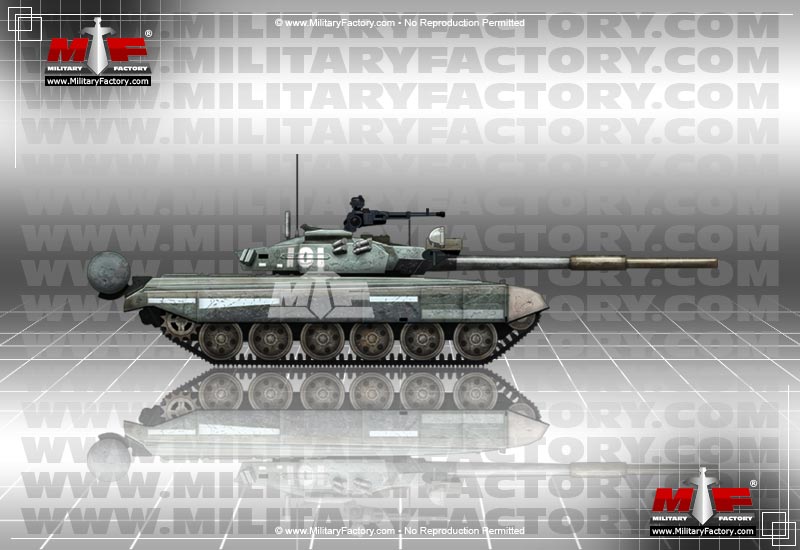
"The North Korean Pokpung-ho main battle tank is thought to be a heavy modification of the Russian T-62 with elements borrowed from other Russian tanks as well."
Despite a design origin that possibly dates back to the late 1980s, the Pokpung-ho ("Storm Tiger") Main Battle Tank remains something of an enigma to observers outside of North Korea. For a time, the tank was known in the West under the codename of "M-2002" as its existence was confirmed in the year 2002 while undergoing performance evaluation trials. It is believed that the Pokpung-ho entered service in 1992 and today represents one of the most modern tank offerings of the North Korean Army. The Pokpung-hu was further unveiled in public during a 2010 North Korean Army military parade, solidifying its existence to Western observers.
Design of the Pokpung-ho is accredited to the Second Machine Industry Bureau with production being handled out of the Ryu Kyong-su Tank Factory of Sinhung, South Hamgyong Province in North Korea. As very little concrete information is currently available on the tank, it is believed that the Pokpung-ho is something of a "mish-mash" of collected technologies from other Soviet-era and Chinese main battle tanks - from the T-62 and T-72 to the T-80, T-90 and the Chinese Type 88. The North Koreans had garnered some experience in the upgrading of Soviet systems when they undertook a program to modernize their T-62 fleet to create the indigenous Chonma-ho ("Sky Horse") Main Battle Tank. It is believed that the Pokpung-ho program was developed in response to the poor showing that Soviet T-72s had in the 1991 Gulf War with the Iraqi Army, falling to the mastery and firepower of American M1 Abrams crews in large numbers. Its sworn enemy, South Korea, maintains the capable K1 Main Battle Tank in several thousand examples and has since moved ahead with mass production of the K2 "Black Panther" - a system with performance qualities not unlike the American M1. The Pokpung-ho, therefore, is something of a North Korean design intended to bring her land forces to something of a modernized state.
From what is known about the Pokpung-ho, it appears to be a wholly conventional tank design. She sports a low profile and battlefield silhouette which works to the crew's advantage when the tank inevitably becomes a target. The low hull and turret design is synonymous with modern Russian tanks so this is to be expected. The front hull features a sharply angled glacis (protected by applique armor) plat contouring up to the turret bustle. The turret itself is situated at the center of the design and is circular in nature with noticeable angled facings to help deflect incoming enemy small arms, artillery spray and projectiles. The barrel is set low in the turret's front facing and extends out over the forward hull. There is an identifiable fume extractor along the midway point of the barrel and no muzzle brake is apparent. The main gun is believed to be either of 115mm or 125mm caliber, though the latter is more likely. The Russian version of this gun can also fire an Anti-Tank Guided Missile. The main armament is complimented by a 14.5 KPVT anti-aircraft heavy machine gun mounted at the commander's cupola to the right side of the turret roof. A 7.62mm PKT general purpose anti-infantry machine is fitted in a coaxial mount in the turret alongside the main gun. At least eight smoke grenade dischargers (in two banks of two) are noted to each side of the turret. Tracks encircling six road wheels straddle the hull design and are covered over by thin armor skirts for limited protection. The Pokpung-ho is powered by a single 12-cylinder diesel engine (possibly 1,000 horsepower output) mounted in a rear compartment and suspension is of the torsion variety. The vehicle weighs in at over 45 tons and features an operational range of approximately 230 miles with a top speed most likely in the vicinity of 37 miles per hour. NBC (Nuclear, Biological and Chemical protection for the crew is assumed as it remains a standard fitting on all modern tanks. Likewise, night vision is almost assuredly supplied to the crew. The crew is made up of three personnel in the tank commander, gunner and driver - the main gun loading presumably handled by an automatic loader mechanism as in the Russian T-90, though some sources suspect manual loading to be a part of the Pokpung-ho's operation. The driver mans a position at the forward left side of the hull.
North Korea claims that the capabilities of the Pokpung-ho are similar to the modern Russian T-90, itself an updated interim form of the Cold War-era T-72. The Fire Control System is thought to be somewhat modern (computerized) and based on foreign technology (possibly a British Chieftain obtained by way of Iran or a Russian T-72). From available imagery, it can be assumed that the Pokpung-ho makes use of an onboard laser rangefinder, infrared sensor and searchlight. All these features come together to make for a lethal offering, though direct warfare is ultimately the final gauge. At any rate, the Pokpung-ho fits well into armored doctrine that the North Korean Army holds to.
As it stands, the Pokpung-ho is an improvement over the Cold War-era Soviet offerings that the North Korean Army is capable of fielding (albeit in large numbers) yet it remains to be seen how this "new" system can compare to the latest generation of Main Battle Tanks the world over. With the North Korean nation always strapped for war-making resources such as oil - largely dependent on some outside allegiances such as China - large-scale exercises involving the Pokpung-ho are few and far between. in the event of total war, however, the Pokpung-ho would most likely spearhead any offensive operations against the South.
The only known North Korean Army element charged with operation of the Pokpung-ho is the 105th Seoul Ry-Kyong-Su Guards Division. This group became North Korea's first armored division back in the Korean War of 1950-1953.
Power & Performance Those special qualities that separate one land system design from another. Performance specifications presented assume optimal operating conditions for the Pokpung-ho (Storm Tiger) (M-2002) Main Battle Tank (MBT).
1 x 12-cylinder diesel engine developing 1,000 horsepower (suspected). Installed Power
37 mph 60 kph Road Speed
230 miles 370 km Range
Structure The physical qualities of the Pokpung-ho (Storm Tiger) (M-2002) Main Battle Tank (MBT).
4 (MANNED) Crew
31.3 ft 9.53 meters O/A Length
12.4 ft 3.78 meters O/A Width
7.3 ft 2.22 meters O/A Height
97,665 lb 44,300 kg | 48.8 tons Weight
Armament & Ammunition Available supported armament, ammunition, and special-mission equipment featured in the design of the Pokpung-ho (Storm Tiger) (M-2002) Main Battle Tank (MBT).
1 x 115mm OR 125mm main gun
1 x 14.5mm KPVT anti-aircraft heavy machine gun
1 x 7.62mm PKT general purpose coaxial machine gun.
8 x Smoke Grenade Launchers
AMMUNITION: 36 x 125mm projectiles (estimated)
300 x 14.7mm ammunition (estimated)
3,000 x 7.62mm ammunition (estimated)
8 x Smoke Grenades
Variants Notable series variants as part of the Pokpung-ho (Storm Tiger) (M-2002) family line.
Pokpung-ho (Storm Tiger) - Series Designation
M-2002 - Possible Alternative Designation
Operators Global customers who have evaluated and/or operated the Pokpung-ho (Storm Tiger) (M-2002). Nations are displayed by flag, each linked to their respective national land systems listing.
Total Production: 250 Units Contractor(s): Ryu Kyong-su Tank Factory - North Korea
[ North Korea ]
1 / 1
Image copyright www.MilitaryFactory.com; No Reproduction Permitted.
Going Further... The Pokpung-ho (Storm Tiger) (M-2002) Main Battle Tank (MBT) appears in the following collections:
The "Military Factory" name and MilitaryFactory.com logo are registered ® U.S. trademarks protected by all applicable domestic and international intellectual property laws. All written content, illustrations, and photography are unique to this website (unless where indicated) and not for reuse/reproduction in any form. Material presented throughout this website is for historical and entertainment value only and should not to be construed as usable for hardware restoration, maintenance, or general operation. We do not sell any of the items showcased on this site. Please direct all other inquiries to militaryfactory AT gmail.com. No A.I. was used in the generation of this content.