Military Factory
Military Pay Chart
Global Firepower
Military Industrial Complex
Second World War
Home
Military Pay Scale
Military Ranks
Small Arms
Aircraft
Land Systems
Navy
Education
Military Factory Facebook Logo
flag of Soviet Union

Katyusha (BM-8 / BM-13 / BM-31) Multiple Launch Rocket System (1939)

Authored By Staff Writer | Last Updated: 12/23/2010

Katyusha rocket systems were heavily employed by the Red Army in World War 2, delivering a lethal payload as well as psychological terror.

Find a School Near You
Follow Military Factory on Facebook:
Trending on Military Factory:
Recent Articles:
The Soviet Army became something of experts in the use of battlefield rockets during World War 2. The BM-13 series (more popularly known as "Katyusha", this derived from the diminutive affectionate form of "Katya") mounting their lethal 132mm high-explosive rockets on rudimentary launch rails, proved devastating against the heart of German Army forces and became the most widely available form of the Red Army mobile launchers. Despite her 1930s pedigree, the Katyusha can be found in various forms even today, a popular weapon system for cash-strapped militaries and insurgent forces alike. The term "Katyusha" also went on to form a family of similarly-minded vehicles, fitting different rocket counts on different vehicle chassis types.

The Katyusha was designed in the latter half of the 1930s and were only beginning to come online by the time the German Army invaded the Soviet Union in June of 1941. At that time, there only a few launcher batteries available and only a small stockpile of 132mm rockets to boot. Regardless, the systems were placed into active service wherever and whenever possible to keep a fragile defense intact until production could keep pace with demand. At any rate, these weapon systems served as quite a wakeup call to the unsuspecting German Army, particularly in July of 1941 during actions at Smolensk. The Germans nicknamed the Katyusha "Stalin's Organ" in response to its arrangement of launch rails (mimicking the pipes of an organ) and the noise the rockets made when launched. The Katyusha was also known to some as "Little Katy".

The rockets themselves, the Rs-82 and Rs-132 series, were in development for some time prior during the 1930s. These weapons were originally intended for use aboard Soviet ground-attack aircraft and ultimately proved effective in the role. It was not until 1938 that Soviet engineers began evaluating the weapon for use by ground-based launchers. Tests revealed the rockets to be viable battlefield implements and, in 1941, the BM-13 launch truck was ordered into production. At their core, these complete Katyusha systems proved relatively cheap to produce and fast to deliver to front line components requiring such a "shock and awe" weapon.

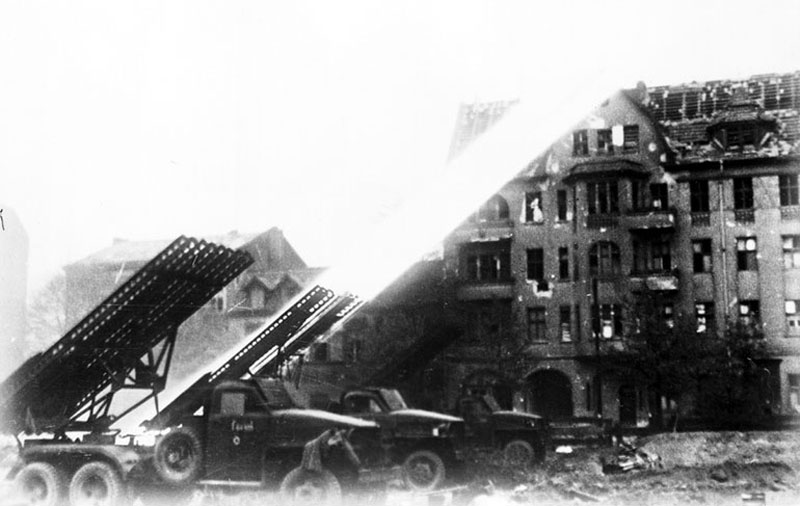
While rocket launching systems such as the BM-13 were largely inaccurate for direct target fire, there was no second-guessing the psychological effect delivered from a release of large, high-explosive rockets against an enemy-held area. If properly amassed in number, a force of such vehicles could lay waste to swathes of enemy-occupied territory and, as such, accuracy proved of little importance in the long run. The end result was usually a dead (or shaken) enemy and a wasteland of debris where trees and structures once stood.

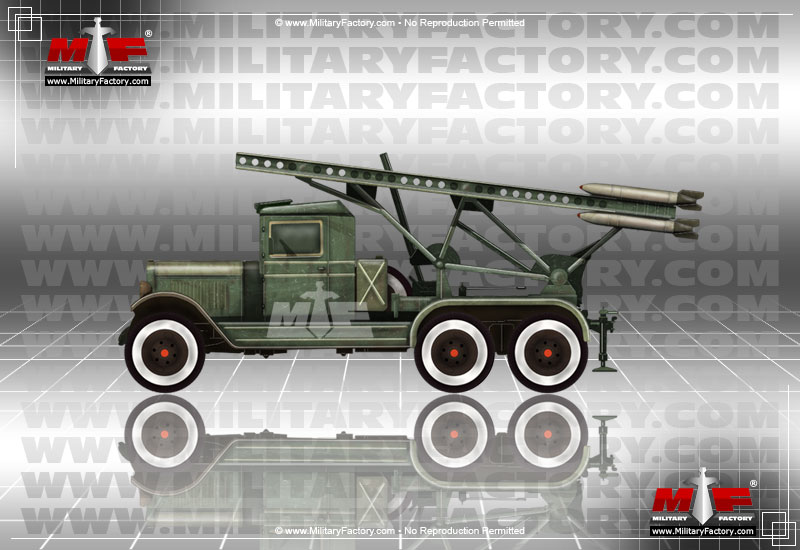
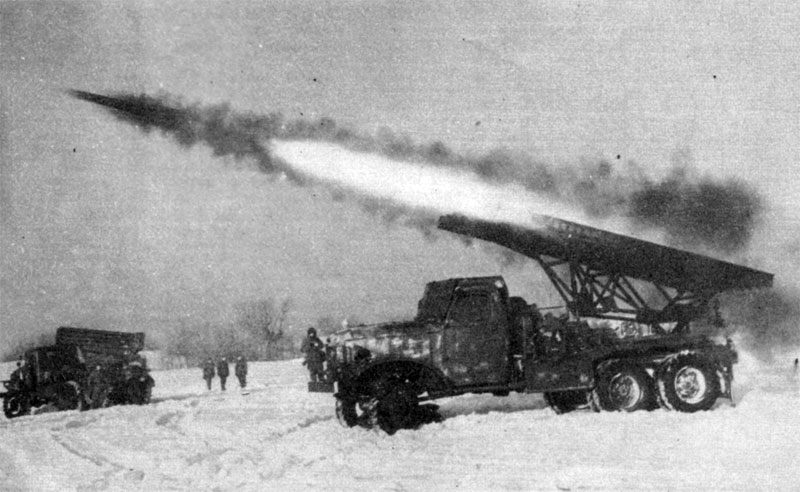
The concept behind the BM-13 was quite simple, it consisting generally of a six-wheeled all-wheel drive truck chassis with a forward-mounted engine and crew compartment followed by the fixed launch rail system itself on a rear-set flatbed. A hydraulic lift elevated the forward portion of the launcher - up to 45-degrees - and interestingly no traverse was afforded on initial models. This meant that the entire vehicle had to be positioned towards the target area. The weapon, as a whole, relied on basic ballistic trajectory that itself relied on adjustments to the firing arc by the crew.

In their early forms, BM-13s were set upon the chassis of the Soviet ZiS-6 - a 6x6, six-wheeled utility truck that was modified to include a 16-rocket launch system. These vehicles fell under the formal designation of BM-13-16. The ZiS-6 offered adequate off-road and on-road capabilities and could reach virtually any battlefield location that a tank or other like-vehicle could. This meant she could participate alongside offensive actions - though most often from behind the direct front line - and launch her deadly salvo before the rush of the initial attack began. Such was the value of these early systems as a weapon to the Soviet Army that measures were taken to ensure their locations were kept secret. Tarps were utilized to shroud their appearance from low-flying enemy reconnaissance aircraft and only proven members (usually Soviet Secret Service - NKVD) of the Communist Party were enlisted to operate Katyushas within the ranks of the Red Army. First actions for BM-13s occurred on July 14th, 1941 in assaults against German Army troops and vehicles.

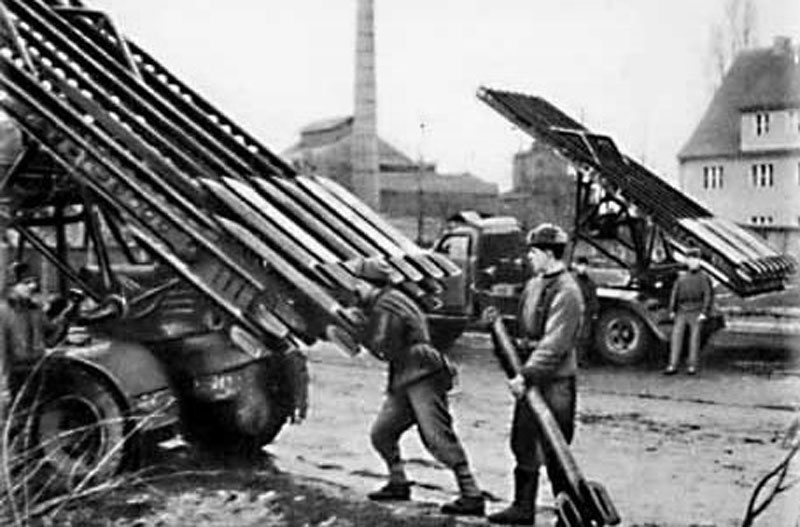
Each Katyusha rocket was fin-stabilized to provide for some level of accuracy against a target area and the launch rails they sat upon (for a time known under the name of "Kostikov Guns" after their designer) became known as "Flutes" to Soviet Army personnel. The launch process was enacted by way of an electric primer fueled by the truck's own battery system. The rockets fielded a range out to 9,300 yards in perfect conditions. Warheads were usually of the high-explosive (HE) fragmentation variety which allowed enemy troops to be decimated by both explosion and subsequent flying metal shards. It was only later that differing warhead types were brought online and these included armor-piercing (AP) for use against collections of enemy tanks, and marking and illumination flare types naturally followed. The gunnery crew could fire as many or as little as two rockets at a time.

Before long, BM-13s were produced in the thousands allowing their secretive nature within the Soviet Army to dissolve - no longer were they allowed strictly for Party members but general Army personnel as well. Once the rocket-launching trade became more commonplace for Katyusha crews, steps were taken to improve overall accuracy with the inclusion of additional spin afforded to each rocket - this, of course, at the expense of some range. Steel roof plates and window shutters were also introduced on several models when possible to serve as protection for the crew during launch. Before long - and with the benefits of Lend-Lease - the Katyusha series was branched out to include 4x4 vehicles and 6x6 trucks of all sorts of makes and models, specifically from American factories in the form of International K7 "Inter Trucks", International M-5-5-318 trucks, Fordson WO8T trucks, Ford/Marmon-Herrington HH6-COE4 series trucks, Chevrolet G-7117 trucks, the Studebaker US6 U3 series and the GMC CCKW-352M-13 type. These went on to form large hybrid batteries of mobile launching systems that included indigenous Soviet trucks and even artillery tractors. One of the more notable BM-13 developments became the long range BM-13-DD. This fielded dual-rocket motor projectiles across its top launch rails and could reach out to targets at 12,900 yards - becoming the longest reaching land-based artillery rocket of its type in the war. Launch rails were evermore increased from their original 16-count to as many as 48. Traverse was ultimately added to allow for 20-degrees pivoting.

Despite its 1930s origins, the BM-13 survived all of World War 2 to serve for a large portion of the upcoming Cold War. As she was now available in some number, Katyusha systems were naturally exported to Soviet allies whenever possible. While the system was generally removed from Soviet Army service around 1980, it endured with other nation's forces for some time longer - modernized forms simply doing away with the original Cold War-era truck chassis and replacing them with modern contemporary types. Regardless, the design philosophy inherent in the original BM-13 remained largely in place.

The Katyusha was supplied in numbers to Communist-held East Germany during the Cold War and fielded by the Chinese during their participation in the Korean War. The weapon served both sides of the Iran-Iraq War and Syrian-based versions were captured by the Israeli Army - enough, in fact, to form two battalions of launchers for the IDF. The Katyusha proved alive and well in the Vietnam War and their use was further documented throughout the 2006 Lebanon War by Hezbollah against Israeli targets. It is believed that such weapons were used on coalition troops in the fortified "Green Zone" in Iraq by insurgents as well, this occurring as recently as March of 2008.

It is believed that over 10,000 Katyusha rocket launching platforms were produced during World War 2. Beyond the notable 132mm BM-13-16 Katyusha model there existed the BM-8-8 mounting eight launch rails for 82mm rockets on an American Willys MB JEEP, the BM-8-24 with twenty-four 82mm launch tubes over Soviet T-40 and T-60 light tank chassis, the BM-8-48 mounting forty-eight 82mm launch rails on a Soviet ZiS-6 or American Studebaker US6 U3 series truck and the BM-31-12 with twelve 300mm rockets on an American Studebaker US6 U3 series truck chassis.
Text ©2003-2013 www.MilitaryFactory.com • All Rights Reserved • No Reproduction Permitted
MilitaryFactory.com does NOT sell equipment/weaponry. Material presented throughout this website is for historical and entertainment value and should not to be construed as usable for hardware restoration, maintenance or general operation. Please consult manufacturers for such information. Our disclaimer. Email corrections / Comments to MilitaryFactory at Gmail dot com.
Picture of Katyusha (BM-8 / BM-13 / BM-31)
Pic of the Katyusha (BM-8 / BM-13 / BM-31)
Image of the Katyusha (BM-8 / BM-13 / BM-31)
View All Images (4)

Specifications for the
Katyusha (BM-8 / BM-13 / BM-31)
Multiple Launch Rocket System


Country of Origin: Soviet Union
Manufacturer: State Factories - Soviet Union
Initial Year of Service: 1939
Production: 10,000


Focus Model: BM-13 Katyusha
Crew: 2


Overall Length: 0.00ft (0.00m)
Width: 0.00ft (0.00m)
Height: 0.00ft (0.00m)
Weight: 0.0 US Short Tons (0kg; 0lbs)


Powerplant: Various - dependent on chassis (ZiS-6, Ford, Chevrolet, International, Studebaker).


Maximum Speed: 0mph (0 km/h)
Maximum Range: 0 miles (0 km)


NBC Protection: None
Nightvision: None


Armament:
8, 24 or 48 x 82mm rockets (BM-8)
16 x 132mm rockets (BM-13)
12 x 300mm rockets (BM-31)


Ammunition:
8, 24 or 48 x 82mm rockets (BM-8)
16 x 132mm rockets (BM-13)
12 x 300mm rockets (BM-31)
High-Explosive, Armor-Piercing, Signal and Illumination Warheads.


Variants:
BM-8 - Light Launcher; 82mm caliber; 8 to 48 launch tubes; beginning service in 1941.


BM-13 - Medium Launcher; 132mm caliber; 16 launch tubes; chassis types included Internal K7 Inter Truck, International M-5-5-318, Fordson WO8T, Ford/Marmon-Herrington HH6-COE4, Chevrolet G-7117, Studebaker US6 U3 and GMC CCKW-352M-13 truck chassis; various forms beginning service in 1941.

BM-13N ("Normalizovanniy") - Standardized use of the Studebaker US6 2.5-ton truck beginning in 1943.

BM-31 - Heavy Launcher; 300mm caliber; 12 launch tubes; beginning service in 1944.

BM-21 - Modernized Wheeled Katyusha launcher; prevalent design throughout Cold War.


Operators: Afghanistan; Angola; Armenia; Azerbaijan; Czechoslovakia; Egypt; East Germany; Georgia; Hamas; Hezbollah; Hungary; Iran; Iraq; Israel; North Korea; Poland; Rwanda; Soviet Union; Syria; Vietnam

ALL LAND SYSTEMS CATEGORIES

By Decade:


1910 to 1919
1920 to 1929
1930 to 1939
1940 to 1949
1950 to 1959
1960 to 1969
1970 to 1979
1980 to 1989
1990 to 1999
2000 to 2009
2010 to 2019
VIEW ALL
Compare Tanks


By Type:


4x4 Military Vehicles
6x6 Military Vehicles
8x8 Military Vehicles
Artillery Gun Systems
Anti-Aircraft (AA) Guns
Anti-Aircraft (AA) Vehicles
Anti-Tank (AT) Guns
Anti-Tank (AT) Vehicles
Armored Cars
Armored Personnel Carriers (APC)
Battlefield Robots
Halftrack Vehicles
Heavy Tanks
Infantry Fighting Vehicles (IFV)
Light Tanks
Main Battle Tanks (MBT)
Modern Combat Tanks
Medium Tanks
Military Motorcycles
Multiple Launch Rocket Systems (MLRS)
Reconnaissance Vehicles
Special Purpose Vehicles
Self-Propelled Guns (SPG)
Tank Destroyers
General Purpose / Utility Vehicles


By Nation:


Afghanistan
Britain
China
France
Germany
Iran
Iraq
Israel / Israeli Army
Italy
Libyan Army
North Korea / North Korean Army
Pakistan
Russia
South Korea
Soviet Union
Syrian Army
United States
VIEW ALL

World War 2:


Artillery
Infantry Fighting Vehicles
Tank Destroyers (All)
Tanks (All)
Australian Tanks
British Tanks
Canadian Tanks
Cruiser Tanks (UK)
Czechoslovakian Tanks
French Tanks
German Tanks
German Tank Destroyers
German FlaK Guns
German Reconnaissance Vehicles
Hungarian Tanks
Italian Tanks
Japanese Tanks
Romanian Tanks
Soviet Tanks
Swedish Tanks
US Tanks
VIEW ALL


World War 1:


France WW1 Tanks
Germany WW1 Tanks
Britain WW1 Tanks
US WW1 Tanks
WW1 Artillery
WW1 Tanks (all)
VIEW ALL


Spanish Civil War:

VIEW ALL


Korean War:

Tanks
VIEW ALL


Vietnam War:

VIEW ALL


Cold War:

Cold War Tanks
Cold War American Tanks
Falklands War
Post-WW2 British Tanks
VIEW ALL


Gulf War (1991):

VIEW ALL


Miscellaneous:

Armored Vehicle Chassis Types

Site Disclaimer | Privacy Policy | Site Map | MF Origins


©2013 www.MilitaryFactory.com • Content ©2003-2013 MilitaryFactory.com • All Rights Reserved • Site Contact Email: militaryfactory at gmail dot com. The "Military Factory" name and MilitaryFactory.com logo are registered ® trademarks and protected by all applicable domestic and international intellectual property laws.


Top MF Stuff: 2013 Military Pay Scale | Military Ranks | WW2 Weapons | Sniper Rifles | Kts to Mph | WW1 Aircraft | Automatic Rifles | Aircraft Cockpits | Vietnam War Weapons | Main Battle Tanks | Submachine Guns | Shotguns | French Military Victories


Most photographic images appearing on this site are courtesy of the United States Department of Defense and are approved for public use. Other images acquired through the public domain. Digital art work courtesy of Dan Alex. Business Consulting by Kyle Williams. Material presented throughout this website is for historical and entertainment value and should not to be construed as usable for hardware restoration, maintenance or general operation. Please consult manufacturers for such information.


eXTReMe Tracker