The Soviet Army need for ever-more formidable tracked firepower came to the forefront after losses of much territory to the invading Germans in the summer of 1941. The stout KV (Kliment Voroshilov) heavy tank series (KV-1 and KV-2) proved adequate but only an extent for they lacked the necessary battlefield mobility of the fabled T-34 medium tank series while utilizing similar weaponry. The KV-1 was more of a tank-killer with its F-34 76.2mm main gun. The KV-2 mounted a 152mm howitzer and was more of a fire support vehicle thank tank destroyer. The T-34, while an ever-evolving system, lacked the required firepower with its base 76.2mm main gun and armor protection was limited, particularly against the ranks of the newer German Panther and Tiger heavy tank series. As such, endeavors were undertaken by the Red Army to present newer and better systems to level the playing field. One such development therefore became IS series of heavy tanks - popularly known as the "Josef Stalin" series - the most powerful tank to serve in the Red Army during all of World War 2. The IS family set the stage for Soviet tank development doctrine for decades to come.
The IS family was born from the interim evaluation "KV-85" tank and its 85mm main gun. The new Soviet Army requirement called for a similar tank system with improved armor protection mounting an 85mm armament. The resulting "IS-85" designation marked the initial batch of 85mm-armed heavy tanks that shortly became the "IS-1" when Marshal Kliment Voroshilov had fallen out of political favor with his government superiors. The new tank series was therefore renamed to "Josef Stalin" in honor of the Soviet leader. IS-85 prototypes emerged in the fall of 1943 and shared the same hull and running gear as the KV series but its armor protection was vastly improved thanks to a new welded turret. Additionally, Soviet engineers managed to create a lighter tank product than the KV-85 which required a less powerful engine while promoting a higher top road speed. The IS-85 then formally became the serial production-minded "IS-1".
Work continued on ever-improved forms of the new IS series as the war waged on. This eventually produced the "IS-100" prototype mounting a 100mm BS-3 main gun. The IS-100 was completed and evaluated in relatively small numbers. Another armament alternative soon emerged in the 122mm A-19 main gun and both systems were tested head-to-head. While the BS-3 fared better in armor penetration qualities, it was not available in the numbers required and lacked maximum utilization of available HE (High-Explosive) projectiles. The A-19, on the other hand, was available in quantity while presenting adequate anti-armor qualities though able to deliver HE ordnance to great effect. It was then sanctioned that the A-19 should become the new main gun of the new IS tank variant. The pilot form of the new IS tank became the "IS-122", the designation denoting its use of the 122mm gun barrel. Upon entering serial production in October of 1943, the IS-122 became the "IS-2". Production of some 2,250 examples spanned from 1943 into 1945 out of the Kirov Factory while UZTM heavy industries was also tapped for manufacture to keep up with Red Army demand. First combat action was recorded in April of 1944 when IS-2, operating under the banners of the 11th and 72nd Independent Guards Heavy Tank Regiments, fared well against German Panther tanks - for all intents and purposes, the legacy of the Joseph Stalin tank had begun.
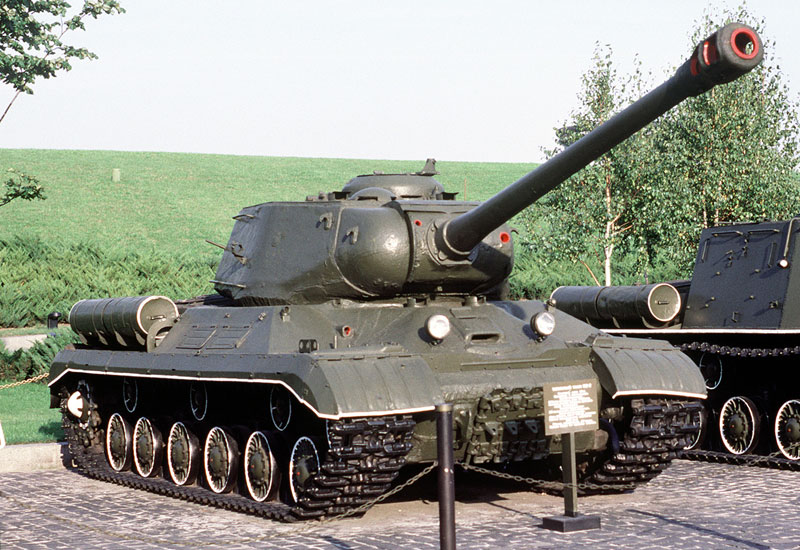
Design of the IS-2 was typical of the Soviet methodology concerning mechanized warfare - be it in World War 2 or in the Cold War years thereafter. A pair of track systems dominated the vehicle sides and worked in conjunction with six road wheels to a track side. The drive sprocket was at the rear with the track idler at the front and three track return rollers guided the upper portion of the track. The glacis plate was well sloped and covered over in thick armor. The hull roof was relatively low to which a rounded, thickly armored turret was set onto its bustle. The turret - situated well-forward in the design - sported a thick gun mantlet for maximum forward protection at this vulnerable spot and a long-barrel 122mm main gun fitting. The gun protruded out over the bow of the hull. The engine, a diesel-fueled, 12-cylinder Model V2 of 600 horsepower, allowed for top speeds of 23 miles per hour in ideal conditions and ranges out to 150 miles. The engine was mounted in a rear compartment within the hull. Additional fuel stores could be carried externally along the rear sides of the hull. The vehicle weighed in at 51 short tons and sported a running length of over 32 feet with a width of over 10 feet and height nearing 9 feet. She was crewed by four personnel to include the driver, tank commander, gunner and loader. The driver managed a position in the front center hull. Armor protection for the vehicle ranged from 30mm to 160mm across the various facings. Original turrets were welded whilst May of 1944 brought about a cast form. A 7.62mm DT machine gun was fitted coaxially to the turret. Another 7.62mm DT machine gun was fixed to the turret rear, meant to contend with enemy infantry attempting to assail the vehicle from the vulnerable rear. Only later IS-2 marks made use of the 12.7mm DShK heavy machine gun on the turret roof for anti-aircraft defense.
The appearance of production-quality IS-2s changed little throughout their wartime run. Original production forms featured a stepped glacis plate with a smaller gun mantlet while lacking a gun travel lock. In 1944, a revised production model appeared with a smooth glacis plate and fitting the 122mm D25-T main gun capped by a double-baffle muzzle brake. The new D-25T gun sported a semi-automatic breech that streamlined the loading/firing process, allowing tanker crews up to two rounds per minute. The mantlet size was increased and a travel lock was finally added to the rear hull. It was only later in the war that a 12.7mm heavy caliber anti-aircraft gun was mounted to the turret roof to counter low-level aircraft threats.
Once in service, the IS-2 proved a formidable addition to the Red Army inventory and was delivered in large numbers, replacing the formations of KV-85 tanks in the process. Any IS-1 series tanks then in production were completed with 122mm main guns and delivered as IS-2 marks. Those evaluation IS-100 tanks were also fitted with 122mm main guns to become "IS-1B" marks. The IS-2 series then went on to become the definitive IS family mark, especially in its 1944 guise when important factors such as cast turrets were introduced to better the series as a whole. The IS-2 proved highly critical in the Soviet demolition of Berlin to close out the war in Europe.
If the IS-2 maintained any drawbacks it was in her oversized projectile ammunition. The 122mm projectile was operated with a separate charge which added to reloading time for even the most experienced of tanker crews. As can be expected, the projectiles themselves were large and heavy, presenting a cumbersome shape to maneuver from within the tight confines of the turret. Since storage space on any tank was limited at best, the size of the 122mm projectile was certainly a limitation, thusly only 28 rounds of 122mm ammunition were carried.
Concerning the available 122mm shells, the AP (armor-piercing) form proved much less adequate against full-frontal attacks on German Panthers though penetration was still possible. Of note was that in the summer of 1944 to which the Germans had formally switched armor fabrication from manganese to high carbon steel with nickel which essentially led to them being more brittle when struck. Couple this with the 122mm shell and the Soviets assumed their projectile was the difference. Vulnerability of the Panther, Tiger or Tiger II was still along its sides, rear or near the turret bustle. It was actually in the IS-2's use of the Soviet HE projectile that the series truly shined. The HE round proved more than capable of dislodging most any German fortified concentrations. As such, the IS-2 could be depended on as an assault gun along with its tank-killing abilities and this "big gun" approach to such actions was something that even the Germans admired and took note of in their own late-war designs.
Following the war, the wartime IS-2 was due for a modernization of sorts to keep it a viable battlefield component throughout the Cold War years. A modernization program brought about use of side skirt armor protection to the upper portion of the tracks while also adding provisions for the mounting of additional external fuel stores at the rear of the hull. In these updated guises, the IS-2 became the "IS-2M". Other Soviet-allied nations also took delivery of the powerful IS-2 including Cuba, China and North Korea. Soviet/Russian Army forms served well into 1995 despite their World War 2 origins.
The IS-2 was eventually superseded by the improved IS-3 series which further addressed armor concerns based on the actions in World War 2. This version featured a new, rounded cast turret with an overall lower profile. Deliveries began in 1944 but the type arrived too late for active use in World War 2 along the Eastern Front. The IS heavy tank family line culminated with the arrival of the IS-10, the final Joseph Stalin tank - later redesignated as the "T-10".
Power & Performance Those special qualities that separate one land system design from another. Performance specifications presented assume optimal operating conditions for the IS-2 / JS-2 (Josef Stalin) Heavy Tank Tracked Combat Vehicle.
1 x Model V-2 12-cylinder engine delivering 600 horsepower. Installed Power
23 mph 37 kph Road Speed
149 miles 240 km Range
Structure The physical qualities of the IS-2 / JS-2 (Josef Stalin) Heavy Tank Tracked Combat Vehicle.
4 (MANNED) Crew
32.5 ft 9.9 meters O/A Length
10.1 ft 3.09 meters O/A Width
9.0 ft 2.73 meters O/A Height
112,436 lb 51,000 kg | 56.2 tons Weight
Armament & Ammunition Available supported armament, ammunition, and special-mission equipment featured in the design of the IS-2 / JS-2 (Josef Stalin) Heavy Tank Tracked Combat Vehicle.
1 x 122mm (121.9mm) D25-T main gun
1 x 12.7mm DShK heavy machine gun in coaxial mount.
1 x 7.62mm DT machine gun in bow superstructure
1 x 7.62mm DT machine gun in rear turret facing
AMMUNITION: 28 x 122mm projectiles
250 x 12.7mm ammunition
2,520 x 7.62mm ammunition
Variants Notable series variants as part of the IS-2 / JS-2 (Josef Stalin) family line.
Object 234 - Program Model Designation
IS-100 - Developmental Prototype; evaluation models fitted with 100mm main gun.
IS-122 - Developmental Designation; evaluation models fitted with 122mm main gun.
IS-2 - Base Production Series Designation
IS-1B - Western Designation for IS-100 retrofitted with IS-2 armament.
Operators Global customers who have evaluated and/or operated the IS-2 / JS-2 (Josef Stalin). Nations are displayed by flag, each linked to their respective national land systems listing.
Total Production: 2,250 Units Contractor(s): State Factories - Soviet Union
[ China; Cuba; North Korea; Soviet Union ]
1 / 1
Front right side view of the IS-2 Joseph Stalin heavy tank; color
Going Further... The IS-2 / JS-2 (Josef Stalin) Heavy Tank Tracked Combat Vehicle appears in the following collections:
The "Military Factory" name and MilitaryFactory.com logo are registered ® U.S. trademarks protected by all applicable domestic and international intellectual property laws. All written content, illustrations, and photography are unique to this website (unless where indicated) and not for reuse/reproduction in any form. Material presented throughout this website is for historical and entertainment value only and should not to be construed as usable for hardware restoration, maintenance, or general operation. We do not sell any of the items showcased on this site. Please direct all other inquiries to militaryfactory AT gmail.com. No A.I. was used in the generation of this content.