By 1939, the German Army had already matched current battlefield conditions with their design and development of the PaK 38 50mm (5cm / 1.97in) anti-tank gun. However, even before this new 50mm system was to reach frontline troops, German authorities were already decided on a new, more powerful antitank gun to counter the expected increases in tank armor. While the requirement for such a weapon was initially low, the German invasion of the Soviet Union - and the subsequent appearance of the heavily armored T-34 medium and KV-1 and KV-2 heavy tanks - forced the gun to become a top priority within the German ranks.
The German firm of Rheinmetall-Borsig AG was selected to produced the next incarnation of the PaK anti-tank gun and essentially took the existing PaK 38 design and "upsized" it to become the potent PaK 40 fitting the 75mm L/46 (7.5cm / 2.95in) caliber main armament. The PaK 40 was formally adopted into German Army service in 1940 though production deliveries were slow to develop - examples appearing out of factories only late that year (in November) and at a rate of just 15 units per month. As such, she was not introduced into quantitative service until February of 1942 to which the German Army was now fully embroiled in war with the Soviets along the East Front and in ongoing campaigns elsewhere across Europe and North Africa - trying to maintain multiple fronts with a steady supply of manpower, machines and critical resources. The PaK 40 would go on to prove her worth, however, for in the second half of World War 2, the PaK 40 became the most deployed German anti-tank cannon and a standard in the Wehrmacht inventory.
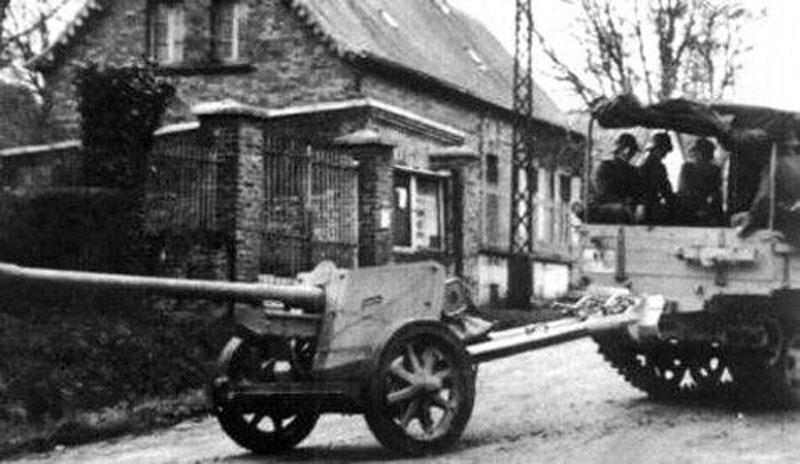
While outwardly similar to the PaK 38 before it, the PaK 40 was larger in dimension and heavier in weight, thusly making her less mobile than her predecessor - the price to be had for a gun system capable of dealing with next generation armor. Traveling weight was listed at 3,307lbs while her "action" weight was in the vicinity of 3,141lbs - the former requiring the use of vehicles to tow the system over long distances and the latter requiring the weapon to be physically handled into place by the gunnery crew.
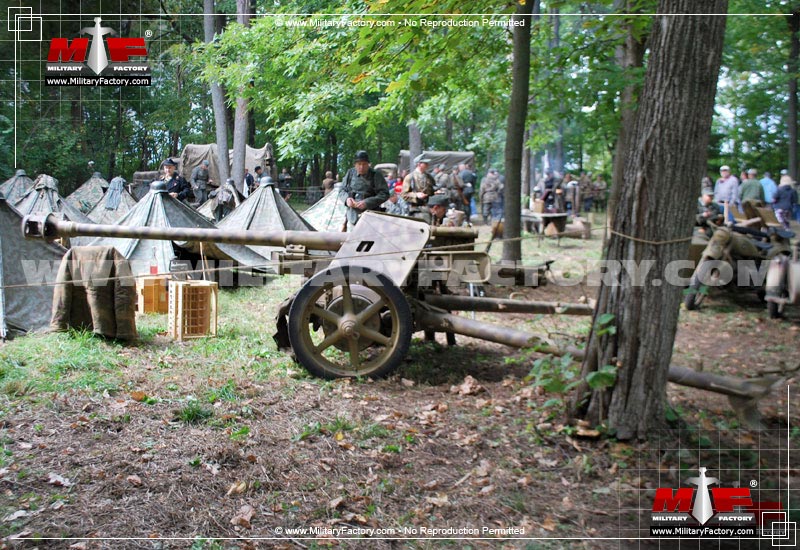
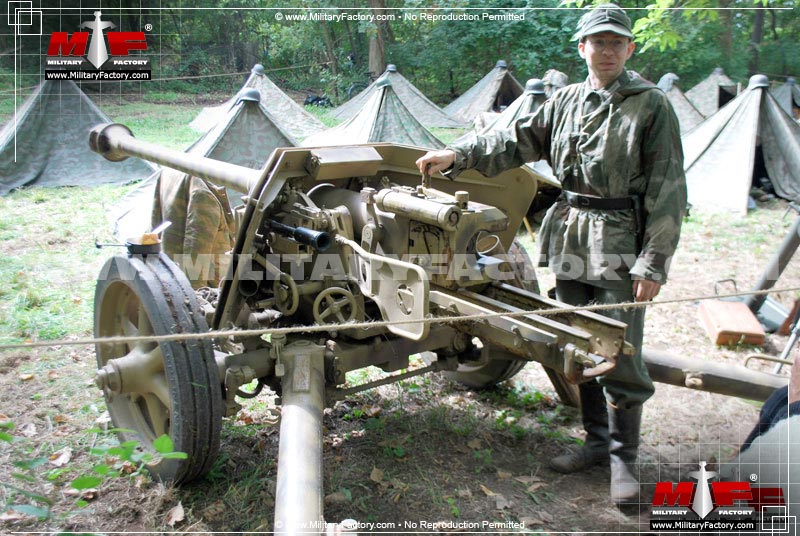
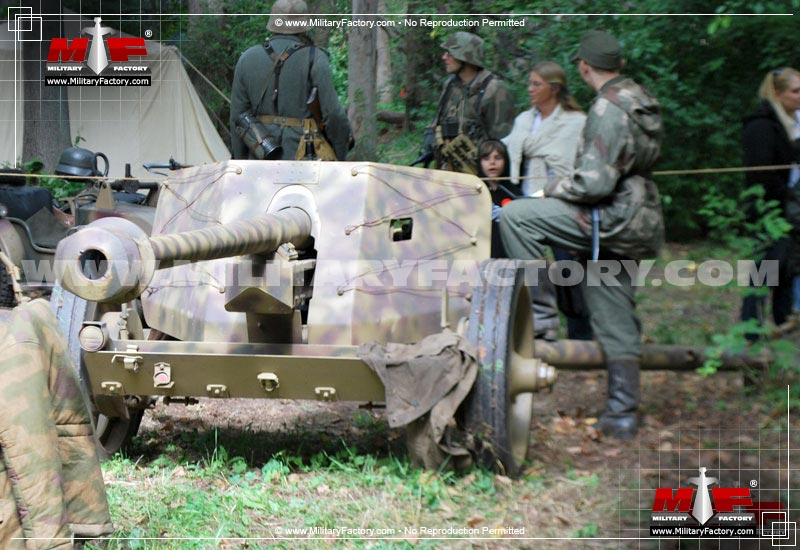
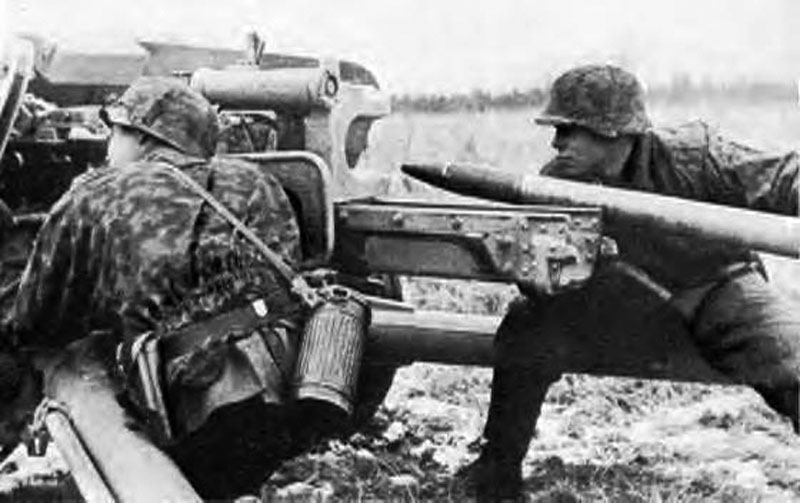
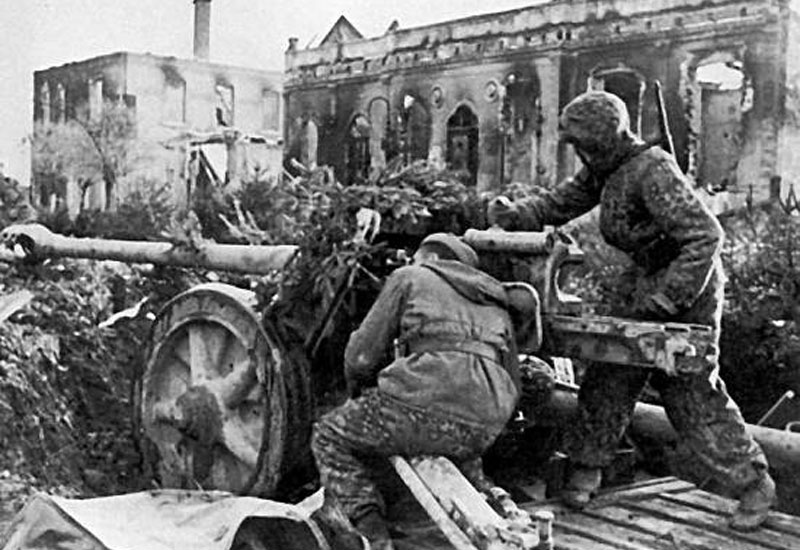
The PaK 40 retained the PaK 38's general layout with the gun mount seated on a two-wheeled, rubber-tired carriage system with split trail ends doubling as both her recoil legs (when split open) and as the carriage tow arm (when brought together). The barrel was long, extending out over a single-piece, three-panel blast shield and fitted with a multi-baffled muzzle brake at its business end. The barrel was loaded from its breech (semi-automatic, horizontal sliding block) at the rear of the gun, the crew only slightly protected from battlefield dangers by the forward shield element - essentially, the gunnery crew would have to crouch down behind their blast shield. Defense was only through any personal weapons carried by the crew which meant that PaK 40 positions could be overrun by enemy infantry. The firing action of the PaK 40 could be managed by a single soldier in a pinch though more hands ultimately led to a more efficient weapon - a basic gunnery crew consisted of five personnel. A trained, experienced crew could let off 14 rounds per minute.
The shortage of raw materials was beginning to play a critical role in the upcoming actions of the German military so special attention in regards to the construction of the PaK 40 was paid. Therefore, various steel types were used and portions were fabricated from large single pieces when possible. To her benefit, the PaK 40 did maintain a low profile which allowed her to be concealed and lie in wait amongst brush, sunken earth or holed out structures. The main gun could manage an elevation range of +22 to -5 degrees with a traverse of 45-degrees. The latter value forced the gunnery crew to apply positional reassessments themselves and physically lift the carriage legs and rotate the weapon on its wheels to provide for a new engagement angle.
The operating crew was given access to a small range of 75x714mm.R (75mm) ammunition options for the specific action at hand. This included the standard 15lb AP (Armored-Piercing) round as well as the 9lb AP40 which featured a tungsten-based core, ultimately proving a rarity as the war progressed. Even out to 2,190 yards, the AP40 (also known as "APCR" = "Armor-Piercing, Composite Rigid") projectile could pierce some 98mm of armor and, as can be imagined, this penetration value (up to 154mm) was only heightened at closer ranges making the PaK 40 one of the more feared - and respected - of the German guns. Of course there was also the standard issue 12.6lb HE (High-Explosive) rounds to deal with infantry and structures. Muzzle velocity of the AP, AP40 and HE projectiles were listed as 2,650 ft/s, 3,300 ft/s and 1,850 ft/s respectively. Effective range of the AP round was out to 8,350 feet while the HE round was rated effective out to 25,350 feet. PaK 40 projectiles were the same standardized rounds utilized by the long-barreled KwK 40 series tank guns fielded by Panzers, being differentiated only by their cartridge cases.
From the outset, the PaK 40 proved an excellent anti-tank weapon system - however, her excellence ultimately relied on the professionalism and training of her firing crew as any weapon was only good as the man behind it. At any rate, the PaK 40 was more than capable of penetrating the armor facings of any Allied tank at the time of her inception. However, if there was a key drawback in her design it was in her weight - her wheels regularly battling the high mud of the terrible Russian winter and forcing the use of artillery tractors to transport her about. In the German retreat of 1943, many PaK 40s were simply deserted along roads and passes by their German Army owners due to their immobility and getting stuck in mud and snow. Combat also brought the PaK 40 to battles in Italy and across the Mediterranean region.
The PaK 40 would see production through to the end of the war, remaining largely unchanged from her original form - such was her excellent design and general battlefield usefulness, plus Germany was fighting an all-out defensive war by the end. In all, over 23,000 PaK 40 guns were produced out of German-held factories with 11,728 of these produced in 1944 alone. The PaK 40 was in action until the final days of the war, still deemed capable of "addressing" most enemy tanks as needed.
The PaK 40 formed the basis of a few other notable developments including a dedicated tank-based main gun and a lighter version specifically designed for use on ground-attack aircraft. The split trail carriage was also the mount for an improvised infantry gun mounting a short-barrel 75mm gun. The PaK 40 was utilized as a field gun under the designation of 7.5cm FK 40 "Feldkanone". The PaK 40 became the primary armament on tracked vehicles to form stopgap "Marder" tank destroyers and fitted to 8x8 armored reconnaissance cars and halftrack carriers for infantry fire support duties and stand-off tank destroyers. Some 6,000 PaK 40 series guns were fitted to vehicles in these manners.
The PaK 40 was utilized beyond the German Army during World War 2, with operators including allies (some by force) such as Albania, Bulgaria, Czechoslovakia, Finland, Norway, Hungary and Romania. The Soviet Army even utilized captured PaK 40s (a common practice by both sides) against their former owners, in a way informally paying "respect" to the German design. Norway retained a stock of PaK 40s in their army inventory for a time during the post-war years.
Incidentally, the acronym of "PaK" stands for "PanzerAbwehrKanone".
Power & Performance Those special qualities that separate one land system design from another. Performance specifications presented assume optimal operating conditions for the PaK 40 (PanzerAbwehrKanone 40) Towed Anti-Tank (AT) Gun.
None. This is a towed artillery piece. Installed Power
Structure The physical qualities of the PaK 40 (PanzerAbwehrKanone 40) Towed Anti-Tank (AT) Gun.
5 (MANNED) Crew
20.3 ft 6.2 meters O/A Length
3,142 lb 1,425 kg | 1.6 tons Weight
Armament & Ammunition Available supported armament, ammunition, and special-mission equipment featured in the design of the PaK 40 (PanzerAbwehrKanone 40) Towed Anti-Tank (AT) Gun.
1 x 75mm (7.5cm / 3in) main gun
AMMUNITION: Dependent upon ammunition carrier. AP and HE projectile types.
Variants Notable series variants as part of the PaK 40 (PanzerAbwehrKanone 40) family line.
PaK 40 - Base Series Designation; many examples also fitted to vehicles.
7.5cm PaK 40 - Formal Designation
7.5cm FK 40 "Feldkanone" - Field Gun Usage
Operators Global customers who have evaluated and/or operated the PaK 40 (PanzerAbwehrKanone 40). Nations are displayed by flag, each linked to their respective national land systems listing.
Total Production: 23,500 Units Contractor(s): Rheinmetall-Borsig AG - Nazi Germany
[ Albania; Bulgaria; Czechoslovakia; Finland; Hungary; Nazi Germany; Norway; Romania; Soviet Union ]
1 / 6
Image copyright www.MilitaryFactory.com; No Reproduction Permitted.
2 / 6
Image copyright www.MilitaryFactory.com; No Reproduction Permitted.
3 / 6
Image copyright www.MilitaryFactory.com; No Reproduction Permitted.
The "Military Factory" name and MilitaryFactory.com logo are registered ® U.S. trademarks protected by all applicable domestic and international intellectual property laws. All written content, illustrations, and photography are unique to this website (unless where indicated) and not for reuse/reproduction in any form. Material presented throughout this website is for historical and entertainment value only and should not to be construed as usable for hardware restoration, maintenance, or general operation. We do not sell any of the items showcased on this site. Please direct all other inquiries to militaryfactory AT gmail.com. No A.I. was used in the generation of this content.