In October of 1941 - four months after the German invasion of the Soviet Union through "Operation Barbarossa" - engineers of the GAZ automotive plant began working on increasing the potency of the Red Army's T-60 series light tank. The general design would remain largely the same to help expedite production and meet wartime demand and precise plans were drawn up to make the most of the ensuing prototypes. It was decided to mate a pair of gasoline engines for increased output, replace the outmoded 20mm main gun with a 45mm offering, increase armor protection from 35mm to 45mm, strengthen the torsion bar suspension system and implement an extra pair of road wheels to each track side. Further elements would comprise the existing systems of the T-60 already in circulation. The initial prototype was available in December of 1941 and, after clearing requisite trials (no doubt hastened by the desperation of war), the T-70 was formally adopted into Red Army service in January of 1942 with serial production scheduled to begin in March.
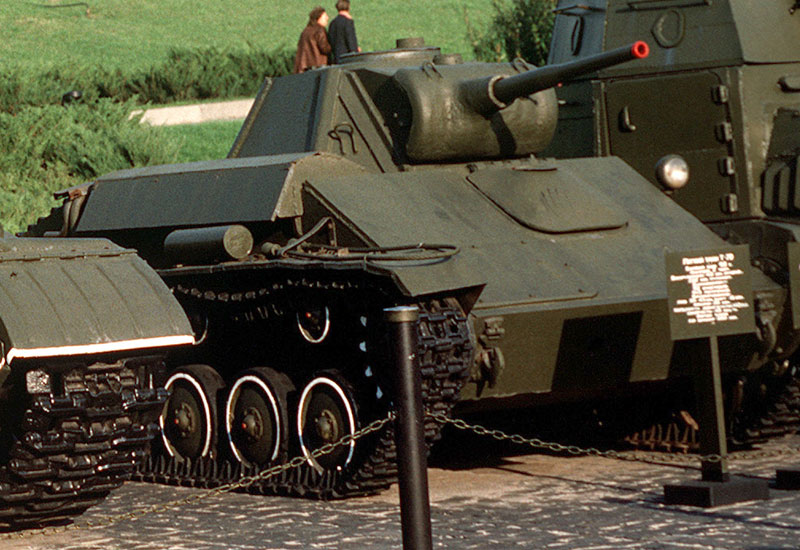
The T-70 featured a sharp-angled hull with a well-sloped glacis plate and accompanying superstructure to which a shallow turret was installed along the roofline. The crew included two (based on the original T-60 design) and was made up of the driver and commander, the latter doubling as his own gunner/loader. The driver was seated near front-center of the forward hull (slightly offset to the left side) with the small, cramped fighting compartment to his immediate rear. The middle of the hull also mounted the coupled engine arrangement along the right side, pushing the fighting compartment and turret to the left of centerline. Five double-tired road wheels were fitted to a track side with the drive sprocket at front and the track idler at rear. Three track return rollers guided the tracks along the upper portions of the hull side and there was no further side armor ("skirts") provided. The transmission system was embedded in the floor of the forward hull. Basic T-70 combat tanks lacked radio sets as these were fielded only with definitive T-70 command vehicles.
The T-70's one-man, all-welded turret (with 35mm armor thickness) was home to the 45mm Model 1938 main gun as well as a 7.62mm coaxial DT machine gun - both operated by the commander. Rate-of-fire was listed at approximately 12 rounds per minute. Initially, 90 x 45mm projectiles were carried (eventually lowered to 70 in the upcoming T-70M) and these were available in two basic flavors - AP (Armor-Piercing) and HE-FRAG (High-Explosive, Fragmentation). Armor penetration of the main gun was up to 50mm at 500 meters. The machine gun was fed from a 945-round onboard store (through 15 individual magazines). The forward portion of the turret was well-protected in a thick, curved steel mantlet. The turret was manually operated through 360-degrees for engagement of enemies at all sides of the vehicle. April of 1942 saw a new, multi-faced welded turret replace the older conical style.
Power for the T-70 series was served through the GAZ-203 series engine, essentially two coupled GAZ-202 automobile 6-cylinder systems rated at 70 horsepower each (140 horsepower combined). The powerplant was fed by two internal fuel stores found along the left side of the hull rear. The engine was mated to a multi-speed transmission system featuring four forward and one reverse gear(s) with suspension of the hull via a basic torsion arrangement. Road speeds could reach 28 miles per hour with operational ranges peaking at 220 miles.
In practice, The T-70 proved a competent gunnery platform against the lighter tanks of the Germans and Italians. It was capable of knocking out medium-class tanks as well but this proved more elusive as German tank development evolved in the middle and latter years of the war. One of the biggest detriments of the T-70's original design was that the commander needed to manage the tactical situation, the driver, the gun and his own reloading - taking his attention away from key developments during critical times. Its light armor protection became readily apparent as the war progressed as did the small-caliber main gun (the mighty Soviet 76mm eventually proved the accepted standard for the Red Army).
Beginning in September of 1942, production of the base T-70 moved to the "T-70M", a modernized and improved form with revised running gear and a reduced ammunition load (down to 70 projectiles). The T-70M would become the most-produced Soviet light tank of World War 2 and help to strengthen ranks reduced through general attrition - particularly the heavy losses incurred in the initial German assault of 1941.
However, by the latter part of 1942, even the newer T-70M was quickly becoming an outmoded product and this led to the development of the short-lived "T-80" .The T-80 represented a slightly evolved form of the T-70M though with a two-man turret (now a complete crew of three) to reduce the commander's workload and increased armor protection. However, the improvements were slight as only 120 examples of the type were produced due to a general decline of the light tank category as a whole, now given up in favor of more potent medium and heavy designs available or coming online. The T-80, therefore, became the last Soviet-produced light tank of World War 2 - serving alongside their T-70 counterparts into 1945.
When the T-70 had met its fate on the then-modern battlefield, the chassis served an extended role as carrier for the SU-76 series self-propelled gun (SPGs) mounting the potent 76mm gun in a new fixed superstructure. To accommodate the added weight and new role, the hull was lengthened and widened while an additional pair of road wheels was added. The SU-76 entered service in 1942 and was produced in an astounding 14,292 examples. The late-war ZSU-37 tracked self-propelled anti-aircraft gun platform followed suit, being built upon the existing chassis of the T-70 Light Tank and existing in 75 total examples, only a few of these available by war's end.
T-70 tanks were regularly fielded side-by-side with T-34 Medium Tanks and SU-76 SPGs and also utilized in the fast reconnaissance role attached to other mechanized forces. In all, production of T-70 tanks reached 8,226 examples including all mentioned variants, production running until 1943. At least 53 were fielded by Poland and a further 10 by Czechoslovakia. As with other Soviet tank developments of World War 2, the T-70 was retained in various trial forms that included the T-90 self-propelled ant-aircraft gun (SPAAG) platform of 1942.
The last T-70 tanks remained in active service until 1948.
Power & Performance Those special qualities that separate one land system design from another. Performance specifications presented assume optimal operating conditions for the T-70 Light Tank (LT).
2 x GAZ 202 (GAZ 203) inline, 6-cylinder, water-cooled engine developing 140 horsepower. Installed Power
28 mph 45 kph Road Speed
224 miles 360 km Range
Structure The physical qualities of the T-70 Light Tank (LT).
2 (MANNED) Crew
17.2 ft 5.25 meters O/A Length
9.0 ft 2.75 meters O/A Width
7.2 ft 2.18 meters O/A Height
27,948 lb 12,677 kg | 14.0 tons Weight
Armament & Ammunition Available supported armament, ammunition, and special-mission equipment featured in the design of the T-70 Light Tank (LT).
1 x 45mm 20K Model 1938 main gun in turret
1 x 7.62mm coaxial general purpose machine gun
AMMUNITION: 90 (later 70) x 45mm projectiles
945 x 7.62mm ammunition
Variants Notable series variants as part of the T-70 family line.
T-70 - Base Production Series Designation
T-70M - Modernized form of 1942; improved running gear; reduced 45mm projectile count (70).
T-80 - Improved T-70M; appearing in 1942-1943; produced in 120 examples.
SU-76 - SPG conversion utilizing chassis of T-70 tank.
T-90 - Proposed SPAAG utilizing chassis of T-70 tank.
ZSU-37 - Late-war SPAAG utilizing chassis of T-70 tank.
Operators Global customers who have evaluated and/or operated the T-70. Nations are displayed by flag, each linked to their respective national land systems listing.
Total Production: 8,226 Units Contractor(s): State Factories - Soviet Union
[ Czechoslovakia; Nazi Germany; Poland; Soviet Union ]
1 / 1
Front right side view of the T-70 light tank on display; color
Going Further... The T-70 Light Tank (LT) appears in the following collections:
The "Military Factory" name and MilitaryFactory.com logo are registered ® U.S. trademarks protected by all applicable domestic and international intellectual property laws. All written content, illustrations, and photography are unique to this website (unless where indicated) and not for reuse/reproduction in any form. Material presented throughout this website is for historical and entertainment value only and should not to be construed as usable for hardware restoration, maintenance, or general operation. We do not sell any of the items showcased on this site. Please direct all other inquiries to militaryfactory AT gmail.com. No A.I. was used in the generation of this content.