In the decades following World War 1, the British Army rewrote their armored warfare doctrine to include two distinct groups of combat tanks - "cruiser tanks" and "infantry tanks". Cruiser tanks were designed with speed in mind, intended to break past enemy defenses and attack the more vulnerable flanks and rear. The heavier Infantry tanks worked in conjunction with infantry units to break the enemy's center of defense through slower paced operations. In conjunction, the theory would bring about two different forces to achieve a singular objective.
On September 3rd, 1939, Britain formally declared war on Germany marking the official start of World War 2 in Europe. In 1940, the British Army unveiled the "Valentine Infantry Tank", a small thee-man tracked vehicle fitting the QF 2-pounder (40mm). The tank was produced by Vickers-Armstrong and was developed into subsequent marks each fitting progressively larger guns. The initial production mark became the "Valentine Mk I" and this was inevitably followed by the "Valentine Mk II" up to the final "Valentine Mk XI" armed with its 75mm main gun. Differences between the Mk I and Mk II were the latter's use of the AEC A190 6-cylinder diesel engine of 131 horsepower and the addition of an external fuel tank (the original mark utilized the AEC A189 gasoline engine of 135 horsepower).
1940 also saw the introduction of the Royal Ordnance QF25 25-pounder field gun/howitzer. This weapon proved to have an excellent rate-of-fire, accuracy at range and good inherent mobility. The weapon could fire a broad range of ammunition types and quickly settled in as a primary artillery system for the British Army for the duration of the war - even seeing service for decades following.
As the war itself spread an British involvement grew, so too did the list of military requirements based on up-to-the-minute operational experience from the front. The British Army now required a mobile artillery piece capable of supplying "plunging fire" against enemy positions at range. In June of 1941, the heavy industries concern of Birmingham Railway Carriage and Wagon Company was charged with developing such an implement. Development saw the selection of the Valentine II tracked chassis and - atop the hull - a fixed, forward-firing slab-sided superstructure was added. Within this superstructure was the fighting compartment which allowed management of the QF25 series field gun installation. At its core, the vehicle was nothing more than an interim solution to a long-term problem - at least until a more capable and purposefully developed weapon system could be manufactured in quantity. A pilot vehicle became available for evaluation in August of 100 and British authorities found the design acceptable enough to the point of placing an order for 100 examples in November of 1941. The new vehicle was formally designated as the "Ordnance QF 25-pdr on Carrier Valentine 25-pdr Mk 1" and was categorized in the British Army as a "self-propelled artillery" system - of "SPA". The vehicle became the first self-propelled artillery system for the British Army.
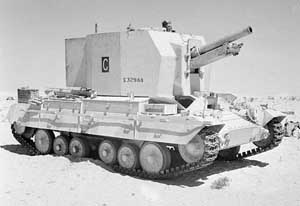
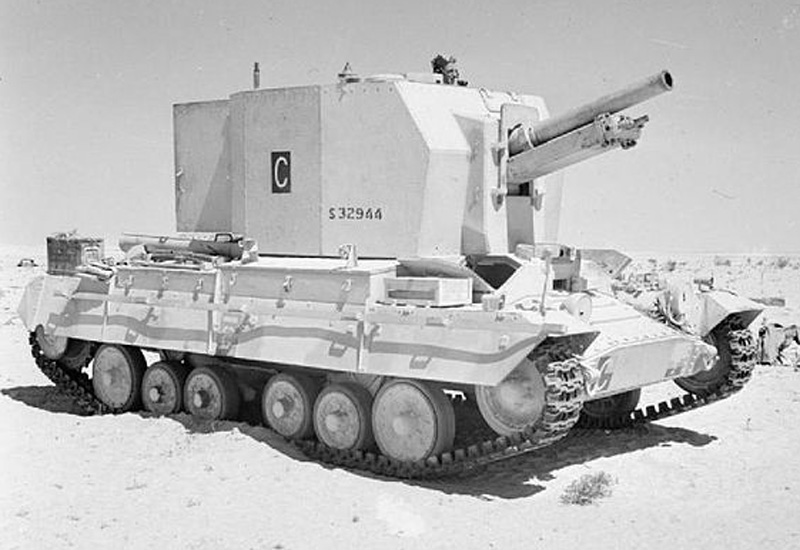
Outwardly, the Bishop held a unique appearance though not unlike the Soviet KV-2 series which operated in the same role. The Valentine pedigree was clearly on display for the running gear was wholly retained. The vehicle was suspended by a coil spring system featuring three-wheel bogies. There were four small road wheels which were book-ended by a larger road wheel to each track side. The drive sprocket was held at the rear with the track idler at the front. The glacis plate was well-sloped for some ballistics protection while the sides were straight. Equipment could be carried over the fenders. The turret sported flat sides and double-doors along the rear facing. The front turret facing was only slightly sloped with the 25-pounder gun barrel protruding out over the hull. The engine was kept in a rear compartment. Crew accommodations amounted to four personnel to include the driver, commander, gunner and loader. The driver maintained a position in the front left hull with the remaining crew in the turret. Secondary armament was a 0.303 Bren light machine gun though the Bishop was never intended to meet the enemy at close ranges. Armor protection was 8mm to 60mm across major facings.
The British and Commonwealth campaign was now centered on North Africa at this point in the war, particularly against famed German General Erwin Rommel. For the British, North Africa would become the proving ground for their own General Bernard Montgomery. Hundreds of thousands of men as well as thousands of armored vehicles would play a role in this early campaign of the war. On October 23rd, 1942, the Allies - led by Britain - went up against the forces of Germany and Italy to begin the 2nd Battle of El Alamein. The battle would last until November 4th of that year and would become the first combat actions of the 25-pdr Valentine gun carrier. By this time, the British Army referred to her simply as "Bishop".
In practice, few doubted the capabilities of the QF 25 gun. However, it was in the overall design of the vehicle that the Bishop suffered mightily. The use of a fixed superstructure provided for many inherent limitations for the combat vehicle. Firstly, the vehicle had to be turned (in whole) to face the direction of the enemy. Secondly, the limited space within the superstructure directly limited the main gun's elevation to just +15 and -5 degrees and traversal as only 8 degrees itself. As such, gunnery crews took to establishing mounds ahead of the Bishop's hull to angle the vehicle further upwards at the front, thusly increasing the trajectory of their 25-pounder guns. The turret's design also made for a high profile along the clean desert horizon - a tempting target to enemy tankers and anti-tank teams alike (the Soviet KV-2 suffered from the same quality). To compound matters, the addition of a heavy gun and superstructure atop the existing Valentine chassis restricted top road speeds and directly limited operational ranges. The Bishop - fitted with its AEC A190 series diesel engine of 131 horsepower - managed 15 miles per hour on ideal surfaces and up to 90 miles of operational range.
Regardless, the need during wartime was great and the Bishop was utilized. Its 25-pounder main gun did not disappoint but crews generally regarded the Bishop as a forgettable creation. It was only the arrival of the American M3 Lee/Grant-based M7 "Priest" self-propelled artillery system that doomed the Bishop to limited use and secondary roles thereafter. The Canadians took the M7 Priest design a step further and developed the "Sexton" - complete with its 25-pounder main gun - and this was used in increasing numbers by the British Army with time. As such, the Bishop only ever existed in 149 total forms with production spanning from 1942 to 1943. Once quantitative levels of the M7 and Sexton were met, the Bishop fell to the pages of World War 2 history.
Power & Performance Those special qualities that separate one land system design from another. Performance specifications presented assume optimal operating conditions for the Bishop Self-Propelled Artillery (SPA).
1 x AEC A190 inline 6-cylinder diesel water-cooled engine delivering 131 horsepower. Installed Power
15 mph 24 kph Road Speed
90 miles 145 km Range
Structure The physical qualities of the Bishop Self-Propelled Artillery (SPA).
4 (MANNED) Crew
18.5 ft 5.64 meters O/A Length
9.1 ft 2.77 meters O/A Width
9.8 ft 3 meters O/A Height
77,162 lb 35,000 kg | 38.6 tons Weight
Armament & Ammunition Available supported armament, ammunition, and special-mission equipment featured in the design of the Bishop Self-Propelled Artillery (SPA).
1 x QF 25-pdr (87.6mm) main gun
1 x 0.303 Bren light machine gun
AMMUNITION: 32 x 87.6mm projectiles
1,500 x 0.303 ammunition
Variants Notable series variants as part of the Bishop family line.
Bishop - Base Series Designation
Operators Global customers who have evaluated and/or operated the Bishop. Nations are displayed by flag, each linked to their respective national land systems listing.
Total Production: 125 Units Contractor(s): State Factories - United Kingdom
[ United Kingdom ]
1 / 1
A Bishop self-propelled artillery system in the African desert during World War 2
Going Further... The Bishop Self-Propelled Artillery (SPA) appears in the following collections:
The "Military Factory" name and MilitaryFactory.com logo are registered ® U.S. trademarks protected by all applicable domestic and international intellectual property laws. All written content, illustrations, and photography are unique to this website (unless where indicated) and not for reuse/reproduction in any form. Material presented throughout this website is for historical and entertainment value only and should not to be construed as usable for hardware restoration, maintenance, or general operation. We do not sell any of the items showcased on this site. Please direct all other inquiries to militaryfactory AT gmail.com. No A.I. was used in the generation of this content.