The 155mm (6.10 in) field gun was originally designed and built by France during World War I under the direction of one Colonel L.J.F. Filloux as the G.P.F. ("Grande Puissance Filloux"). The gun was to fill a vital French Army requirement for a heavy artillery piece. The design ultimately proved a success and became the standard heavy field gun of the French from 1917 through to the end of World War II.
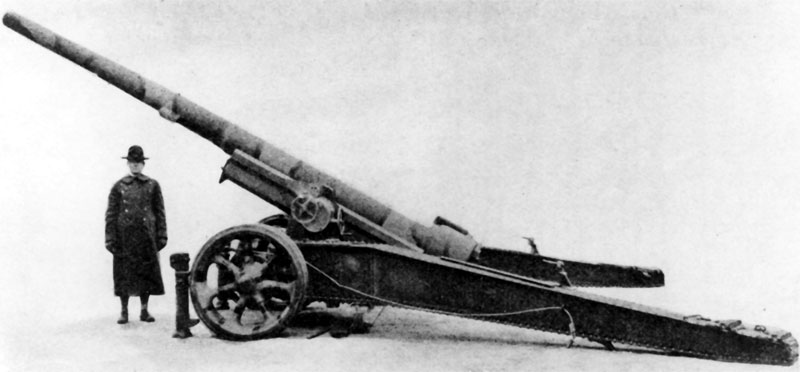
So successful was the gun that the United States Army paid for, and subsequently copied, the design as the Model 1918 (M1918). The M1918 gun was mounted on a large, four-wheeled carriage weighing in at 11,065 lbs and having a split tail in anchoring to the ground for firing stability. The split tail design allowed recoil clearance for the gun from 1.8m/10 degrees to 1.1m/ 28 degrees at high elevation and also provided for firing over a horizontal field of 60 degrees and an elevation from 0 degrees to 35 degrees. While traveling the split tail was closed together to form a trail and supported by a carriage limber having a gear brake. Transportation was normally by a tractor. The carriage would be travelling on paved roads and open terrain so the limber was supported on semi-elliptical springs to absorb all road shocks.
The top carriage was a steel casting mounted on top of the bottom carriage so the gun could pivot when traversing; Belleville springs carried the load of the gun. However, when the gun was fired, the springs were compressed and the stress was centralized along the surfaces of the top and bottom carriages. The bottom carriage was a steel casting suspended from the axle by a heavy leaf spring. The main purpose of this design element was to support the top carriage; also it housed the axles and the hinges for the trail. The trail was a "split" type made of steel beams with locks pivoting along their front ends for securing them in the open position. When the gun was in the towing retracted position, a lock was provided for on the trail. Spades were fitted mounted on the trail ends for soft or hard ground stabilization and could be removed when the gun was in transport mode. The carriage wheels were made of cast steel with a solid rubber tire and each wheel was afforded its own brakes. Caterpillar wheel shoes are used when on soft ground and these simply fit over the rubber tires. They consisted of twelve shoes that spread the load weight over a given soft surface.
The gun was sighted by a "quadrant sight panoramic" system and a peep sight. The quadrant sight was mounted on top of the left side trunnion of the carriage and was used for elevation. The angle of sight mechanism was mounted on top of the quadrant and an extinction bar was provided for use with the panoramic sight. The peep sight was used only for direct firing or in an emergency - if the latter then it could be mounted on the quadrant sight instead of the panoramic sight. For night-sighting, an aiming lamp, an azimuth lamp along with cables and fixtures were provided. These fit into a provided storage chest that was mounted on the carriage.
Ammunition shell types made available were HE (High-Explosive) steel, shrapnel, gas, and some special ammunition. The powder was smokeless and packed in two sections - a larger base section and a smaller one. The most common fuse used was a 31-second combination fuse for shrapnel and combination time and percussion. For high explosive steel rounds, the Mark 4 detonating fuse was used. For gas shells, the Mark 2. The 155 mm shell was the same size as the 6-inch artillery round and was the heaviest mobile artillery of the day except for railroad guns and some howitzers. The round weighed 95 pounds (43.1 kg) and fielded a muzzle velocity of 735 m/s (2,411 FPS) with a range of 17,700 yards (10+ miles). The weight of the maximum powder charge itself was 25 pounds. The gun crew could fire off two rounds per minute and the life of the gun was rated at about 3,000 firings. The rounds were not carried on a caisson because of their sheer weight but instead transported on support trucks. The barrel length was 19.35 ft (5.915m) with the rifling being one turn 2,989 caliber right-handed and considered uniform.
The breech block was the uninterrupted screw type that had four plain and four threaded sectors. The breech mechanism was of an obturator type having the forward mushroom type head of the breech block fitted with an asbestos ring known as the obturator pad. When the gun was fired, the ring was compressed and acted as a gas check to prevent the explosive gas from escaping from the breech. The cradle was made of forged steel bored with three parallel cylinders to house the recoil brake and recuperator. On the upper sides of the cradle were slots for the gun slides and underneath the cradle was the bolted elevating rack.
The recoil mechanism was of a hydropneumatic variable type. The mechanism was made up of a piston, a piston rod and a control rod. The piston rod was connected to the breech lug and recoils when the gun fired. The control rod featured oil groves that allowed oil to flow along the rod controlling the oil, going to the piston ports during the recoil. The piston rod rotated as the gun was elevated by the arm and gear sectors in such a way that this reduced the recoil of the weapon. A replenisher, or gravity tank, was fitted in connection with the recoil cylinder. The tank held 17 quarts of overheated oil and assured the recoil cylinders were always filled with oil.
The French gun was widely used in Europe by Allied and captured systems were fielded by the Central Powers as well. German units named the captured guns the 15.5-cm K 418(f) where it served with heavy artillery battalions and as coastal defense weapons. On D-Day in 1944, the Germans had over 50 of the 155-mm French guns trained on the northern French beaches with the most famous collection near Pointe du Hoc - these were ultimately destroyed by the US Army 2nd Ranger battalion during the Allied invasion of France.
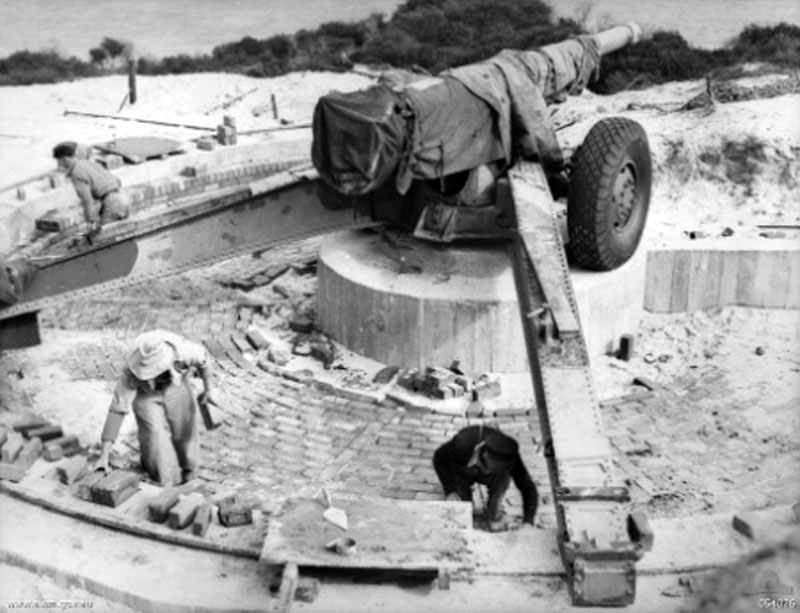
During World War 2 in the United States, the 155mm guns were taken out of storage and utilized for coastal defense on American shores and across allied territories such as the Philippines and Australia. These defensive guns were sat upon "Panama" mountings that allowed the gun to swivel on a concrete pillar with the split trails spread out on wheel rails that could be rolled around the pillar for maximum flexibility in training the gun against targets.
Ultimately, both the US Army and Marine Corps phased out their M1918 guns for the 155-mm M1A1 "Long Tom" beginning in 1942. The M1918 was also fitted to the M12 Gun Motor Carriage as a self-propelled gun (SPG) and used from 1944 to 1945.
Power & Performance Those special qualities that separate one land system design from another. Performance specifications presented assume optimal operating conditions for the M1918 155 GPF 155mm Field Gun / Coastal Artillery.
None. This is a towed artillery piece. Installed Power
Structure The physical qualities of the M1918 155 GPF 155mm Field Gun / Coastal Artillery.
7 (MANNED) Crew
19.7 ft 6 meters O/A Length
28,660 lb 13,000 kg | 14.3 tons Weight
Armament & Ammunition Available supported armament, ammunition, and special-mission equipment featured in the design of the M1918 155 GPF 155mm Field Gun / Coastal Artillery.
1 x 155mm gun barrel
AMMUNITION: Dependent upon ammunition carrier.
Variants Notable series variants as part of the M1918 155 GPF family line.
Canon de 155mm GPF mle 1917 - Original French Design.
M1917/M1918 - American Designation of French Canon de 155mm GPF; utilized by both the US Army and the US Marine Corps.
Operators Global customers who have evaluated and/or operated the M1918 155 GPF. Nations are displayed by flag, each linked to their respective national land systems listing.
Total Production: 0 Units Contractor(s): State Factories - USA
[ Philippines; United States ]
1 / 3
Left side view of the M1918 155 GPF field gun; note scale as compared to individual
2 / 3
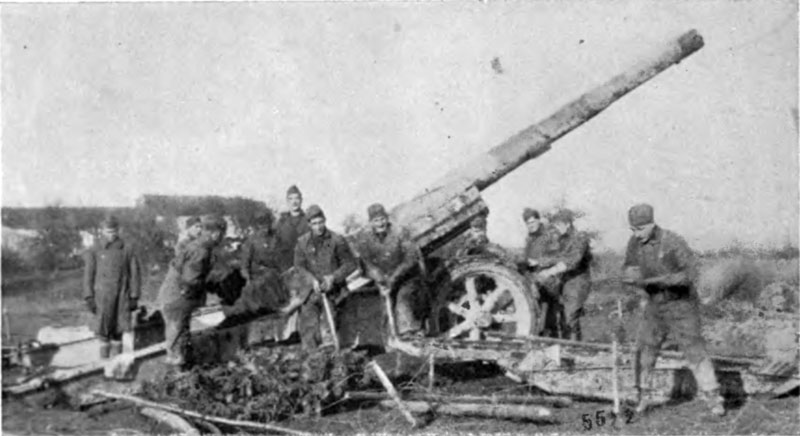
Some of the M1918 crew pose for the camera in this 1918 photograph
3 / 3
The M1918 155mm gun sits atop a prepared Panama mount as a coastal defense system
The "Military Factory" name and MilitaryFactory.com logo are registered ® U.S. trademarks protected by all applicable domestic and international intellectual property laws. All written content, illustrations, and photography are unique to this website (unless where indicated) and not for reuse/reproduction in any form. Material presented throughout this website is for historical and entertainment value only and should not to be construed as usable for hardware restoration, maintenance, or general operation. We do not sell any of the items showcased on this site. Please direct all other inquiries to militaryfactory AT gmail.com. No A.I. was used in the generation of this content.