The T-18 was the first Soviet-designed and produced tank. Russia initially lacked the internal expertise to design, develop and produce their own tanks in the early 20th Century, relying heavily on the importing of existing systems from abroad. Like other nations in the post-World War 1 world, the Russians took to designing their new post-war tank around the proven French Renault FT-17 - a successful little two-man light tank that appeared quantitatively in places such as France, Italy and the United States - the latter two devising locally-produced designs around the original Renault as the "Fiat 3000" and the "M1917 6-ton". The resulting Russian design became the T-18 which would go on to begin the successful line of Soviet "T" tanks that - at least in name - are still in existence today. Close to 1,000 of these little systems were eventually produced.
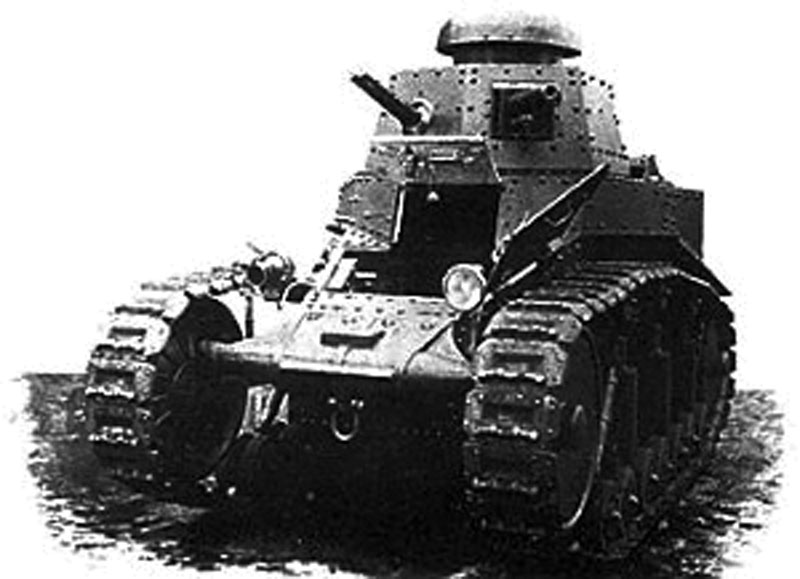
In 1924, Russia's new Tank Bureau issued a specification for an equally-new infantry support vehicle. The prototype T-16 emerged from the mind of Professor V. Zaslavsky and was based on the Renault FT-17 with a major improvement being the use of a vertically sprung suspension system to help improve performance over rough terrain. Like the FT-17 before it, the T-16 was crewed by two personnel and featured a full-rotatable turret with an engine mounted to the rear. The engine was nothing more than a Russian copy of the Italian Fiat 6-cylinder gasoline-powered engine of 40bhp at 1,500rpm. The main gun, this being of 37mm caliber, was a modified copy of the French Hotchkiss SA 18 series. The main gun would be complimented by a pair of self-defense anti-infantry Hotchkiss 7.62m machine guns. The crew of two was made up of the driver, seated in the forward hull, and a tank commander doubling as the gunner in the turret. The rotatable turret contained the main armament which, interestingly, fitted the guns at 45-degree offset angles to one another. Power from the engine supplied the tank with a top speed of nearly 10 miles per hour and a range of nearly 40 miles. The open-sided track systems sported seven miniscule road wheels to a side. The hull was topped with a short superstructure that itself was capped with a rather ungainly turret and raised cupola. Most of the riveted armor surfaces were angled inwards to help promote some protection against small arms fire. Armor thickness ran from 6mm to 16mm.
Testing of the T-16 began in May of 1928 and revealed some inherent deficiencies in the design. As such, the engine was improved and the hull revised before becoming the newly-designated "T-18" light tank. An initial batch order produced some thirty tanks beginning in May of 1928 out of the Leningrad Obukhov / Bolshevik Factory. Another slightly revised form appeared on the assembly lines from 1929 onwards. All production of the T-18 ceased in 1931.
Some Soviet T-18s went to action against Manchuria in 1929 in defense of the Far Eastern Railway system. In practice, the T-18 eventually proved to be something of a disappointment by 1930s standards for it was lightly armed and inadequately armored for the tasks at hand. After 1932, the T-18 was withdrawn from frontline duty to be used strictly for training new generations of Soviet tankers. Despite its limited legacy, the T-18 served as a valuable spring board for the armor-conscious Russians. Soviet expertise in the design, development and production of locally-grown tank systems would reach their pinnacle in the excellent T-34. The T-34 would become the tank that saved Russia from German aggression in World War 2 and, in some ways, owed its existence to the little T-18.
The T-18 was also known under its manufacturer designation of MS-1 for "Maliy Soprovozdiniya" meaning "Small Escorting" or "First Small Support".
Power & Performance Those special qualities that separate one land system design from another. Performance specifications presented assume optimal operating conditions for the T-18 (MS-1) Light Tank.
1 x Fiat 6-cylinder gasoline-fueled engine developing 40 horsepower at 1,500rpm and driving a conventional track-and-wheel arrangement. Installed Power
10 mph 16 kph Road Speed
37 miles 60 km Range
Structure The physical qualities of the T-18 (MS-1) Light Tank.
2 (MANNED) Crew
11.5 ft 3.5 meters O/A Length
5.8 ft 1.76 meters O/A Width
7.0 ft 2.12 meters O/A Height
11,927 lb 5,410 kg | 6.0 tons Weight
Armament & Ammunition Available supported armament, ammunition, and special-mission equipment featured in the design of the T-18 (MS-1) Light Tank.
PRIMARY:
1 x 37mm M1916 main gun.
SECONDARY:
2 x 7.7mm Hotchkiss Machine Guns.
AMMUNITION: Not Available.
Variants Notable series variants as part of the T-18 (MS-1) family line.
T-16 - Prototype Designation
T-18 / MS-1 - Base Series Designation
Operators Global customers who have evaluated and/or operated the T-18 (MS-1). Nations are displayed by flag, each linked to their respective national land systems listing.
Total Production: 960 Units Contractor(s): Leningrad Obukhov Factory / Bolshevik Factory - Soviet Union
[ Soviet Union ]
1 / 1
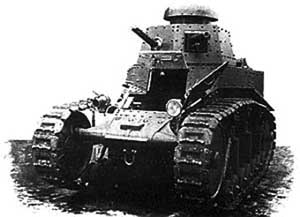
Front left side view of the T-18 light tank; note offset angled turret armament and open drivers compartment
Going Further... The T-18 (MS-1) Light Tank appears in the following collections:
The "Military Factory" name and MilitaryFactory.com logo are registered ® U.S. trademarks protected by all applicable domestic and international intellectual property laws. All written content, illustrations, and photography are unique to this website (unless where indicated) and not for reuse/reproduction in any form. Material presented throughout this website is for historical and entertainment value only and should not to be construed as usable for hardware restoration, maintenance, or general operation. We do not sell any of the items showcased on this site. Please direct all other inquiries to militaryfactory AT gmail.com. No A.I. was used in the generation of this content.